Commercial Real Estate Lending Is Back: But Has the Game Changed?
Originally published on September 11, 2026
“It’s going to be cash flow, cushion, and credibility.” — Daniel Roccanti, CPA
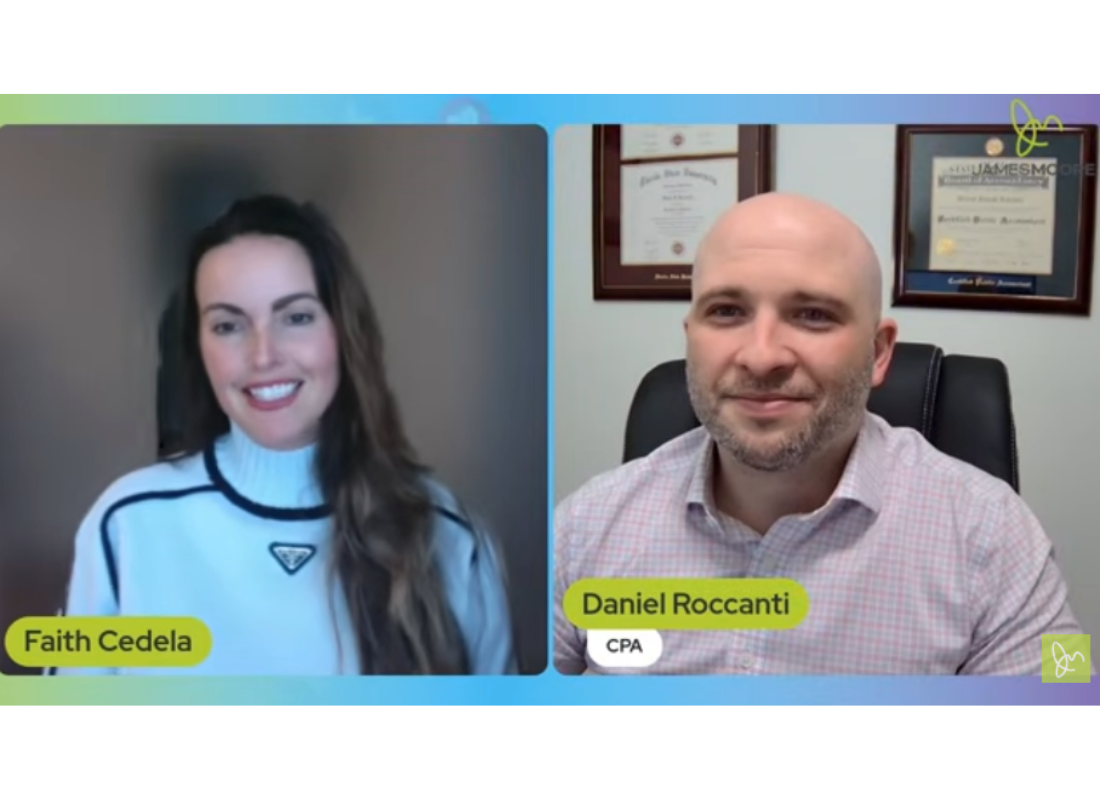
In a recent episode of Your CPA’s Take on Real Estate, James Moore CPA Daniel Roccanti unpacked a Wall Street Journal report on big banks re-entering commercial real estate lending. The conversation moved quickly from headline to substance: what’s changed in the lending environment, and what borrowers need to have ready before they ever sit down with a bank.
Roccanti has spent his career advising real estate developers and investors on financing, tax planning, and deal structure, and this conversation covers all three. Watch the full discussion below, then use the resources and transcript to revisit any part of it.
Resources
- Your CPA’s Take on Real Estate
- Your CPA’s Take on Real Estate YouTube Channel
- Watch this episode on YouTube
Full Transcript
[00:02] Faith: Hi everyone, and welcome to the James Moore Channel. Today I’m here with Daniel Roccanti. Hi Daniel, how are you?
[00:02] Daniel Roccanti: Hi Faith, it’s always good to be back.
[00:02] Faith: Yeah, absolutely. So today we’re talking about an article that was trending in the Wall Street Journal, and it was about how big banks are moving into commercial real estate.
[00:19] Faith: But this time they’re betting on the growth of areas for multi-family, industrial, and data centers, but always staying cautious. So I wanted to get your opinion on some things and ask you some trending questions that came from the article.
[00:19] Daniel Roccanti: Absolutely, let’s get started.
[00:19] Faith: Okay. So the first thing is, we’re hearing that large banks are becoming more active in commercial real estate lending again. What has changed, and why is that happening now?
[00:41] Daniel Roccanti: I would characterize this more as a selective reopening, not a return to the lending environment we saw several years ago. With these larger banks, timing changes things, but banks generally right now are pretty strong in capital and have a pretty good liquid position.
[01:07] Daniel Roccanti: And this just means that they have the capacity to lend right now. Competition plays a role in this too. We’ve seen a lot of alternate banking options and lenders. Smaller banks are getting their appetites back, which brings stronger demand for larger banks, but it really comes down to this: no one was really lending for a couple years, and at the end of the day, to make money, you have to lend money at some point.
[01:35] Daniel Roccanti: Over time, in this current environment, everyone is getting more accepting of the fact that this is the environment. It’s not going to change dramatically. It’s just not what it was a few years ago, and that’s okay. How can we adapt to the current environment and start lending money again?
[01:55] Faith: Absolutely. And the next question: although financing is becoming more available, lenders are still being cautious. What are they looking for before approving a loan today?
[02:17] Daniel Roccanti: If I had to put it into a few categories, it’s going to be cash flow, cushion, and credibility. The first one, cash flow, we always know real estate cash flow is king. Lenders are really looking at this right now because the whole point of them lending money is they want to get paid back.
[02:41] Daniel Roccanti: So they’re really analyzing the numbers you’re giving them, looking at historical averages, current rent rolls, and the quality of your tenants. Then they’re looking at all your expenses, because a lot of people are optimistic and provide the best numbers possible. Lenders realize you’re probably giving them an optimistic projection, so without support, they’re looking at your numbers and making sure that under a conservative projection, you’re still going to cash flow. Cash flow is the first thing they look at.
[03:09] Daniel Roccanti: After that is cushion, which plays off cash flow. What happens when things go worse than expected? Do you have the cushion to absorb that and still make your monthly payments to the lender? Lenders want to make sure sponsors aren’t using every available dollar to complete their acquisitions.
[03:33] Daniel Roccanti: They want to make sure there is cushion and liquidity if an unexpected repair happens, and that borrowers can still make their payments. Now, more than ever, credibility comes back to the sponsor. If you want a loan, you still have to have good numbers, but that might not be enough if you don’t have the credibility.
[03:56] Daniel Roccanti: As a sponsor, you need a great track record. You need a great relationship with lenders, accurate financial reporting, and a realistic business plan. This alone can be one of the biggest differentiators when dealing with lenders. People love to do business with people they like and know.
[04:14] Daniel Roccanti: It’s important that the lender knows you and likes you.
[04:14] Faith: Absolutely. How can developers and investors strengthen their financial position before approaching a lender?
[04:36] Daniel Roccanti: A lot of this comes down to understanding what the lender is looking for, and strengthening that. I recommend going through a mock underwriting process, essentially asking, what is the bank going to ask for? If we were to start providing this information now, what does it look like? Then you can catch your mistakes or find where you need to improve before the process even happens.
[04:58] Daniel Roccanti: When the lender asks you for everything, you want to already have it available. This usually means creating a consistent financial package. Do you have financial statements? Do you have all your tax returns, and are they up to date? Do you have a trailing 12-month property operating statement? Do you have your current rent roll? Do you need a personal financial statement? All your schedules of real estate owned, debt, liabilities, all of that.
[05:27] Daniel Roccanti: Then show them a realistic projection, an expected case and even a downside case. That’s really what it comes down to: what is my lender looking for, and do I have that ready for them?
[05:53] Daniel Roccanti: Also, make sure liquidity is available right now. You don’t want to show that you don’t have any available cash. Lenders are really looking at that and making sure there’s cash available in a downside case.
[06:21] Faith: What are some of the biggest financial mistakes you see borrowers make during the financing process?
[06:21] Daniel Roccanti: I’ll touch on some of the bigger ones. The one I see everyone make is focusing entirely on interest rates. It’s important, don’t get me wrong, and a high interest rate will cost you more money than you need to pay, but the interest rate is just one part of a loan.
[06:47] Daniel Roccanti: Sometimes a slightly lower rate isn’t actually a better deal if it comes with less proceeds, a shorter amortization period, messes with your recourse, or comes with a restrictive prepayment penalty. There’s a lot more to lending than the rate. So while interest rate matters, focusing on it solely can actually be a mistake.
[07:17] Daniel Roccanti: The second mistake I see is everyone being a little too optimistic with their assumptions and their numbers. Banks are really being conservative right now. You need to have supporting data for why you’re using a number if it looks good, and you should probably be conservative.
[07:33] Daniel Roccanti: You should underestimate your vacancies, because all your expenses are probably going to be more expensive than you think. Over-promising and under-delivering is a very bad look for sponsors. Lenders are already looking at your numbers assuming they’re probably optimistic. So the closer you are to reality, the better your relationship will be with that lender.
[07:54] Daniel Roccanti: You also need to make sure your financial statements are good. Good bookkeeping is worth every dollar, and it’s also where almost everyone tries not to spend money, because to them it doesn’t directly increase revenue. Spending money on something that looks like just an expense and compliance is actually the biggest opportunity loss.
[08:20] Daniel Roccanti: Good books bring in better information, which provides lending opportunities and more accurate tax returns, which could lead to less taxes and, more importantly, you just need to have good numbers. Inconsistent financials can ruin a deal quickly.
[08:47] Daniel Roccanti: The last mistake: don’t ever do a deal thinking the future is going to save you. You think, “the rates will go down in the future, I’ll refinance, and this will rescue the transaction.” The deal needs to work under today’s financing that’s available today.
[09:08] Faith: This is where your expertise really comes in, because you’d advise people on this. Interest rates remain elevated compared to a few years ago. How should investors evaluate whether a deal still makes financial sense?
[09:08] Daniel Roccanti: High interest rates make every deal more complicated, but the reality is it comes down to the same principles. It needs to make sense under the current environment and the current financing available.
[09:27] Daniel Roccanti: If I doubled everyone’s interest rate but slashed everyone’s purchase price in half, everyone would be pretty happy overnight. It’s really not about the interest rate, it’s about whether you can afford the size of the payment and still cash flow your deal.
[09:56] Daniel Roccanti: You need to look at your property-level economics, run your net operating income, run your cash flow statements, and really look at whether you budgeted your expenses correctly. In a worst-case scenario with an unexpected repair, is that calculated in? You also need to understand today’s financing economics: what’s the real debt service coverage ratio, what’s the real debt yield, what mortgage can I actually get, not based on some future scenario. Always protect your downside.
[10:29] Daniel Roccanti: What happens if the deal ends up being worse than expected? Rents go down, operating income goes down, interest rates increase. What happens if I can’t exit as well as I thought I would? It’s really important to protect your downside in a worst-case scenario.
[10:50] Faith: Beyond financing, what tax planning opportunities should developers and investors be thinking about before closing on a project?
[10:50] Daniel Roccanti: The key word here is “before.” If you really want tax planning opportunities, they need to happen before you close. If you come to me after you’ve closed, you might still have some options, but you’re losing out on a lot of potentially big savings.
[11:15] Daniel Roccanti: I’ll break this down into a few different opportunities. The first is basis depreciation. When you buy an asset, I rarely see anyone actually allocate the purchase price in the purchase document. If you buy a $5 million property, very rarely does the closing document specify how much is land, how much is building, or how much is personal property.
[12:01] Daniel Roccanti: You can actually do that. The IRS is fine with it as long as it’s an arms-length transaction between two parties who treat it the same way on both sides. That’s an easy way to do something more favorable in the purchase price or pre-closing documents. Allocate the land, allocate the building, and allocate how much is personal property, which you can then use with bonus depreciation. It’s almost a way to get around a cost segregation.
[12:50] Daniel Roccanti: The second is cost segregation. If it’s appropriate, we always need to be looking at a cost segregation, especially in this environment with 100% bonus depreciation. It’s going to be favorable in almost every situation involving a sizable property. The only thing you need to understand is whether you can actually take the deduction, because rental real estate is listed as passive, and you don’t want to take a huge deduction that just ends up suspended.
[13:11] Daniel Roccanti: Another planning opportunity: if you’re getting into large real estate investments with a significant number of investors, say 35% or more of the deal is investors, you need to think about business interest limitations.
[13:29] Daniel Roccanti: Interest from paying off that mortgage, the deduction from it, could be limited for large real estate deals involving more than 35% passive investors. It’s important to model that, because you could take a huge cost segregation deduction and then have it limited by this business interest limitation, and you did all that work for nothing.
[14:00] Daniel Roccanti: You also always need to think about your exit before you even get into the deal. If you’re thinking about a 1031 exchange and you have multiple owners and investors, that’s really important. How does a 1031 exchange work if not everyone wants to do one? Do you have to do a drop and swap? How does that look, and what’s the IRS guidance around it?
[14:31] Daniel Roccanti: Too many times I’ve seen half the people want to do a 1031 exchange and half don’t. They hear about the drop and swap, and I have to tell them, you can’t just do this overnight. It takes years to prepare for. You need to plan well before that.
[14:31] Daniel Roccanti: There are also plenty of tax incentives, whether energy efficient incentives like Section 179D or solar. Some of this is going away because of the new tax law, but I promise it’s going to come back in some form, whether under this president or the next one, because someone is going to incentivize energy given the consumption needs of this country, especially with AI usage and how much energy data centers use.
[15:17] Daniel Roccanti: It’s going to come back in a different form, but all of that is necessary, and just a few of the strategies developers and investors need to be looking at.
[15:42] Faith: Last question. If someone is considering buying or developing commercial property over the next 12 months, what advice would you give them today?
[15:42] Daniel Roccanti: We’ll touch on a few different things, but it’s all a bit of the same. My recommendation is: start early and preserve your options. If you’re going to buy a property, talk to the lender before you’re signing contracts, well before that. If you’re refinancing, you need to be talking to your lender up to 12 months out. That’s not unreasonable. Start earlier than you think you need to, so you have more options to find the right financing.
[16:07] Daniel Roccanti: Second, if you’re buying, use today’s numbers: today’s cash flow, today’s cost of capital, today’s interest rates. Do not expect them to fall, and don’t expect the future to be better than what you think and bail out the deal. The deal needs to work in today’s environment.
[16:38] Daniel Roccanti: I’ll mention this again because I’ve dealt with this issue too many times this summer: preserve your liquidity. In this market, interest rates are up, operating expenses are up, vendors, labor, everything is up. You need to be conservative with your numbers and have liquidity. Banks are really looking at that right now, so maximum leverage isn’t actually good. You need to be optimizing your leverage today, not maximizing it.
[17:07] Daniel Roccanti: The last one is preparing for a downside plan. If everything happens worse than expected, what’s your plan? Do you have the liquidity and the actions you need to take? It’s going to happen, and lenders are almost expecting it. They want you to have a plan if the numbers end up being a lot worse than expected.
[17:50] Faith: Absolutely. Well, thank you so much Daniel for that. I really appreciate it, and I actually really enjoyed going over some of these trending news articles and getting your expert commentary. I think we’ll do a few more of these and touch on trending topics moving forward.
[18:06] Faith: But thanks for joining today, and we will talk again soon.
[18:06] Daniel Roccanti: Thanks, Faith. It’s always a pleasure.
Watch the Full Conversation
For Daniel Roccanti’s complete take on where commercial real estate lending stands today, and what it means for your next deal, watch the full episode above or read the transcript in full.
All content provided in this article is for informational purposes only. Matters discussed in this article are subject to change. For up-to-date information on this subject please contact a James Moore professional. James Moore will not be held responsible for any claim, loss, damage or inconvenience caused as a result of any information within these pages or any information accessed through this site.