5 Investor Reporting Mistakes Real Estate Operators Should Avoid
Originally published on August 31, 2026
“If you’re constantly over-promising and under-delivering to your investors, that’s going to catch up with you at some point.” — Daniel Roccanti, CPA, James Moore
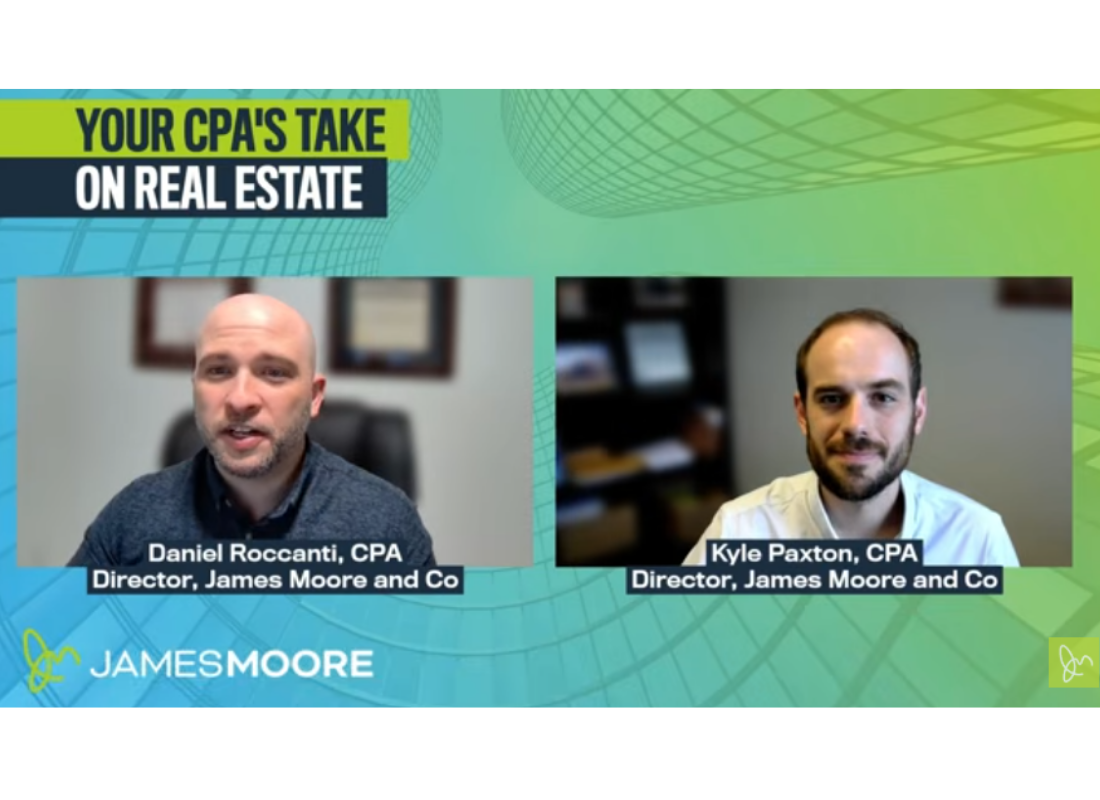
In this episode of Your CPA’s Take on Real Estate, James Moore CPAs Daniel Roccanti and Kyle Paxton walk through five of the most common investor reporting mistakes real estate operators make, and why each one can quietly damage investor trust.
From delayed reporting to missing performance metrics to confusion between fund-level and property-level results, Roccanti and Paxton explain what investors are looking for in a report, and how operators can build the kind of transparency that keeps investors coming back for future deals.
Resources
- Your CPA’s Take on Real Estate
- YouTube Channel: Your CPA’s Take on Real Estate
- Watch the full video: 5 Reporting Mistakes That Scare Off Investors
Full Transcript
[00:03] Daniel Roccanti: Welcome to Your CPA’s Take on Real Estate. We’re your hosts, Daniel Roccanti and Kyle Paxton, here for another episode. In today’s episode, we’re going to talk about some of the biggest reporting mistakes that scare off your real estate investors. Kyle, this is a pretty big deal, I think, with a lot of our investors.
[00:27] Kyle Paxton: Because we put so much focus on actually obtaining the investor upfront. Like, “Hey, fund my deal,” and we forget that it’s just as important to make them happy throughout the entire deal. So sometimes a lot of effort goes into the beginning, and then we have a tendency to slack off a little once we’re actually going in the deal.
[00:47] Daniel Roccanti: And this is very important because your reporting is really the only way the investor knows if you’re a good operator or not. So a lot of times you’re being judged based on your reporting. Even if you’re a great operator, the investor doesn’t know if your reporting is bad.
[01:09] Kyle Paxton: There’s two things at play here. If I’m a passive investor in a real estate deal, the two things I’m looking for: am I actually making money? That’s the biggest one. But secondly, is communication clear from start to finish of the deal? Those are the two easiest ways to say, “This is a great operator,” or “This is a terrible operator.” I have plenty of examples where the return is really good, but there are communication breakdowns around state and local tax implications, or around the timing
[01:37] Kyle Paxton: of K-1s being received. Regardless of the return, that can totally break trust and keep that investor from coming back. I’ve seen so many examples of that. We focus a lot on the returns, getting your money back plus the timeline.
[01:56] Kyle Paxton: But Daniel and I talk about this a lot in these conversations: it comes down to trust, and you build trust with communication. So let’s start by breaking down delayed financial reporting and the pain points
[02:21] Daniel Roccanti: that can cause. When you have reporting mistakes, this creates uncertainty for your investors. So what are the biggest mistakes we see in reporting? The first one Kyle already mentioned: delayed financial reporting. I said I was going to have my investor reporting to you by a certain date, and it’s late. What does this do? This is your first impression. This is where you want to make sure you deliver. If you’re constantly
[02:56] Daniel Roccanti: over-promising and under-delivering to your investors, that’s going to catch up with you. Making sure you do what you say and file on time gives off a good impression. You really need to understand your processes and when you can actually deliver on time. It’s better to say, “I’m going to deliver this later,” and do it consistently, than to promise earlier and always under-deliver.
[03:22] Daniel Roccanti: Let’s say I’m a great operator, and I promise reporting by the 15th at the end of every quarter, but I’m consistently giving it to you on the 25th.
[03:47] Daniel Roccanti: I’m 10 days late every time. It’d be much better for me to just say, “I’m going to give it to you on the 25th after every quarter,” and then do that. I’m delivering on the same day, but my expectations are different, and your investors are going to judge you differently.
[04:08] Daniel Roccanti: Because when you have constant delays, it signals weak processes, poor property management, inadequate staffing, or a lack of financial controls. And if you’re constantly delayed, investors are going to assume you’re hiding bad news.
[04:28] Daniel Roccanti: It’s important to start on a high note, find a date you can actually hit, and then meet it every single time.
[04:49] Kyle Paxton: I’m sorry to talk over you here, Daniel, but perception is reality in this. As the investor, if I’m waiting on delayed reporting for the third time, I’m going two places. As the investor, I’m saying, “You have bad news you’re procrastinating on,” which Daniel just touched on.
[05:11] Kyle Paxton: Or, “You’re just not prioritizing me. That reporting piece isn’t important to you.” That’s not something I want to see as an investor, because I want you as the operator actively engaged, making sure I’m up to date on how my money’s being deployed and what the results are.
[05:32] Kyle Paxton: And I’m not going to be excited to invest again if I feel that breakdown in trust.
[05:39] Daniel Roccanti: You just don’t want a pattern of being unreliable. It happens sometimes, and most investors are reasonable with an occasional delay. But if that’s the case, you need to communicate it early.
[05:55] Daniel Roccanti: Silence is the worst thing you can do. Give an explanation: you’re delayed for a specific reason, but you’ll get it to them by a specific date, and then follow through.
[06:16] Daniel Roccanti: If that happens once or twice occasionally, most investors will understand. A pattern of silence is the worst thing you can do in this scenario.
[06:22] Kyle Paxton: I really like the idea of operators having a reporting calendar with internal deadlines several days before investor reports are due, so you’re on a good cadence and checking the boxes early.
[06:41] Kyle Paxton: We have real-time data these days, or we should, so in theory we’re not spending time catching up data. It’s more about distilling it in a way that makes sense. Daniel, take us through what you might see in an investor report, key performance metrics, and what happens if those are inconsistent or missing.
[07:09] Daniel Roccanti: Absolutely. There are still a lot of mistakes that can be made once the reporting is given. One we see a lot is missing performance metrics. It’s very common to show the financial statements, the balance sheet and income statement. But performance metrics are what help investors understand what actually happened. It’s more than just, “Here’s my profits from my income statement.”
[07:55] Daniel Roccanti: Investors want to know your occupancy rates, rent collections, delinquencies, rental rate growth, concessions, net operating income. A big one is capital expenditures, and what’s your debt service coverage ratio. These metrics tell your story and create certainty, instead of having investors read numbers and come to their own conclusions.
[08:12] Kyle Paxton: And budget versus actual is very important here. Having that transparency, here’s what we expected, here’s the actual results, and here’s why there’s a variance, is huge. Assigning budgets to the key metrics helps further demonstrate that transparency.
[09:00] Kyle Paxton: For example, saying occupancy is at 91%. What does that actually mean? Did it increase or decrease from what was projected? Why did performance change? What is management doing to address it? Those extra steps go a long way toward building trust and transparency.
[09:30] Daniel Roccanti: I love that, Kyle. You really need to understand that these performance metrics aren’t as useful without a comparison. If I see 91% occupancy, is that good?
[09:47] Daniel Roccanti: It could be either way. If the previous quarter was 95% and now it’s 91%, that might look bad. But if the previous quarter was 87%, 91% looks good, you’re on the uptick. Management needs to explain why there’s a difference.
[10:11] Daniel Roccanti: Why is it different from last quarter, or from what was budgeted? That’s what investors want. They don’t always expect you to meet expectations, but they want a reasonable explanation for why it changed.
[10:29] Daniel Roccanti: What’s management doing next, especially if you don’t meet it, so you can meet it going forward?
[10:36] Kyle Paxton: All good points. I want to take this into cash. Cash is king, and cash flow is important to investor perceptions.
[10:50] Kyle Paxton: There are a million ways to define income in reporting, and different stakeholders need different things. Your tax income is different than your book income. What’s your operating cash flow compared to those? Being able to distinguish between your tax return income, what’s on your K-1, and how that translates into operating cash flow matters. You have a lot of big
[11:19] Kyle Paxton: ticket, tax-only, non-cash items, like bonus depreciation, that impact things you’re capitalizing to the balance sheet without showing up as taxable income. Debt payments, reserves, and ultimately what investors want to see: distributions. Making sure there are good expectations around when cash is coming out, and explaining any discrepancies around
[11:50] Kyle Paxton: that. A lot of the mistakes come from reconciling tax income to cash availability. Real estate is an illiquid asset.
[12:13] Kyle Paxton: It takes a lot of capital to get going, and it’s tied up for however long you’re holding it. It’s important to understand how cash correlates with the bottom-line income or loss investors see on their tax returns.
[12:36] Kyle Paxton: A big portion of the real estate equation is capital expenditures. If you’re making significant capital expenditures, a lot of cash goes toward those, and you might be drawing down debt to fund them. That’s not reflected in income until you add that
[12:54] Kyle Paxton: depreciation layer, which isn’t directly tied to the cash you pay. Another thing I see is omitting reserve activity from projections and ongoing communications. And sometimes distributions aren’t as expected. Real estate is somewhat squeezed right now, and cash is tight.
[13:26] Kyle Paxton: Distributions aren’t flowing like they have in years past. Being able to level-set with investors and get out in front of why they’re reduced or suspended goes a long way.
[13:39] Daniel Roccanti: Let me add some perspective. When we talk about cash flow, what mistakes are being made? What are investors expecting? The first mistake is I don’t even see a cash flow statement. It’s very common not
[14:13] Daniel Roccanti: to see one in investor reporting. Why is that a big deal? Because cash is king, and your investors know cash. They might not know what accrual basis accounting is, but they love cash, and they’re trying to understand why the numbers don’t line up. If a company isn’t making money and there are no distributions, that lines up. But what happens when the income statement shows
[14:45] Daniel Roccanti: the investment is very profitable, and management says distributions are being reduced because there’s not enough cash? That doesn’t make sense to the investor.
[15:05] Daniel Roccanti: The cash flow statement explains that, because accrual basis accounting is completely different than cash. You can’t write off large capital improvements all at once, you have to depreciate them over time. That’s a huge difference for why an income statement can show profit while distributions are small because there’s no cash in the company.
[15:28] Daniel Roccanti: Your cash flow statement is your chance to explain that and complete the picture. Without it, you’re giving investors a chance to draw their own conclusions from uncertainty, and that’s what you don’t want. You want certainty.
[15:47] Daniel Roccanti: You want to be able to say, “We’re reducing distributions, and the cash flow statement shows why.” It’s important that investors truly understand why cash differs from the income statement.
[16:16] Kyle Paxton: All good points, Daniel. I’d love if viewers left a comment about any cash flow troubles they’re having, or on the flip side, success stories around communicating distributions with challenging investors. Let’s go through
[16:44] Kyle Paxton: another mistake. We work with a lot of real estate syndication funds, and those can have multiple properties within one umbrella, or K-1s flowing through from different sources in a fund setup.
[17:05] Kyle Paxton: Daniel, can you walk through property-level reporting versus fund-level reporting, and where those can cause confusion?
[17:22] Daniel Roccanti: Another mistake we see is fund level versus property level. Property level is the actual property. The fund is the bigger deal, sometimes just one property, sometimes multiple. Both need to be reported, and they tell different stories. Fund level tells you overall portfolio performance.
[17:56] Daniel Roccanti: That’s total expenses, management fees, cash being held, capital calls, distributions, debt obligations, and overall investor return. Property level explains actual operating performance for that specific property: capital projects, operations, challenges, and the plan for that property. Because the fund level,
[18:28] Daniel Roccanti: if you aggregate everything together, can actually hurt investor insight into which properties are doing well or poorly. When you combine them, everything looks fine, and you’re not showing which properties are underperforming or overperforming.
[18:52] Daniel Roccanti: It’s important to show both, because aggregation can accidentally hide strong and weak performance. Your investor might need to know everything, good and bad, happening at each property.
[19:12] Kyle Paxton: Daniel, I’ve had recent experience with this, where the fund muddies the property. Say I put a million dollars into a fund, and one-third goes into each of three properties. Hypothetically, one property is foreclosed upon, and
[19:38] Kyle Paxton: I don’t get that third of my money back. There could be items of gain that come out of that foreclosure from the tax side,
[19:55] Kyle Paxton: because of depreciation taken against debt. My first reaction might be, “I put in $333,000, I’m getting zero back, I should have a $333,000 loss.” But there are two tiers of operating agreements: potentially the property level, if it’s a separate entity, and the fund-level agreement dictating how taxable income and loss is allocated.
[20:21] Kyle Paxton: That can differ from cash in a partnership structure. I’ve seen a lot of surprises where, at fund wind-down, it all ties back to the actual cash received, but there can be timing differences depending on the operating agreements.
[20:44] Kyle Paxton: Both levels are important: outlining individual property performance, outlining fund performance, and helping translate the tax mechanics of the fund structure to investors.
[21:04] Kyle Paxton: That can otherwise cause a lot of headaches and trust issues.
[21:09] Daniel Roccanti: The goal is to provide clarity to your investors. Our last mistake is around transparency. Transparency creates confidence. It doesn’t mean only reporting negative information.
[21:31] Daniel Roccanti: It means results need to be presented balanced, consistent, and understandable. You give the good and the bad, but it needs to be the same in every reporting. You don’t want to change metrics or skew results. Everything needs to be reported consistently, whether positive or negative. You need to identify emerging risks before they become problems.
[22:01] Daniel Roccanti: You need to explain corrective actions if there are problems, provide updates on prior commitments like capital improvements, and keep your definitions and reporting format consistent.
[22:20] Daniel Roccanti: If your reporting format keeps changing, that’s a problem. You need to be clear about what’s a fact versus an estimate versus a management expectation. Investors shouldn’t mistake an estimate for a fact. Credibility is the big difference. You build credibility as an operator
[22:54] Daniel Roccanti: by acknowledging problems earlier. That wins investors over, not just for this deal, but for future deals, which is really the goal for all your current investors.
[23:12] Kyle Paxton: Clarity is important here, Daniel. The absolute worst is saying results are impacted by market conditions.
[23:20] Kyle Paxton: You have to get more granular than that. I like using a communication framework we use internally at James Moore for staff communications, because your investor group has a million different communication styles.
[23:44] Kyle Paxton: If you’re familiar with DISC or a similar personality framework, you have all types in your investor pool, and they want information in different ways. A consistent framework helps with expectations: what happened, why did it happen, what’s management doing, and what should investors expect next.
[24:04] Kyle Paxton: That covers everything: the problem, how you’re approaching it, where you go from here, and how it impacts the investor. Having that consistency really helps alleviate stress. Daniel, take
[24:16] Daniel Roccanti: I was going to say take us out of here, but you’ve got more to add.
[24:22] Kyle Paxton: I was just going to say, answering those four questions builds credibility with investors. Once you break it down, it’s not complicated.
[24:32] Daniel Roccanti: Simple stuff.
[24:34] Kyle Paxton: Yeah, it’s pretty self-explanatory. Investors just want to know what happened, when it happened, what management is doing, and what to expect next. That’s really what transparency comes down to.
[24:57] Daniel Roccanti: So we want to do a slight recap here. The most damaging reporting mistakes we’re seeing: delivering reports late, omitting performance metrics, failing to provide or explain cash flow, blurring the lines between fund-level and property-level results, and not being transparent. If you can be timely, consistent, and provide comparables while being honest about performance,
[25:32] Daniel Roccanti: we’re glad you stopped by today. Leave a comment if you have questions, and let us know what topics matter to you.
[25:54] Daniel Roccanti: Kyle and I come up with topic ideas, but we’re always looking at what our listeners and readers want to hear. Put your suggestions in the comments and we’ll do our best to get to them. Thanks for stopping by, and we’ll see you next time.
Watch the Full Episode
Want the full breakdown of these reporting mistakes, including the specific metrics investors expect and how to build a transparent reporting cadence? Watch the complete episode here, or reach out to the James Moore real estate team.
All content provided in this article is for informational purposes only. Matters discussed in this article are subject to change. For up-to-date information on this subject please contact a James Moore professional. James Moore will not be held responsible for any claim, loss, damage or inconvenience caused as a result of any information within these pages or any information accessed through this site.