The Real Estate Tax Mistakes Investors Make
Originally published on November 19, 2026
“Entity structuring is one of those areas where the wrong structure can completely ruin an investment.” – Daniel Roccanti
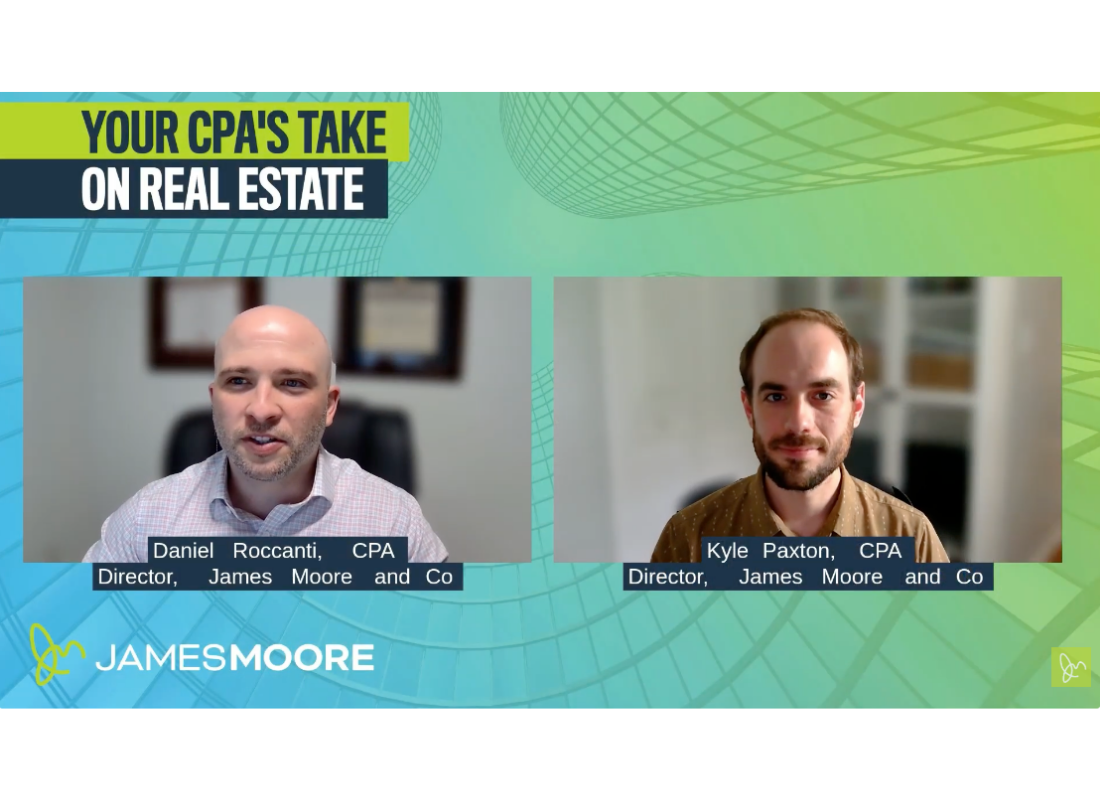
In this episode of Your CPA’s Take on Real Estate, Daniel Roccanti walks through the real estate tax mistakes investors make before they ever buy a property. He covers what to look at during underwriting, how entity structure can make or break a deal and why your CPA belongs in the conversation before you make an offer.
What This Episode Covers
Most of the costly mistakes Daniel sees happen before closing. Investors focus on purchase price, skip the exit plan or set up the wrong entity, then try to fix it after the fact. Some of those mistakes can’t be fixed at all.
The conversation starts with the three questions every investor should answer before buying: what the property is, how it will be used and what the exit strategy looks like. From there, Daniel explains how cost segregation affects taxable income over time, why long-term rentals rarely belong in an S corp and what to ask your CPA before signing a purchase agreement.
Resources
Transcript
[00:01] Host: Hi everyone, and welcome to the James Moore channel. Today I am here with Daniel Roccanti. Hi Daniel, how are you?
[00:01] Daniel Roccanti: Glad to be back.
[00:01] Host: Good. So today we’re talking about the real estate tax mistakes that investors can make that you’ve encountered, or I’ll just ask you a few trending questions on this matter.
[00:20] Host: So the first one is, what tax issues should investors look at before making an offer?
[00:20] Daniel Roccanti: A lot of issues I see come down to mistakes made before the purchase because they’re not looking at it. I want to understand three things when I’m working with my investors. What are you buying? What do you plan to do with it? And what is your exit strategy? So before you even buy it, you should already have an exit strategy, because this all determines what we’re going to do.
[00:51] Daniel Roccanti: Is this a long-term rental property you’re going to hold for 10 years? Is this something you’re going to renovate and flip? Is this a short-term rental? All three of those scenarios have completely different strategies, with different tax consequences. If I don’t truly understand what you’re doing with this property from beginning to end, I can’t properly plan, and then you’re just going with the flow.
[01:23] Daniel Roccanti: For my investors, if I’m flipping, am I going to put that in the same entity as a long-term rental property? Those might be two different entities. With long-term rentals, I have depreciation. With flipping, I do not. So that’s a whole different strategy. It’s really important that you understand the life cycle of the entire property before you buy it so you can match the appropriate tax strategy.
[01:44] Host: Absolutely. What gets overlooked when investors focus only on purchase price and cash flow?
[01:44] Daniel Roccanti: Well, I’ll first say investors should never overlook cash flow. Cash flow is the first thing you should look at. Before you look at taxes, before you look at everything, when I’m advising my clients, I say, is this a cash-flowing property? Because if it’s not, you’re going to put yourself in trouble.
[02:08] Daniel Roccanti: It doesn’t matter about the great tax benefits you could potentially get from it if it doesn’t cash flow. So never overlook cash flow. But beyond that, I think people do get caught up in purchase price because they just see the price and go, “Oh, that’s so expensive.” But I’m like, “Does it cash flow? Then it’s not expensive.”
[02:26] Daniel Roccanti: So from there, now that it cash flows, taxable income is going to be different than cash flow. You might make a lot of money but have a huge loss on the tax side, or vice versa, because it’s all a timing issue. Cost segregations are very important opportunities we can use with real estate assets.
[02:48] Daniel Roccanti: So what does it look like? That first year you might actually have made money, but we’re taking a significant loss because we’re accelerating all those deductions. But how does that play out in future years? Now I don’t have as many deductions in future years, so that cash flow might be the same, but now I might technically have more taxable income coming from that investment.
[03:10] Daniel Roccanti: So we have to make sure we see both sides. It doesn’t mean a cost segregation is bad. It usually actually increases your ROI, but you have to understand that you’re front-loading all those deductions, and you could create a little bit more taxable income that’s above your cash flow because you can’t deduct things like the principal portion of mortgage payments.
[03:31] Host: Yeah. So how can entity structure affect a real estate investment?
[03:31] Daniel Roccanti: Entity structuring is one of those areas where the wrong structure can completely ruin an investment. It’s really important that I understand what you’re actually doing to make sure we match it.
[03:50] Daniel Roccanti: You’ll hear from everyone, “I have an LLC. I have a corporation. I have an S corp. I have a C corp. I’ve got a partnership. I’ve got a single-member LLC or disregarded entity.” And you’re like, “What is all this?” This is basically legal jargon, because you have legal entities and then you have tax entities. Legal entities can be multiple tax entities and vice versa.
[04:12] Daniel Roccanti: So you need to match your property. This goes back to the first question you asked me. Is this a long-term rental property? This is where LLCs, either disregarded or partnership LLCs, are going to be a much better choice for you. If you’re flipping properties, that’s where we might want to consider an S corp or something like that, because it’s going to matter.
[04:38] Daniel Roccanti: The wrong entity can actually create an issue. I see people put long-term rental real estate in S corps, and now you might not even be able to take your losses because they’re stuck at the S corp level.
[04:38] Host: Absolutely. So when should investors bring their CPA into the conversation?
[04:38] Daniel Roccanti: The answer to this is always as soon as possible.
[04:58] Daniel Roccanti: Before the deal, before you do anything, before you’re even thinking about it, you need to bring us in. I think a lot of investors are just thinking of CPAs from the compliance side. So they think, “My tax return doesn’t have to get prepared until next year. I’ll let my CPA know.”
[05:15] Daniel Roccanti: If that’s the kind of relationship you have with your CPA, then you just have a transactional compliance relationship. With my clients, we’re more advisory, where day to day I want to be planning and strategizing for you. To do that, I need to know before the deal even goes into play, because it’s not just about tax strategies.
[05:35] Daniel Roccanti: I’m working with my clients on financial modeling, making sure it’s operating, making sure your property is cash flowing. So when they say, “I’m interested in this property,” before you even put an offer in, let’s make sure this thing is going to cash flow. Then let’s start building out our tax strategy to increase our ROI so we don’t have to pay as much in taxes. If you bring in the CPA too late, you’re just limiting your options, or you’re going to have to go back and fix a lot of things, which costs a lot of money.
[06:03] Daniel Roccanti: I still have to do this sometimes. I get brought in late, and I’m reading your operating agreements and saying, “You wanted this. This is not what your operating agreement says,” or “This isn’t a very efficient operating agreement. You need to go back and change it.”
[06:23] Host: Yeah, absolutely. What tax consequences can come from choosing the wrong ownership structure?
[06:23] Daniel Roccanti: I’ve talked about this a little bit already, but I’ll elaborate here. Matching the right kind of property and use with the right structure completely decides if this investment is a good one or a bad one.
[06:45] Daniel Roccanti: If I have something like a long-term rental property, I really want partnerships because they allow qualified non-recourse debt. They allow me to take basis. That’s when you can do your cost segs and your cash-out refis without producing any kind of taxable situation. You get to take those deductions.
[07:04] Daniel Roccanti: S corps don’t allow those kind of things. You might take a cost segregation on a property in an S corp, but unfortunately the losses are suspended at the company level, which means it never actually flows down to the individual, and now you’re stuck. You can’t actually take these losses. I see these mistakes all the time.
[07:23] Daniel Roccanti: You definitely don’t ever want to put appreciating property in an S corp, but S corps are great in specific scenarios. If I’m flipping properties or I’m a developer, then I definitely want to consider an S corp, maybe over a partnership. But it really comes down to what type of property it is, what my use is, who my investors are and whether I’m using debt. It’s such a big question, and I think a lot of times real estate people overlook this and then try to clean up these mistakes later on. One, it might not be possible to clean up, or two, it’s going to cost a whole lot of money to do it.
[07:56] Host: Absolutely. I do remember us talking about this before, and it can be confusing. That’s why you need to come to your CPA right away.
[07:56] Daniel Roccanti: Absolutely.
[07:56] Host: So our last question today is, what should investors be asking their CPA before signing a purchase agreement?
[07:56] Daniel Roccanti: There’s probably a lot of questions.
[08:17] Daniel Roccanti: Let’s go through some of what we already talked about. Investors should be asking me, how should I be structuring this deal? What entity should I be putting it into? What’s the use of this? What’s my ownership? It’s completely different if I have investors than if I’m just owning this property 100%.
[08:47] Daniel Roccanti: So you should really be talking to your CPA about the proper tax structure for this property and this ownership. LLCs, partnerships, S corps. What should the operating agreement say? There’s a whole legal side to that too, so you should also be talking to an attorney. Then we want to get into what tax planning opportunities there are. Deductions, cost segregations, things like that.
[09:13] Daniel Roccanti: What kind of losses can I actually take, and do I have income to offset them? Sometimes people get so caught up in cost segregations and things like that, and I say, “Okay, but you don’t actually have any income this year. So is it the best strategy for you?” Then, can we use the actual losses? Again, with rental real estate, losses could get stuck at the entity level, and it’s passive.
[09:36] Daniel Roccanti: So if you’re not a real estate professional, you might not be able to take it against non-passive income. You really want to look at this. Those are some of the things. Then there are renovations and capital improvements. You want to make sure you’re getting the tax deductions. What does that look like for you? And then the sale.
[09:54] Daniel Roccanti: Every time you buy a property, you should already have in mind what your exit strategy is. That doesn’t mean you’re going to follow through on it 100%, but you should say, “I’m going to hold this property for seven years and then I’m going to sell it.” Great. Now we know the plan around that. The economy might change in seven years, and you might have to pivot, but the reality is that holding a property for five to seven years is completely different than holding a property for 20 years. It requires a different strategy.
[10:21] Host: Yeah, absolutely. Thank you so much for joining me today and sharing your wisdom on this matter. We’ll do a few more episodes before the new year if I can get a hold of you, because I know you’re busy.
[10:21] Daniel Roccanti: End of year is perfect tax planning time, so I’m always looking out for my clients and investors.
[10:41] Host: Yeah, absolutely. We’re almost there, which is crazy. All right, Daniel, I look forward to speaking to you again. Have a great day.
[10:41] Daniel Roccanti: Thanks.
[10:41] Host: Thanks.
Watch the Full Episode
Hearing Daniel walk through these examples makes the planning steps easier to follow. Watch the full episode above and subscribe to Your CPA’s Take on Real Estate for more conversations on real estate tax planning.
All content provided in this article is for informational purposes only. Matters discussed in this article are subject to change. For up-to-date information on this subject please contact a James Moore professional. James Moore will not be held responsible for any claim, loss, damage or inconvenience caused as a result of any information within these pages or any information accessed through this site.