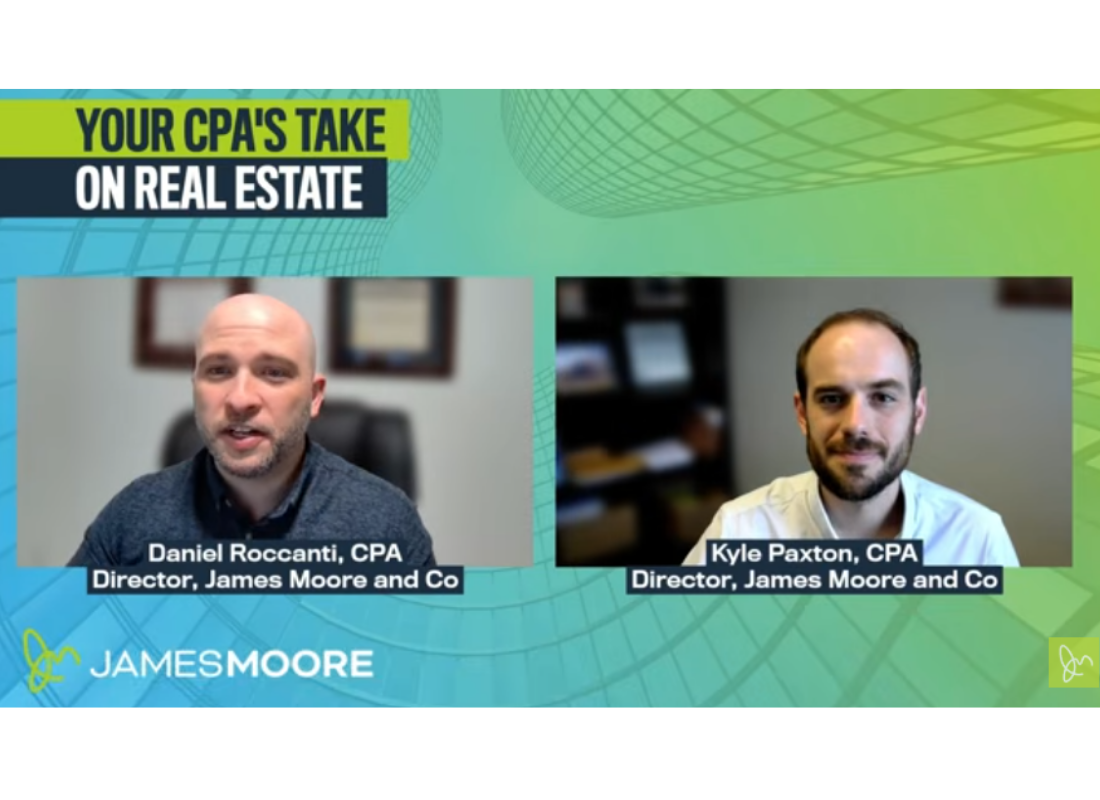
Driving Financial Clarity in Real Estate and Construction With Daniel Roccanti
Originally published on September 29, 2026
“Don’t manipulate the numbers to get to what you want, you should use the numbers to manipulate your actions.” (Daniel Roccanti, CPA, James Moore)
In this episode of Your CPA’s Take on Real Estate, host Faith talks with Daniel Roccanti, a CPA at James Moore, about driving financial clarity in real estate and construction. Daniel explains why profitable projects don’t always add up to a healthy business and what owners can do to see problems before they hit.
Inside the Conversation
Daniel starts with a problem he sees constantly: profitable jobs that don’t add up to a profitable company. He explains why cash and profit are different, how overhead can eat into job-level margins and why doubling revenue can leave owners with the same profit and twice the work.
He also shares the one metric he believes every operator should track (cash runway), the three warning signs that a company is growing too fast and how bridge loans taken out before the pandemic are now creating refinancing pressure for real estate owners.
Resources
Full Transcript
[00:01] Faith: Hi everyone, and welcome to the JMCO channel. I’m excited for today’s conversation. I’m here with Daniel Roccanti. Hopefully I got that last name right. We went over it in the pre-show.
[00:01] Daniel Roccanti: Yeah, it’s a pretty Italian last name, but I’m mostly American, so however you pronounce it, I’m usually good with it.
[00:22] Faith: Okay, good. Daniel is a CPA at James Moore who specializes in working with leaders in the real estate and construction industries. Today we’re talking about driving financial clarity in real estate and construction. Daniel, it’s so great to have you here.
[00:40] Faith: I’m excited to have a conversation with you, and I think we should jump right into it because there are a lot of good questions to cover.
[00:40] Daniel Roccanti: Let’s go. I’m ready.
[00:40] Faith: Awesome. The first question is, why do so many profitable projects still result in struggling businesses?
[00:40] Daniel Roccanti: This is a big issue in a lot of our industry today, and it’s because most people don’t realize that profits and cash don’t necessarily always translate into what a healthy business is.
[01:10] Daniel Roccanti: They’re not the same thing. Most owners are looking at the cash and not really looking at what profits are. Cash can get squeezed with timing, payroll, materials and collections, and if you’re in construction and development, retainage and lender draws. There are going to be a lot of things going on, so really it’s making sure that you understand that cash and profits are different.
[01:35] Daniel Roccanti: Then you’re going to throw in overhead. Overhead is one of the biggest issues because there’s overhead at the project level, and then you have overhead at the more administrative level. If you’re not counting what your overhead is, you don’t actually know if your business is a healthy business or if you just have profitable jobs where your overhead basically eats up all the profits.
[01:35] Faith: Wow, I like that.
[02:00] Faith: I’m actually interested to see how you answer this one. What’s the difference between job-level profitability and overall business profitability?
[02:00] Daniel Roccanti: This goes right off what I said on my last question. When you’re looking at your business, you’re going to have the job level. If you’re a construction person, it’s your actual construction job. If you’re in development, it’s your development job.
[02:19] Daniel Roccanti: So you’re looking at, what’s my actual profit on this specific job? Did we get this right? Did we price it right? Did we get our labor right? Did we get our material right? Everything that is very job specific.
[02:37] Daniel Roccanti: But then we have to think about all these other expenses it takes to run a company. The staff to do the accounting and the supervising and everything we have just running a business, your general and administrative expenses. This is where the biggest difference is with overall business profitability.
[02:56] Daniel Roccanti: I can actually have very profitable jobs and have an unprofitable business because I’m not factoring in my overhead. Then from a business perspective, I have poor results. So you’ve got to make sure that you understand both of those. Does this project work, and when I add my overhead, does it still work?
[02:56] Faith: Right, I like that.
[03:22] Faith: So where do you see owners confusing growth with financial strength?
[03:22] Daniel Roccanti: I think the biggest confusion comes with treating revenue growth or bigger projects as proof that a business is stronger. Just because revenue goes up does not mean your business is better. Or because I’m getting into bigger projects doesn’t mean I’m getting better.
[03:46] Daniel Roccanti: You can actually have growth and be a weaker company because it takes more capital or overhead, with thinner margins. This is a big one I see: “Hey, I doubled my revenue, but now my profits are split in half.” So all you did was double your workload for the same amount of profits. When that happens, your cash gets worse and stress goes up.
[04:11] Daniel Roccanti: Now you’re potentially looking at debt. Real strength comes from growth when it comes with stable margins, clean billing and controlled overhead. Strength isn’t just, am I increasing my revenue line, am I increasing my projects? It’s really about controlled growth, stable growth.
[04:39] Daniel Roccanti: That way when I grow, my profit margins stay the same, and I’m having true growth, not growth that just looks good on my revenue line.
[04:39] Faith: Right. What’s the most common cash flow surprise you see in real estate or construction firms?
[04:39] Daniel Roccanti: I see this a lot: “Hey, my P&L looks fine, but cash isn’t there.”
[05:01] Daniel Roccanti: Or, “Why does it look like I’m making money? Why am I getting profits, but I have no cash?” A lot of this is timing. When you’re dealing with real estate, cash is a timing difference. You’ve got retainage, underbilling and AR. In real estate, you have capex, turnover and vacancies, and your debt service is hitting.
[05:25] Daniel Roccanti: So you have a lot of different things going on, and you’ve got to realize that your profits and your timing are a little different when you’re thinking about cash. You really have to understand where your cash is at all times, and don’t forget about those non-job expenses like tax payments.
[05:47] Daniel Roccanti: This is a big one that surprises people: “Hey, I made money and now I got to pay this huge tax bill and I didn’t have it.” That’s something you’ve got to think about too. The company made money even though you feel like you don’t have cash, and I see this sometimes with some of our clients.
[06:05] Daniel Roccanti: That’s why projections and planning are very important. You don’t want to be surprised with a huge tax bill come April. You’d rather have enough time to realize what that is, and then some good planning can actually take care of it.
[06:21] Faith: Have you ever had clients come to you that have been blindsided and don’t know what to do?
[06:21] Daniel Roccanti: Yeah. I would say the majority of clients, especially new clients, come to us and this is a big issue for them. They’re surprised, and a lot of this comes from there just being no planning.
[06:42] Daniel Roccanti: There are no projections. They’re just getting a tax return done for compliance. They’re just looking at the cash of the company, and they don’t truly understand what profitability looks like, how it works with taxable income and how that all relates back to the actual cash in your account.
[06:42] Faith: When should tax strategy start influencing business decisions instead of just cleaning them up, which is kind of what we just talked about?
[07:16] Daniel Roccanti: This can be a lot of things. It depends on how new you are in your business. When people are first starting out their business, I tell them, “Look, the most important thing is get profitable.” All the strategy in the world doesn’t matter if you can’t make a dollar. But once you do start becoming profitable, these tax strategies should start influencing your decisions before you ever commit to them. It should all be proactive, not retroactive.
[07:44] Daniel Roccanti: There are very limited things you can do. So before you take on this big project, before you buy this equipment, before you change the entity structure, before you take on another partner or investor, or in real estate, before you sell the property, that’s when you need the tax strategy. The best tax strategy is not at the end of the year or after the year. It’s the beginning of the year, mid-year.
[08:10] Daniel Roccanti: It’s as you’re doing it, and sometimes the best planning is even years before it happens, especially for really big things. I always tell my owners, if you’re thinking about selling your company, especially a construction company, we need to be 3 to 5 years out in front of that.
[08:30] Faith: Wow. What’s the biggest mistake owners make when scaling?
[08:30] Daniel Roccanti: This goes back to revenue. I would say it’s scaling revenue before you start scaling your systems. A lot of times owners really want to grow their business, so they take on more work. They add people, they buy equipment and they forget about all the extra things.
[08:57] Daniel Roccanti: They forget about the back office. They forget to do the job costing. They forget about AR follow-up, forecasting and financial reporting. All that stuff is on the back burner because I’m worried about revenue. Revenue is flashy. It’s what everyone wants to see. But you’re making a huge mistake if you’re not thinking about scaling your systems, and you’re actually going to create a bigger problem for yourself, because you increased your revenue but you don’t have the systems to actually service it.
[09:26] Daniel Roccanti: Then you’re going to have lower profit margins and bad reviews. I can’t tell you how many times doing a bad job on something leads to no work in the future. You really need to be building your systems so that your margins are repeatable and your cash flow and controls are disciplined. If you can get your systems set, then you can scale your revenue and you won’t have to deal with the problems that come with growing too fast.
[09:54] Faith: Right. And I feel like the next one is a piece of wise information you’re giving away for free. What is one financial metric every operator should consistently track?
[09:54] Daniel Roccanti: I don’t know, some operators might agree with me here, but there are always the metrics everyone thinks about, like “What’s my rate of return?” and everything like that.
[10:16] Daniel Roccanti: In this situation, when you’re dealing with operators, I would say the one that actually matters the most is your cash runway. This is how many weeks or months you have to operate using the cash on hand basically until it runs out. What this does is give you a warning sign about your company.
[10:40] Daniel Roccanti: I have 3 months of cash on hand, so if collections slow down and I don’t get what I’m owed, I can still pay my bills before it’s a red flag. You can have a large ROI and then run out of cash. That actually happens all the time because of timing. So you really want to understand this, and it’s even better if you pair it with a 13-week forecast.
[11:04] Daniel Roccanti: That gives you those 3 months, and 3 months is kind of key there. You always want to know, “Hey, do I have enough cash to pay the next 3 months?” If you’re always going month to month on your cash flow, the worst part is it’s going to be a lot of stress on you. You’re not going to sleep well, and you don’t want to deal with that. But more importantly, you truly understand when something goes wrong, because this is business.
[11:28] Daniel Roccanti: In business, something happens. Now I know 3 months in advance that I’m going to have a cash problem. I have 3 months to deal with that instead of I have a cash problem today and I have no time to pivot and make a better decision.
[11:28] Faith: I love that. What’s one proactive move a real estate or construction owner should make this year?
[11:28] Daniel Roccanti: I’m going to go right off that last question.
[11:54] Daniel Roccanti: Implement the 13-week cash flow forecast. We just talked about this, the cash runway and everything. If you really care about your cash, implement it, and then actually review it. I can tell you I’ve seen people will implement it and then they never look at it.
[12:11] Daniel Roccanti: I know it sounds simple, but it really does change a lot. You just see everything before it happens. Cash dips, purchases coming up, when I’m doing my owner draws, surprise tax payments, what if I have to negotiate with the lender. It gives you actual strength in your numbers and in your business, so there’s no panic.
[12:31] Daniel Roccanti: We want fewer surprises. With a 13-week cash flow forecast, those surprises disappear if you’re actually doing it and reviewing it.
[12:31] Faith: Absolutely, and I think that goes back to what we said before. I feel like you’ve had clients come in and you’ve told them, “No, you should know this. This will save you. This will help you sleep at night.” I love that.
[12:50] Daniel Roccanti: Absolutely.
[12:50] Faith: How should owners think about overhead allocation across multiple projects?
[12:50] Daniel Roccanti: Allocation is one we talked about a little bit before, but overhead allocation should help you price your contracts, not hide a problem. This is truly understanding the true cost to deliver your job, including the burden of running the company.
[13:23] Daniel Roccanti: You need to have a consistent method. What is my common base: direct labor hours, direct labor cost or direct cost in general? And how does my applied overhead compare to my actual overhead? The biggest trap a lot of companies fall into is using overhead allocation to make their numbers look better instead of using it to answer the real question.
[13:48] Daniel Roccanti: Don’t manipulate the numbers to get to what you want. You should use the numbers to manipulate your actions. This is confirmation bias in its truest form: “Hey, I need this project to have 20% margins, so now I manipulate my overhead allocation to get myself 20% margins.” What you should have done is say, “Based on the actual overhead allocation, I have 10% margins.
[14:16] Daniel Roccanti: I need to have 20% margins. What could I have done better so that my next job will have 20% margins?”
[14:16] Faith: Right.
[14:16] Daniel Roccanti: That’s what you really need to be doing when you think about your overhead allocation.
[14:16] Faith: I like that. And I’m actually interested in this answer for the next question.
[14:36] Faith: What three warning signs tell you a company is growing too fast?
[14:36] Daniel Roccanti: It always goes back to cash. Cash is king.
[14:36] Faith: Yeah.
[14:36] Daniel Roccanti: But it’s cash and operations, and how they mesh together. If your AR is always stretching, like 90-day AR turning into 150-day AR, or you’re too busy to follow up on AR, these are all signs you’re growing too fast.
[15:01] Daniel Roccanti: You’re not doing the key part of owning a business, and that’s bringing revenue in. You’re not doing collections. You’ll also see this with relying more on debt, like lines of credit, even though revenue could be up. My revenue’s high, but I’m still not collecting. Gross margins are down. We talked about this already.
[15:28] Daniel Roccanti: You should make sure you understand what your true gross margins are. If it’s one project, it could be a one-time thing, but if I start seeing all of my gross margins drifting downward, that’s a sign I’m growing too fast. And then books: delayed books, numbers that aren’t clean. When I see a business go from “I always have my books two to three weeks after the end of the month, I’ve got good numbers” to “I never have the time, I never have books,” that’s usually a sign to me that something’s wrong.
[16:01] Daniel Roccanti: Something’s growing too fast, and too much of the company is on your shoulders. This goes back to scaling your systems. You’re scaling work, you’re not scaling your systems. So your company’s growing too fast.
[16:21] Daniel Roccanti: You actually might need to slow down. Slowing down might be the correct choice here and actually give you a healthier company.
[16:21] Faith: Oh, I love that. How do financing structures impact long-term profitability?
[16:21] Daniel Roccanti: I think a lot of times people think financing is just, “I’ve got to get this deal done,” especially in real estate. “I’ve got a deal, I need to get financing, I need to get this deal done.”
[16:47] Daniel Roccanti: But the reality is, you’re buying real estate, and this is a long-term asset. How you finance this deal can completely change how profitable this deal is, or make it not profitable at all. A lot of times when people are buying real estate, especially in today’s environment, traditional debt is just harder to come by.
[17:08] Daniel Roccanti: So you have to layer debt. You have to do a lot of things to make deals happen. If you do a bridge loan or all these other things, you’re basically taking a short-term structure and creating pressure on this long-term asset. Variable rates and things like that can turn a good deal into a bad deal if interest rates change.
[17:31] Daniel Roccanti: So when you’re really looking at financing, you need to understand that it’s part of your long-term profitability. If you have to use something short-term, you really need to model a good case and a bad case. What if I do a bridge loan that’s 5 years, which is still a pretty good bridge loan, since most are less than that, and then in 5 years the market’s not better, it’s worse?
[17:57] Daniel Roccanti: It’s a higher interest rate. This is happening right now, because a lot of people did this pre-pandemic, and now all these bridge loans are coming up and people are having to refinance at a much higher rate, or maybe not even getting as much loan-to-value. This can really make your deals go upside down.
[18:19] Daniel Roccanti: When you’re doing financing, you’ve got to really understand the long-term impact it will have on the profitability of your projects.
[18:19] Faith: Oh, I love that. And I’m sure people made a lot of rash decisions and mistakes around COVID. Now, 5 years later, we really have to deal with it and look at things.
[18:45] Daniel Roccanti: Yeah, and these are real-life problems my clients have. I have several clients who had a really good debt package that they got pre-pandemic, when interest rates were really low.
[19:04] Daniel Roccanti: Maybe they did interest only, or it was something where they weren’t paying much principal down. Now they’re coming back and having to refinance, and they’re not getting anywhere near those kinds of deals. Higher interest rates. The banks are being really risk averse right now. They might not even be able to get full traditional financing.
[19:23] Daniel Roccanti: They might have to bring some mezzanine debt in. Now they have all this real estate, and they didn’t plan for it because real estate had been excellent for the last 10-plus years since the ’08 crash. It kind of bottomed out in 2012, and real estate’s been up ever since then.
[19:44] Daniel Roccanti: We haven’t had to think about this for a long time, and now we do. Now their ROIs are actually lower, and this is a big problem. It’s tough to tell an investor, “Hey, we were living good 5 years ago, but now we’re not getting the same kind of returns that we were.”
[20:02] Faith: Absolutely. We’re going to do just one or two more questions, but this has been such a great conversation. Very informative. You’ve actually taught me a lot, so I love talking to you. How should owners evaluate whether to take on a large new project?
[20:02] Daniel Roccanti: I would say it comes down to three parts.
[20:25] Daniel Roccanti: We’ve got margins, we’ve got cash and we’ve got capacity. Margins is, what’s my profit, and what’s my real profit? Going back to the previous questions, not just profit at the job level. What do I have to do with my overhead? What’s my risk? What are my contingencies? What is it going to be in 5 or 10 years when I have to refinance my debt? When you’re taking on a new project, understand what your margins are and what your margins could be when there’s a big event like a refinance.
[20:57] Daniel Roccanti: Next was cash, I think I said. Cash really comes down to whether you can actually fund this deal, because on a lot of deals the revenue comes in later. I have to fund the whole project up front before I even get paid. And if you’re in construction and development, you have to deal with billing terms, retainage and things like that.
[21:26] Daniel Roccanti: Really understand what your cash is so that you can take on this large project. The last is capacity. This goes back to systems. If I take on this big job, do I actually have the resources to do it? Or am I getting a little bit in over my head and taking on a project that’s too big? You’ve got to make sure you have the right systems and the right people in place, because nothing is worse than taking on a job and failing.
[21:54] Daniel Roccanti: That’s going to prevent you from getting other jobs in the future. You want to make sure you take on a job and over-deliver, and that’ll lead you to even larger projects in the future.
[21:54] Faith: Yeah. Oh, I love that answer. What separates financially disciplined operators from those constantly under pressure?
[21:54] Daniel Roccanti: This goes back to almost a summary of everything I said. A good operator is disciplined. It just runs on rhythm.
[22:29] Daniel Roccanti: It’s these weekly cash flows. It’s these clean monthly closes. It’s actually job costing and looking at it, not just something your CPA needs at the end of the year to get your tax return done. It’s the change order discipline. It’s understanding what my overhead is and how it affects my profits. You’re not just on a whim, hoping everything goes well. Am I keeping good reserves? The 13-week cash flow, everything here.
[23:00] Daniel Roccanti: These are the best operators. When I see issues is when operators are coming under pressure, and they all have the same story. I can see this even with my own clients: “Hey, I need your numbers.” “Ah, they’re running late. I’ll get them to you in a few weeks.” They make decisions without good financial numbers in front of them.
[23:28] Daniel Roccanti: They’re making a decision based on their knowledge, what I think, not what I know. Then when it comes to cash, you just never know: do I have enough cash? It really comes down to the best operators having the most information in front of them. They’re not surprised.
[23:47] Daniel Roccanti: They’re disciplined. They know how to run their systems, and they don’t look like they’re running around like chickens with their heads cut off.
[23:47] Faith: Oh, absolutely. This has been such a great conversation, Daniel. You taught me a lot, and I think this is such an exciting kickoff for one of our lives. We’re going to have Daniel back April 9th, when we’ll talk about turning projects into profitable businesses.
[24:11] Faith: I’m excited to have another conversation with you, and I know this is a really busy time of year for you.
[24:11] Daniel Roccanti: It is, but it’s also the time that everyone thinks about this the most. I always tell everyone at the CPA firm, my staff, whoever, “Look, this is like our Super Bowl.
[24:30] Daniel Roccanti: Everyone’s paying attention right now. I know you’re busy, but this is also when your clients care the most. This is when you need to be on your game, whether it’s preparing the tax returns, advising your clients or jumping on these webinars with Faith and giving out a few tidbits.” All of this will actually help your clients become more profitable and grow their business, which of course makes my job a little bit easier.
[24:54] Faith: Yeah, I love that. Thanks so much. We’ll chat with you again April 9th for your second episode. It was great talking to you today, Daniel.
[24:54] Daniel Roccanti: Thanks, Faith. Take care.
Watch the Full Episode
Daniel’s advice comes down to knowing your numbers before you need them, from job-level margins to cash runway to how your debt holds up at refinance. Watch the full episode above and subscribe to Your CPA’s Take on Real Estate for more conversations like this one.
All content provided in this article is for informational purposes only. Matters discussed in this article are subject to change. For up-to-date information on this subject please contact a James Moore professional. James Moore will not be held responsible for any claim, loss, damage or inconvenience caused as a result of any information within these pages or any information accessed through this site.