What AI Agents in Manufacturing Mean for Your Workforce and Operations
Originally published on November 23, 2026
“It may replace some of what you do, but not you the individual.” – Kevin Golden
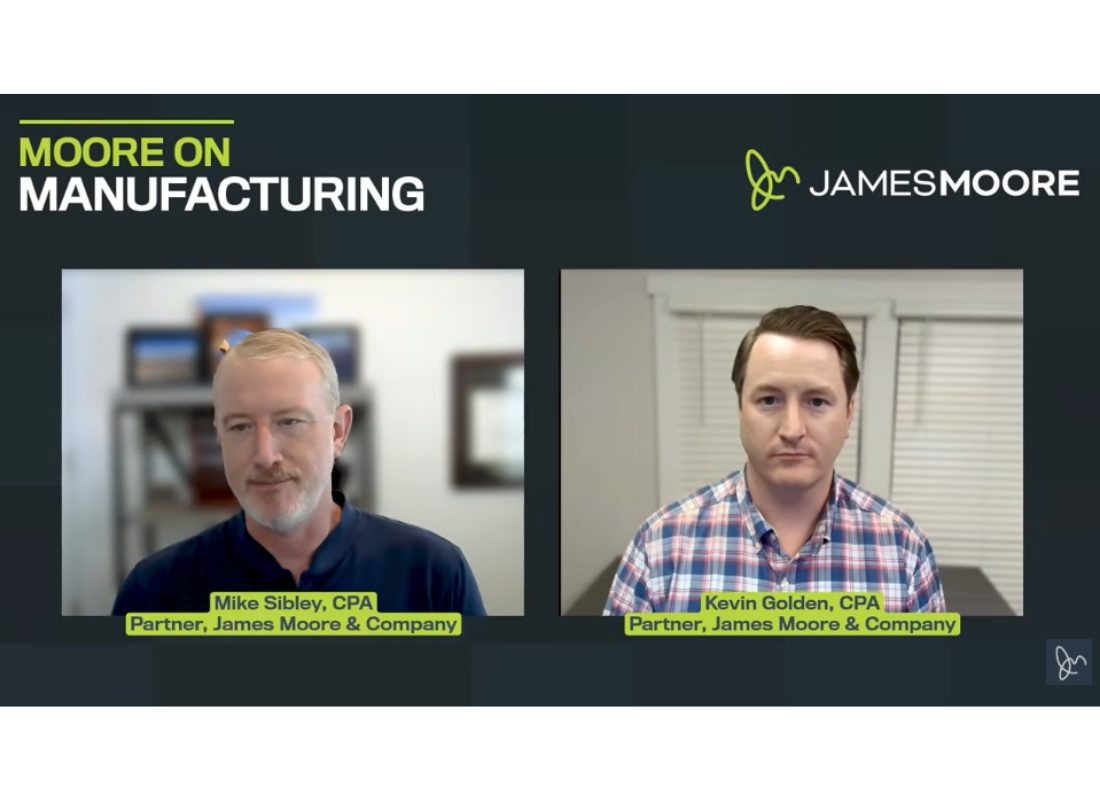
In this Moore on Manufacturing episode, Faith sits down with Kevin Golden to talk about AI agents in manufacturing and what they could mean for your operations. Kevin explains where agents can take on time-consuming work, why human oversight still matters and how manufacturers can start preparing.
Why This Conversation Matters Now
AI is moving past answering questions and into handling tasks, analyzing data and supporting business decisions. For manufacturers facing ongoing labor challenges, that opens new opportunities, from inventory counts to around-the-clock KPI reporting. It also raises real questions about data security, the workforce and how much control to hand over.
Kevin compares AI agents to a new hire who needs training and oversight. He also shares a client example where AI uncovered hidden patterns in an inventory process and makes the case that critical thinking will matter more as AI becomes more capable.
Resources
- James Moore Manufacturing Services
- Moore on Manufacturing YouTube Channel
- Watch This Episode on YouTube
Transcript
[00:01] Faith: Hi everyone and welcome to the James Moore channel. Today I am here with Kevin Golden. Hi Kevin, how are you?
[00:01] Kevin Golden: I’m doing great, Faith. How about yourself?
[00:01] Faith: Good. I feel like it’s been a minute.
[00:01] Kevin Golden: Yeah, it has been.
[00:01] Faith: Everyone’s been busy, but hopefully going into the holiday season we can do a few more episodes about your thoughts moving into 2027.
[00:23] Kevin Golden: Sure.
[00:23] Faith: Which is crazy to think about, but we’re there.
[00:23] Kevin Golden: Almost. I mean, we’re literally two days away from November.
[00:23] Faith: I know. All good things though. So today we’re talking about AI agents and how they’re coming to manufacturing. What does that mean? The first question today is, everyone is talking about AI agents.
[00:46] Faith: What does an AI agent mean in a manufacturing environment?
[00:46] Kevin Golden: This is probably true in any environment, but manufacturing is very labor intensive, right? You need a lot of people, and those are harder to find. More importantly, it’s harder to find people to work the jobs that we need them to work. So you’re sitting there trying to grow your manufacturing facilities, and you’re lacking the people to do so.
[01:12] Kevin Golden: So I think in a manufacturing world, I don’t want to say replace. I will say that they just help supply additional labor, so to speak. Think of manual things. Inventory is a good example of this. I’ve seen this work alongside robotics to help do an inventory cycle count or a regular count.
[01:34] Kevin Golden: That takes a lot of labor and a lot of time. Maybe I don’t have as many people, and I have specific things I need them to work on that I think are more important, like making our products, than doing the inventory counts. So now insert AI, insert robotics, things like that that can help supplement that labor. Not replace, but supplement, so they can redirect their time to what I need them to focus on to help move the dial on my business.
[01:58] Faith: Absolutely. So where could AI agents, and you kind of just mentioned this, have the biggest impact on manufacturing operations?
[01:58] Kevin Golden: Like I just said, I see it working alongside robotics and things like that you may be using or adopting inside your manufacturing facility.
[02:16] Kevin Golden: I also see it on anything else that takes a lot of time. As an accountant, I think of the financial side. If you’re managing your company with your C-suite, you spend a lot of time analyzing data, because in manufacturing there’s data all over the place. You get it from every which way. But I need to analyze that into what’s important for me as a company, based on my vision and my growth.
[02:39] Kevin Golden: Well, it can do that all the time, 24/7, and send you the feedback you need. Send you the data, the ROI, the analysis, the KPIs, all that good stuff you need, so now you spend your time talking about how we change those KPIs. How do we move the dial? How do we solve these problems? Less time trying to figure out what they even are.
[02:58] Kevin Golden: So again, there are a lot of manual processes in there, and agents are going to take care of that. More importantly, agents don’t sleep. Agents don’t need overtime. So they’re working continuously. I will caution with human oversight, but they’re working continuously in that environment to give you what you need in real time, so you can spend your time making better decisions on things that are higher level and less time trying to analyze and pull all this data together.
[03:25] Faith: Absolutely. So could AI agents eventually handle tasks that currently require entire teams?
[03:25] Kevin Golden: I think the answer to that is yes. I want to be careful here. We’re not replacing teams. I will say this: if you’re someone working in a manufacturing environment and your sole job is to do manual, repetitive tasks over and over again without any sort of thought or judgment, yes, it would replace you.
[03:53] Kevin Golden: But that thought or judgment part is what’s important. It may replace the manual repetitiveness, and a lot of times we’re seeing great improvements like healthier lifestyles around these types of jobs because they’re just not as strenuous. But that thought and judgment is where you need to spend more of your time. So yes, I do think a lot of the manual labor and a lot of that manual analysis, you’ll see it replaced more and more, especially with robotics.
[04:21] Kevin Golden: But that thought and judgment, it can supplement, it can help, but it’s never going to replace.
[04:21] Faith: Absolutely. So what manufacturing processes are good candidates for AI agents, and which ones aren’t?
[04:21] Kevin Golden: Again, I think about what we don’t have time to get to, or things that require a lot of our time to get to an end result.
[04:53] Kevin Golden: Usually, either through some sort of procedural efficiency or the use of agents or AI in some way, shape or form, you can make that quicker and quicker. It may be as simple as asking what you’re not getting to quickly enough, or simply not getting around to, as an owner or a production floor manager, that you wish you had more time for. Great, let AI, whether that be through agents or other technology, help you do that.
[05:14] Faith: Absolutely. So how should manufacturers think about the risks of letting AI make or execute decisions?
[05:14] Kevin Golden: I heard it put this way and I love it so much. You have a brand new staff person or employee who’s new to your company.
[05:34] Kevin Golden: You would not just turn over and say, “This is what we do, good luck, go do it. Oh, and by the way, my job is riding on your success.” You wouldn’t. You’d have oversight, you’d have judgment, you’d have thought, you’d train that person. AI is the same way, right? AI agents are the same way.
[05:49] Kevin Golden: So I think you’ve got to look at it from that standpoint. We’ve got to have that oversight and thought and judgment around what it’s doing. You’ve also got to be prepared from a technology standpoint. I know we at James Moore are very careful before we let agentic AI just run free. Why? Because we’re dealing with a lot of sensitive information that, if it gets out, creates more problems than it solves. So you’ve got to have either someone internally or someone externally looking at that.
[06:15] Kevin Golden: What could it do, and where are our risks as far as leaking information, especially sensitive information, maybe trade secrets for a manufacturer that you don’t want out, before you let it run wild. So use it, experiment with it in a controlled environment, giving it input and thought and oversight all the time, so that it works for you, as opposed to figuring out it can do some really cool things but it can also put some really unwanted risk out there.
[06:41] Faith: Yeah, absolutely. So could AI agents help manufacturers operate with smaller teams without sacrificing productivity?
[06:41] Kevin Golden: Yeah, I think so. If anything, even increase productivity. Go back to what we said at the beginning. Yes, it can help replace a lot of those repetitive processes, whether they’re physically manual or just manual processes that take a lot of time, and say, “Great, let’s skip past all that and get to the end results that I need to analyze.”
[07:10] Kevin Golden: Is this moving the dial? Is this progressing like we want? Is this the result I wanted? If it’s not, great, go back to it. And even then, AI can help you fix your process. Where is this wrong? Where is it messing up? Where are you spending a lot of your time? No different than a staff person. You could ask them the same thing.
[07:27] Kevin Golden: So I think the mixture of the two, yes, can help you work in smaller teams and sometimes even be more productive.
[07:27] Faith: Absolutely. So what does this shift mean for the manufacturing workforce?
[07:27] Kevin Golden: First of all, if you’re not on board with the use of AI, think about it today if we said, “I just don’t want to use a computer.”
[07:49] Kevin Golden: It’d be insane. No one says that, whether it’s on your phone, a tablet or the ones we’re on right now. That’s the way AI is going to be. This is the next wave of technology, and you’ve got to get comfortable with it. It doesn’t mean you have to go and bite off a huge chunk of your budget to do it, but if you’re not involved, you’re going to be forced to be involved at some point. So I think that’s step number one.
[08:17] Kevin Golden: Step number two is remembering it is a tool to help you. Whether it’s agentic AI or not, it is there to help you. It’s not there to replace you, no different than any other technology we’ve had over time. It’s there to help, not replace. It may replace some of what you do, but not you the individual.
[08:36] Kevin Golden: That’s still very much needed, especially inside of the manufacturing realm.
[08:36] Faith: Yeah, and I love how you said critical thinking. This is a great tool, but you still have to have that thought, that critical decision-making.
[08:36] Kevin Golden: Absolutely. I was speaking with some college students a few weeks ago, and they asked me, “What do you think college students need?” This was just in general.
[08:57] Kevin Golden: I could apply it to our firm or whatever, but in general, what do you need? I told them critical thinking. People can teach you technical skills, whether it’s with technology or not, about what they build, what they do, what their process is. But what they need you to do is tell them how it could be better. When it’s broken, how do we fix it?
[09:18] Kevin Golden: So the ability to think it through, even if you don’t have the answer, being able to think through a problem and potential solutions, is part of the problem-solving process that we need young people, I mean everyone, but especially the new workforce coming into play, to be thinking about. Sometimes I think technology dampens that a little bit.
[09:37] Kevin Golden: So I would encourage that line of thinking within your manufacturing realm, and don’t let technology make us become lazy to where we don’t critically think. If anything, it frees us up to more critically think.
[09:37] Faith: Absolutely. It’s the whole mentality of you can read how to build a car engine or you can physically build one.
[09:56] Kevin Golden: Right.
[09:56] Faith: Those are two very different ways.
[09:56] Kevin Golden: Yeah. Look at our phones. If we just told it where we were going and didn’t pay attention to where we’re driving, most of the time we’d probably be okay, but every once in a while we’d drive off a cliff or something, right? [laughter] Because it’s not perfect. That sounds silly because of course you wouldn’t do that, but it’s the same thought process.
[10:17] Faith: Absolutely. Okay, our last question is, are manufacturers prepared for the speed at which AI capabilities are changing? I love doing these lives with you because I feel like potential clients could come on your LinkedIn page and get a lot of their questions answered. A lot of what we talk about on these lives are questions people should be asking when it comes to their CPA.
[10:43] Kevin Golden: Right.
[10:43] Faith: So what do you think?
[10:43] Kevin Golden: Well, yes and no. I know that’s kind of a mixed answer, but here’s why I say that. No, in some ways, if you’re on that end of “I haven’t adopted this, I’m not for adopting newer technology, I’m not embracing that.” And sometimes it’s not even so much the current workforce, it’s the newer workforce that’s coming in and embracing it, because I’ll be honest with you, the staff people we hire know it a lot better than I do, and hallelujah they do, because I’m learning as quick as I can.
[11:10] Kevin Golden: But I’m glad they know it better because they’re the future leaders of where we are. You’re probably not prepared at all. But then again, I think some people who are very open to it are better prepared. But I think it still takes a lot of thinking about what it can do.
[11:27] Kevin Golden: I’ll give you an example. We have a manufacturer that does very well. They’re just trying to grow, and we’re trying to help them. In doing so, they said, “There’s no rhyme or reason to this process or procedure that we do, which makes it hard to plan how much we need to buy in inventory and materials.”
[11:42] Kevin Golden: With the use of AI, we showed them there are patterns. They’re just not patterns that are easy to spot on the surface, but they really are. And here’s a thought process you should be thinking about instead. So again, it’s that critical thinking that becomes much more valuable, and the use of technology and AI can help with that.
[11:57] Kevin Golden: So I think some people are prepared, as in “I’m open, I’m using it.” But really pushing the boundaries of how it can be used and what it can help me think through takes a lot more than just one person, usually a whole staff. In those regards, we need to keep pushing ourselves. Continuous improvement is constant in manufacturing.
[12:17] Kevin Golden: We need to think that way when it comes to AI, because only then are we going to fully unlock what it can do, both now and as it evolves in the future.
[12:17] Faith: Yeah, absolutely. Thank you so much for joining me today, Kevin. We will chat again soon, but it’s always a pleasure.
[12:17] Kevin Golden: Of course. Thanks, Faith.
[12:17] Faith: Thanks.
Watch the Full Episode
Hear Kevin’s full take on AI agents, oversight and the future manufacturing workforce by watching the episode above. For more conversations like this one, subscribe to Moore on Manufacturing on YouTube.
All content provided in this article is for informational purposes only. Matters discussed in this article are subject to change. For up-to-date information on this subject please contact a James Moore professional. James Moore will not be held responsible for any claim, loss, damage or inconvenience caused as a result of any information within these pages or any information accessed through this site.