Tariff Planning for Manufacturers: What to Expect in the Next 12 Months
Originally published on October 27, 2026
“I would not put a strategy on tariffs going away.” – Mike Sibley
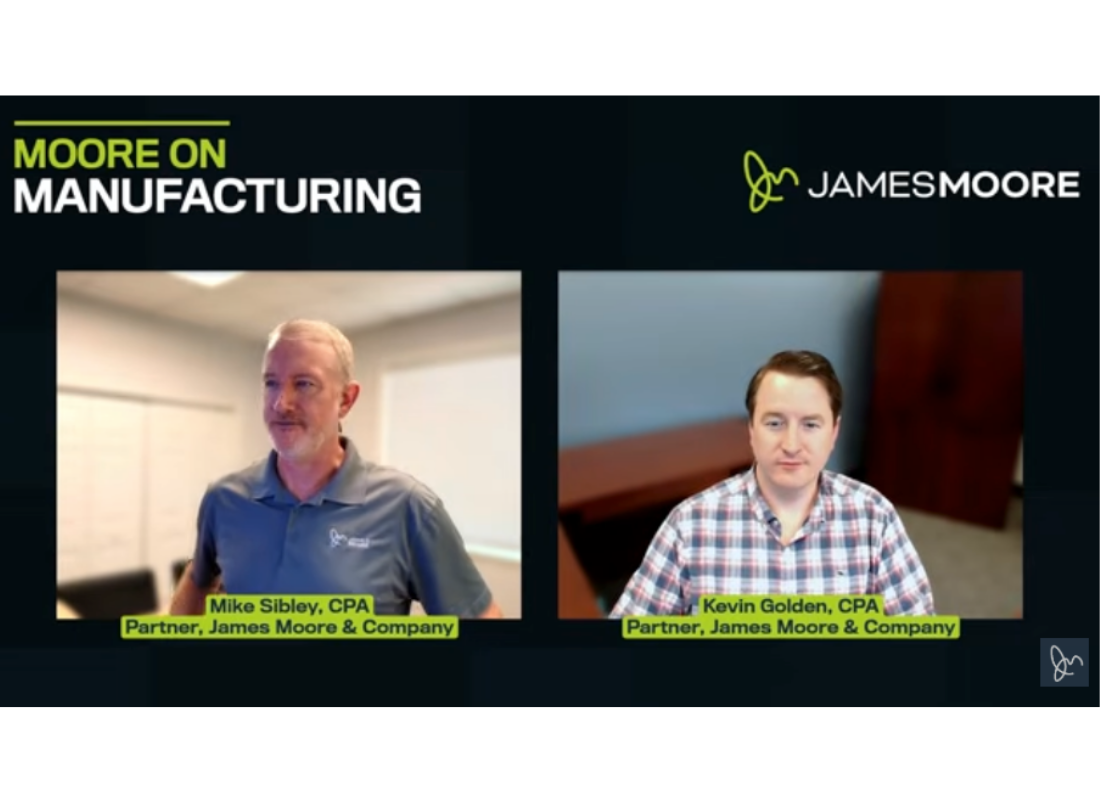
Tariff planning for manufacturers can’t wait for the policy picture to settle. In this episode of Moore on Manufacturing, Faith sits down with Mike Sibley to talk through the cost pressures, planning gaps and warning signs manufacturers should be watching over the next 12 months.
Tariffs are only part of the story. Raw material costs, petroleum-driven pricing and ongoing legal questions around tariff refunds are all adding pressure, and many companies that absorbed those costs are now deciding whether to pass them along.
Mike explains why waiting it out is an expensive choice, how excess inventory quietly drains cash and what good supplier planning looks like right now. He also covers the signals companies tend to ignore, including purchase price variance and slipping margins at the product level.
Resources
Transcript
[00:02] Faith: Hi everyone, and welcome to the JMCO channel. Today I’m here with Mike Sibley. Hi Mike, how are you?
[00:02] Mike Sibley: Good. How are you, Faith?
[00:02] Faith: Good, doing good. So, we talked before we went live about how this is all over the news right now. Tariffs, trade pressure, uncertainty. Who has the right advice? Who’s optimistic about this but shouldn’t be, who’s a realist or who sees it negatively? You don’t really know where to listen. So I think today is a really good conversation to have with you.
[00:27] Mike Sibley: Right. Looking forward to it.
[00:27] Faith: So, the first question is, what’s the biggest pressure point manufacturers are dealing with right now when it comes to tariffs and trade conditions?
[00:27] Mike Sibley: Well, I think overall, costs are just continuing to rise, and it’s not just tariffs. It’s raw material costs. And if you take a bigger picture look at things, you’ve got the whole thing going on in Iran. Obviously, that’s hopefully opening back up now, but that put a lot of pricing pressure because of petroleum and oils in everything, it seems. Then you layer on the length of time the tariffs have been around. Obviously, there was the SCOTUS decision a few months back that said, “Hey, certain companies will be able to get refunds and prove it back.” That’s taken a long time, and the process itself isn’t easy. And now you still have the 122 tariffs, which are allowed to continue on. I’m sure that’s going to end up at the Supreme Court as well. So now these costs continue to stay there and rise, and some companies have absorbed those costs or absorbed some of it. And I think what you’re seeing in surveys and other business executive surveys is they’re going to start passing those along. So it’s a really big pressure point, because that’s a really hard decision to make. It’s not easy to say, “Hey, we’re really going to raise these prices.” And so when you have that, you’ve got supplier decisions that are really difficult. You’ve got quoting, you’ve got margin decisions. So it’s a complicated process.
[02:06] Faith: Absolutely. So, what’s changed most in how manufacturers are making decisions today compared to a few years ago?
[02:06] Mike Sibley: Well, first and foremost, decisions have to be made faster. And you need better line of sight into your supplier base, into what’s going on with them. You need better statistical analysis, better analytics, better software, whatever it might be that’s going to help you make these decisions. Your cost assumptions can change just like that, and it’s really hard, especially in a high-volume scenario, to keep up with that. So you’ve got to have the systems in place. And so I think it’s more important than ever to have a really good supplier strategy.
[02:53] Faith: Absolutely. How are tariffs impacting real cost structures, sourcing strategies and operational planning?
[02:53] Mike Sibley: Well, there’s a whole lot of reasons the tariffs were in place, and obviously one of the goals was for onshoring to happen. But that takes a really long time. And to onshore and bring anything back, there’s also a labor cost difference in certain circumstances. So that difficulty is still out there. But jumping back into the cost pressures, tariffs are part of the cost of raw materials. Those costs can only be absorbed for so long before you have to do something with it. So then the question is, if I can’t pass it along, or I can’t pass it along enough, what other initiatives can I take internally to try to reduce costs? That’s the other thing you’re seeing manufacturers do a lot of to deal with this cost pressure. Can we get more efficient? Can we use automation? Of course, automation is being used to deal with the labor struggles. Labor costs are high, or labor is sometimes difficult to get, so automation is coming in a lot. So manufacturers are really evaluating everything to try to deal with the cost pressures. It’s just not easy to go in and raise prices over and over and over again, but I do think that we haven’t seen the full effect of price increases because of tariffs. I think we’re going to start seeing them in the coming months.
[04:32] Faith: Yeah. So, where do you see companies making the most expensive mistakes right now?
[04:32] Mike Sibley: Well, I think the very first thing is not planning properly. I don’t know how many times we’ve talked about this before, but supply chain strategy is really, really critical. I also see a lot of companies with too much inventory on hand. And it’s not because it’s all safety stock. It’s a lack of planning, uncertainty, not having a good process to understand their forecasts. So when you’re overstocking, you have carrying costs, and those carrying costs can be 20 to 30% of your inventory value. Could be a little less, could be a little more, depends on the company. So that’s a really expensive thing, especially if you have inventory that is prone to expiration or can go obsolete because of technology or something else. That’s a super expensive mistake, and I still see it a lot. And of course, absorbing these tariffs and not trying to pass it along. Some companies I’ve seen do surcharges to try to offset that, some have absorbed, as we talked about, and some are trying to do it in small chunks in order to not disrupt too much. But those are all very, very expensive things. And of course, I heard this early on, so this is really more of a year ago. There were companies saying, “Hey, I’m just going to wait till this ends.” Or even now with the 122 tariffs, “Well, it should be up in July or August.” I wouldn’t count on that. I would not put a strategy on tariffs going away. I would plan on them being around. If they go away by some chance, then great. You can adjust easier to that.
[06:19] Faith: Yeah, and this leads into the next question. Why is waiting it out no longer a viable strategy for manufacturers? I mean, I think you just answered that.
[06:19] Mike Sibley: Yeah. Waiting it out is probably just throwing money away, because how long are you going to wait before you make a decision? That time frame is costing you money. Tens of thousands, hundreds of thousands, I don’t know, depends on the size of your business, right? I just don’t think waiting is a strategy. It’s like saying hope is a strategy. Hope’s not a strategy. Obviously, you hope things go well, but I wouldn’t put a whole strategy on “I hope things go well.” Go make it happen. And I think it’s the same thing with inventories. Go make it happen, do the right things for your business and put the right strategies in place to protect yourself and de-risk yourself.
[07:19] Faith: I love that. I think you need to put that on a coffee mug. Hope is not a strategy. I actually really like that. I think I’m going to use that with my kids.
[07:19] Mike Sibley: Yeah, I wish I made it up. I’ve heard it somewhere. I don’t know who the first person to ever say it was.
[07:19] Faith: I love it, and I’m using it all the time. I’m obsessed. Okay. What does good planning actually look like in this environment?
[07:36] Mike Sibley: Well, it goes back to the fundamentals, the things I somewhat alluded to. Try and understand your customer forecast if you can. That’s one thing. And there are times where you just can’t. Maybe you’ve got a wide base of thousands of customers, and those are really hard. Well, you can do statistical analysis, do years’ worth of it and talk to your sales team to try and get some intelligence on that. So that’s one aspect of it. The second aspect is going back into the supply chain. Who are your top vendors? What does their outlook look like? How are they feeling? What are they seeing for costs? How do you get them to be collaborative with you? I was actually talking with a company yesterday about setting up KPIs. They never really had any KPIs, and we broke it down by different areas. We were talking about suppliers and setting up some supply chain KPIs, even if they’re simple ones like getting on-time deliveries from your suppliers, price increases, quality coming in. Do you have to reject a bunch? So really put some good strategy around that. And then, of course, the other thing is, is there more than one source? Do you have any concentration? Do you have suppliers where, if something happened to that supplier, you would be really, really hurt? So there’s a risk assessment going into your supply base, too. And of course, are there other options for that? And whether you’re dealing with tariffs or not, have you looked inside the US versus outside, and what do those cost parameters look like? So there’s plenty that can be done to try to plan appropriately, try to de-risk and give yourself the best opportunities to be successful going forward.
[09:26] Faith: Absolutely. That’s why it’s key to have a trusted advisor that can help you manage all of that, for sure. What’s one key indicator that leaders should be monitoring beyond cost?
[09:26] Mike Sibley: Okay. Well, there are a lot of key indicators. And I do think it somewhat relates to cost. So you look at margins. If your margin starts slipping, and forget about gross margin for a second, even look at contribution margin. Contribution margin is your revenue minus your direct costs, as opposed to allocated overhead. So you can look at your contribution margins, you can look at your material costs as a percentage of revenue as a KPI, but also have a process to be able to understand price changes at the vendor level. Those are really hard. So if you see those price changes happening, those signals, you can react faster. And I think that’s sometimes the hard thing. There’s so much volume that sometimes it’s not right away, but I think you’ve got to work with your supplier base to do that. The other thing you might really look for is out in the market. If you’ve got something that’s commodity-based (I’ve worked with wood products companies, companies that depend on resin, companies that depend on petroleum-type products), if you can see out in the commodity markets that those prices are changing, you need to use that as an indicator for what’s to come for your business. So there’s inside and there’s outside, depending on your business. There’s steel prices, things like that. So keeping an eye on those things can also be useful in judging what’s going to affect your business.
[11:06] Faith: Absolutely. And you kind of mentioned this, too, but what’s one signal companies ignore that actually tells you trouble’s coming?
[11:06] Mike Sibley: Well, you could start with the news, which you led off with, right? What’s going on in the world. As business leaders, we do have to pay attention to what’s going on in the world, so that’s a signal in and of itself. But sometimes those signals can come in different ways. Again, I go back to keeping it simple. What do they ignore? Unfortunately, I see a lot of companies that ignore the basics, what you can call PPV, purchase price variance. It’s a really good signal that often gets blown away in the P&L and maybe even hidden into material costs without them realizing it. So matching up your PPV can be really helpful. What you’re doing there is saying, “Well, I thought my cost was this, but my actual cost was this,” and we take that difference and we kind of blow it into the P&L. That’s something that doesn’t get watched close enough, and those price changes can impact your margins. Next thing you know, your margin starts slipping a little bit, but you’re not really paying attention to that close enough. So that’s kind of a quiet one that you can see. I’m always a big fan of margin reports. So, margin by product and trending. I love trends. Always have that as part of your monthly reporting package or whatever you do. That way you can see, is there a particular product? Maybe some products have different materials in them than others, and you can see one slipping. If you look at margins as a whole and they look okay, it could be because these products are doing okay, maybe a little better than you thought, and maybe some of these are not because of price changes. So looking at it at a product level can actually be very, very helpful to make sure you don’t have something slipping in one area that’s being covered by another area.
[13:09] Faith: Absolutely. So, the last question we have for you today is, what is your biggest piece of advice? I know there are so many things, but think of the first thing that comes to mind for manufacturers looking to build resilience in today’s environment.
[13:37] Mike Sibley: Yeah. I think the first thing to understand is that resilience is the key to success in these quickly changing times, with geopolitics that don’t seem to be going away. So resilience is the key, and you build that in. Don’t wait. That’s the first thing. Don’t just sit back and wait and hope. Hope is not a strategy. Don’t do that. Build a risk assessment into your processes and your supply chain. Collaborate with those suppliers. Build that plan out, build that collaboration and at least take your top 10% of suppliers, and hopefully that’s just a handful. You don’t necessarily have to do all of them. Do the key ones. Really look at those key ones. Start there. Know your exposure. Know your price. Collaborate with them. See if they’re willing to be a partner in this. You can show them, “Hey, this is where our business is going. We want you to be part of that. How can we work together?” And then have a system to be able to review your costs and those changes quickly. Maybe a month or two slips by, but don’t let months and months slip by before you’re able to react on that.
[14:46] Faith: Absolutely. Well, thanks for talking with me today. I think this brings some clarity to a very volatile, confusing moment in time in the manufacturing field. We’ll definitely keep talking about this throughout the summer, and I look forward to talking to you again.
[15:05] Mike Sibley: Yeah, same. Thanks, Faith. Bye-bye.
Watch the Full Episode
Hear Mike’s full take on tariffs, supplier strategy and the warning signs worth watching this year. Watch the episode and subscribe to Moore on Manufacturing for more conversations on what’s affecting manufacturers right now.
All content provided in this article is for informational purposes only. Matters discussed in this article are subject to change. For up-to-date information on this subject please contact a James Moore professional. James Moore will not be held responsible for any claim, loss, damage or inconvenience caused as a result of any information within these pages or any information accessed through this site.