Estate Planning for Real Estate Portfolios
Originally published on June 30, 2026
“It’s not just about transferring wealth. You need to be transferring a functioning portfolio to your next generation.” — Daniel Roccanti
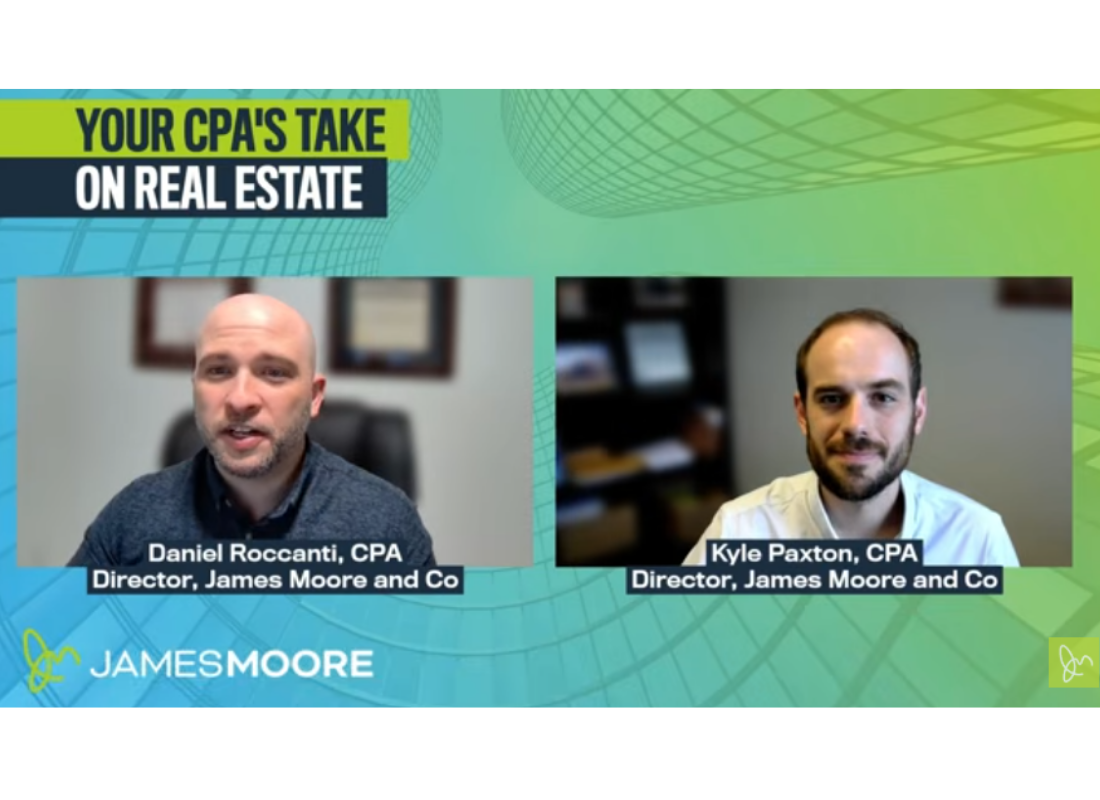
Estate planning for real estate investors goes well beyond wills and inheritance. In this episode of Your CPA’s Take on Real Estate, hosts Daniel Roccanti and Kyle Paxton walk through the structures, tools and conversations that real estate investors need to have before it is too late.
From LLC governance and trust strategies to step-up in basis, succession planning and the role operating agreements play in making an estate plan actually work, this is a practical discussion for anyone building or managing a real estate portfolio with generational goals in mind.
Daniel and Kyle cover the five questions every real estate investor’s estate plan should answer, common planning tools including SLATs, GRATs and ILITs, and why the gap between an estate plan and the underlying operating agreements is one of the most costly mistakes investors make.
Resources
Full Transcript
[00:02] Daniel Roccanti: Welcome to Your CPA’s Take on Real Estate. In today’s session, we’re going to talk about estate planning for real estate investors. I’m your host, Daniel Roccanti, back with Kyle Paxton to talk about a subject that I think is very timely for a lot of real estate people.
[00:23] Daniel Roccanti: When people hear real estate or estate planning, they usually think about wills, trusts, and who gets what. But for real estate investors, estate planning is much bigger than that. It’s about who gets control of the portfolio, who manages the debt, who talks to the tenants, and how the family avoids forced sales and tax surprises.
[00:39] Kyle Paxton: Yes, Daniel, and there’s a lot of nuance to this. When we talk about a real estate portfolio, you could have the rental properties, development entities, debt guarantees, some minority investors. When family members get involved in a real estate investment, things can get complicated. Property managers, operating agreements, the whole thing. What often happens is we have an individual or a small family office who has done very well in real estate investing in a short amount of time, and then as we start getting through these conversations on transition planning, what’s it going to look like for the next generation, people can be quick to say, “I’ll gift this property to my son.”
[01:18] Kyle Paxton: Definitely a spot to stop, take full inventory of everything, figure out what’s what, and get the right people around you. This is a very important conversation and can save a lot of headache, money, and tax in the estate planning process.
[01:41] Daniel Roccanti: Real estate specifically has a couple of special things going on when you’re talking about estate planning. Real estate is usually very illiquid. It’s high leverage. It’s entity-heavy, so you’re talking sometimes with some of these families, there’s 30 entities or more.
[02:00] Daniel Roccanti: That can make for very complex estate planning. For our real estate investors, a good estate plan should answer five questions. Who owns the assets after death? Who controls the entities or the real estate? Who has the authority to manage, refinance, sell, distribute cash? How will taxes, debt, and liquidity needs be handled? And how will active and passive family members be treated fairly? Not everyone wants to take over the real estate and be active. You’re going to have a mix of that.
[02:34] Daniel Roccanti: Let’s break down the structures investors use. Most real estate investors are very familiar with LLCs. If you’re buying real estate, you’re putting them in LLCs. That’s usually how it goes, especially once you’re scaling up. LLCs are great for asset protection, especially while you’re alive. But estate planning needs to take it a step further. Who actually owns each LLC’s interest? Who’s managing the LLCs? Whether the ownership interests are voting or non-voting. Whether the transfer to a trust or family members is even permitted. And whether lender consent is needed before ownership changes.
[03:38] Kyle Paxton: This is all about governance, and governance really matters here. The goal is not just moving value to the next generation. It’s deciding who’s making the decisions and when. Who gets the economics, how are decisions made for sales, refinancing, property management, all of that. It gets very nuanced and complicated.
[03:58] Kyle Paxton: I want to get back to the fact that real estate is illiquid, and that’s huge in this. As part of the estate planning, we have to understand where cash flow is coming from. If you actually have an estate tax liability, how is the next generation going to cover that if all of that wealth is tied up in real estate?
[04:31] Kyle Paxton: Another vehicle to bring into the picture is trusts. You mentioned wills and trusts at the start of this conversation. There are two big buckets of trusts. Revocable trusts help avoid probate and centralize administration of your assets. Irrevocable trusts are often used in estate tax planning for additional asset protection or generation skipping planning. To me, the trust conversation is low-hanging fruit here. What trusts could we possibly set up? How does that impact ownership of these LLCs we’ve been talking about? Is there any gifting that needs to happen now of LLC interest and direct property into these irrevocable trusts? The design of all this comes around whether the trustee has the skill or authority to operate real estate, sign leases, manage debt, capital calls, do tax elections.
[06:16] Daniel Roccanti: Trusts are very popular when it comes to estate planning. Kyle mentioned the revocable trust, which is very common across the board. It doesn’t actually take anything out of your estate. It’s mostly there for probate avoidance and to make transition easier, but it still stays within your taxable estate. That’s important because irrevocable trusts take it out of your taxable estate. This is where you start thinking about inheritance tax. With the most recent tax code, the exemption is $15 million per person, so a married couple gets $30 million before inheritance tax kicks in.
[07:11] Daniel Roccanti: If wealth is over $30 million, the amount over that will be taxed when it’s passed to heirs. That can go all the way up to 40%. So if you have $100 million worth of real estate, you’re looking at a very hefty tax bill when passing it to your kids. So it’s really important that we talk about trusts here.
[07:29] Daniel Roccanti: Another common entity we see for estate planning is the family limited partnership or family LLC. This creates a separation between control and economics. The senior generation can retain management control while still transferring economic interest to the kids and lower generations, so we can start getting them into real estate without directly giving them real estate.
[08:29] Daniel Roccanti: These structures need real governance. They need real records. They really need a business purpose beyond tax. When you’re doing these things, it’s very important that you structure this like any other business. But it’s a very important tool for estate planning, for how you can start giving interests to your kids without handing them direct interest in real estate.
[08:59] Kyle Paxton: Let’s talk about the step-up in basis. At a high level, property acquired from a decedent receives a step-up in basis equal to its fair market value at the date of death, or potentially an alternate valuation date if elected through the estate process. This is huge for our real estate investors. The classic real estate playbook is you acquire a property, you take bonus depreciation on the eligible portion of the property, which currently is 100%. The eligible assets get a 100% write-off in year one. The catch of that is depreciation is a timing difference. When you go and sell, barring a 1031 like-kind exchange or other strategies, you have a taxable event on the sale to recapture that depreciation.
[09:59] Kyle Paxton: The step-up in basis as part of this transition planning is huge because you can potentially wipe out that recapture component. A lot of our planning around this in the real estate space revolves around whether it makes sense to sell now, gift now, refinance, whatever it is, if this step-up in basis is on the horizon. These can be awkward conversations because you’re talking about somebody passing away. But you have to be serious about this and understand that how you go about passing property down can have a drastic difference on tax implications. This is one of the most important tax consequences when you’re thinking about real estate.
[10:57] Daniel Roccanti: This is sometimes one of the reasons why people even get into real estate. It’s great for generational wealth because of things like the 1031 exchange, where you can keep deferring, and then pass away and give it to your kids with a step-up in basis. It’s important to note that what we’re talking about here is income tax. Step-up in basis means when you pass away and give your real estate to your kids, your kids receive it at fair market value. They get a step-up from your original cost basis to the fair market value.
[11:35] Daniel Roccanti: So if they turned around and sold it immediately for the same value, they would have no gain. Or if they held onto it, the gain would only be what it appreciates from when they received it. But this is not the same as inheritance or estate tax. When you gift property, they receive it at your original cost basis. So let’s say I buy a property for a million dollars. It appreciates to $5 million. If I pass away and give it to my kids, they get it at a cost basis of $5 million. But if I gift it to them, they only get it at a million dollars. So there’s a $4 million built-in gain there.
[12:24] Daniel Roccanti: Transferring assets does reduce your estate value. So even though I transferred it and created an income tax problem, I reduced my estate. Or if I hold onto it, I’m reducing a future income tax but potentially creating an estate tax issue. When you’re doing real estate planning, especially if you’re over the $30 million estate threshold, you really need to use these trusts, entity structures and estate planning tools to balance income tax, estate tax, controls and family goals. If you don’t have it set up for the right controls and the right people taking over, it’s just going to be a huge mess for your kids.
[13:29] Kyle Paxton: I really like this conversation and the tension among these planning components. It speaks to the nuance involved here. As tax advisors, we have a unique position. When we’re working with a family that has real estate, we get good third-party visibility into family dynamics, the goals of the older generation versus the younger generation. We add a lot of value by having the tax knowledge and understanding of how these things function, but also making sure we’re rooting all of this in what are the actual goals of the family. Are the goals aligned? Do we have to help work through that? We can be part-time therapists sometimes as CPAs.
[14:35] Kyle Paxton: This is a very important conversation that often happens too late. If you’re a scaling real estate investor, it’s never too early to have this conversation. The more complex you get, the more work it takes to get everything moved to the right place. I like having these conversations early as we onboard clients. Year one, let’s focus on compliance, but then let’s talk estate planning, because there’s often work we can do there.
[15:05] Daniel Roccanti: We always primarily focus on compliance and income tax, but estate planning gets overlooked. It gets pushed off as an end-of-life issue.
[15:29] Kyle Paxton: It’s a very uncomfortable conversation, but it’s very important to address it as soon as possible. Real estate appreciates and can appreciate really quickly. I can’t tell you how many people I’ve talked to who say they’re under the $30 million threshold, and then two years later they’re well over it. They’re one good deal, one good year away from being over that. And now they’re already over it without having talked about it. And then the bigger your family gets, with five or six kids and grandkids, it just creates a complex situation.
[16:10] Daniel Roccanti: Let’s move into estate planning specifically. We talked about the $15 million estate exemption per person, $30 million if you’re married. If you are around those limits, you really need to start thinking about estate tax planning. And we need a reminder that some states also have estate and inheritance tax, and their thresholds might be significantly lower than the federal. You’re not just thinking about federal here. In Florida it’s easy to forget, but there are other states that definitely have them. About 15 states have some form of inheritance or estate tax. Property values can grow quickly, so always talk earlier than you think you need to.
[17:13] Daniel Roccanti: Some of the planning tools that are great to use: don’t forget the annual exclusion. It’s $19,000 per person. This is a really helpful tool to move something every year. If you and your spouse both gift $19,000, you can move a significant amount to any person in a year. This doesn’t have to be cash. It can be LLC interest. Family limited partnerships commonly just slowly give more non-controlling interest over time. Annual exclusion gifts seem small, but they can really add up over many decades.
[17:54] Daniel Roccanti: The lifetime exemption is basically the $30 million we talked about. You can use that to move assets before you die. Common ones we see in trusts: the spousal lifetime access trust, or SLAT. Married couples can gift into the trust, remain the beneficiary, and for estate purposes it gets removed from your estate. Grantor retained annuity trusts, GRATs, are a great way to shift appreciating properties to beneficiaries. They work well with assets expected to significantly appreciate. We’ve talked about family limited partnerships and family LLCs. Instead of transferring real estate directly, you transfer a small portion of interest every year, building it up slowly as non-controlling interest.
[19:13] Daniel Roccanti: You can also use life insurance trusts, ILITs. This is a good way to provide liquidity. When you have real estate, it’s very illiquid. If you’re going to have an inheritance tax, it’s difficult once you’re over $30 million to completely avoid it. The question becomes how to limit it and how to fund it. If you don’t have a way to fund the tax bill, your heirs are going to have to sell real estate to pay it. Life insurance can be a really good asset here. Just keep in mind that the payout could be included in your estate as well, so make sure it is properly structured to keep it out. Or at minimum, be aware that estate taxes may apply to the payout, but at least it’s paying for itself without forcing a sale.
[20:34] Daniel Roccanti: You do not want to sell class A generational wealth real estate. Once you buy it, you can’t get it back, especially not for that price.
[21:08] Kyle Paxton: One other thing I want to touch on: we have a strong footprint in several college towns, and we’re seeing a rise in the charitable planning component of estates. Clients are increasingly interested in pulling real estate into their charitable planning. That can look a lot of different ways in terms of how it’s structured, when it’s contributed, and strategies around contributing appreciated property to help address some of these tax issues.
[21:38] Daniel Roccanti: Charitable giving comes up a lot. Let’s move into succession planning for real estate operators. Real estate is not truly passive. It’s called passive income, but someone still has to manage the tenants, deal with repairs, handle financing, distributions, investors and deals. When doing estate planning, we need to identify who becomes the managers of these LLCs, who communicates with the lenders, who negotiates the leases. Basically, who’s taking over and managing these properties.
[22:18] Daniel Roccanti: When you have a family, who has control? Say you have four kids: one very active, three who are not. The active one is most likely the one taking control. But what are the family dynamics? How does it look having three passive members? It can be equal in interest but unequal in control. Who’s actually getting the manager duties? Do they even want them? How many times have we seen that none of the kids want them?
[22:58] Daniel Roccanti: If none of the kids want the duties, now that’s an even bigger conversation because you need to find a third party or a trustee, or the kids are just going to sell everything and take the money.
[23:19] Kyle Paxton: This is often where those tensions around family dynamics come into play. When there’s a mismatch in family goals, this process has to be intentional. Separating ownership from control is very important. Fairness and equality get convoluted when someone’s doing the heavy lifting. Having these intentional conversations on the front end saves a disaster on the back end. Within family dynamics, everything can be fine until the family patriarch or matriarch passes away, and then everything falls apart. It’s almost like a switch sometimes.
[24:01] Kyle Paxton: Being intentional about that separation of ownership and control and preparing the next generation matters. Make sure everyone is on the same page. Involve successors before a crisis. Document all your contracts and policies so everything can be picked up and kept moving. For family members actively involved in the portfolio, make sure compensation is clarified and there’s a clear plan. All of those things ease this process during what is typically a high-emotion time.
[24:41] Daniel Roccanti: It’s very important to prepare the next generation. As the one who built this whole thing, each generation loses a little of that drive it feels like. Make sure you’re planning for that, and thinking about how to bring in third parties if needed. We see a lot of family offices now treating themselves like normal businesses with employees running things. It’s not just heavily relying on individuals in the family. Prepare that next generation and figure out who gets control.
[25:27] Daniel Roccanti: One of the last things I want to leave with: when you’re doing your estate planning, make sure you’re coordinating with your operating agreements. You might create a huge estate plan, and then someone reads your operating agreement and finds out none of it is actually permitted.
[25:46] Daniel Roccanti: That gets skipped a lot. You make a huge estate plan and don’t even think about the operating agreements. It comes up a lot, and then we have to say you need to amend your operating agreements, and hopefully it’s not too late. Make sure you’re looking at both, because if we’re going to transfer everything to irrevocable trusts, the operating agreement has to actually allow that.
[26:02] Kyle Paxton: A lot of times we see that no operating agreement exists at all. You can have $100 million in real estate LLCs and zero of them have an operating agreement. That is bad news for so many reasons, and it definitely comes into play here. Starting point one is to have an operating agreement, and then have someone who knows what they’re doing help you craft it. All of this conversation for real estate held within entities needs to be grounded in the operating agreement to make sure your estate plan is consistent with what’s allowed based on your company documents.
[26:44] Daniel Roccanti: I want to finalize with this: estate planning is not just about transferring wealth for real estate investors. There is the income tax component. There is the estate component. But there’s also a third piece. You need to be transferring a functioning portfolio to your next generation. Making sure they’re prepared to take it over, that they know who has control, that everyone’s family goals are being met, so you’re not handing them a huge mess. Everything you’ve built in your lifetime shouldn’t just fall apart.
[27:08] Kyle Paxton: The huge mess takes years to deal with, and half the time it ends up with everyone just selling things off and taking the cash. You just want to make sure that you’re leaving it better than where you found it, and a good estate plan is the perfect way to do that.
Watch the Full Episode
If this conversation raised questions about your own portfolio, it’s worth watching the full episode above. Daniel and Kyle go deeper on each of these topics, including the specific tools and trust structures that may apply to your situation. Reach out to a James Moore professional to start the conversation.
All content provided in this article is for informational purposes only. Matters discussed in this article are subject to change. For up-to-date information on this subject please contact a James Moore professional. James Moore will not be held responsible for any claim, loss, damage or inconvenience caused as a result of any information within these pages or any information accessed through this site.