What Real Estate Operators Get Wrong About Tax Planning (And How to Fix It)
Originally published on February 25, 2026
“Keeping who is financing your operation happy is the key to your success.” — Kyle Paxton, CPA and Tax Director, James Moore
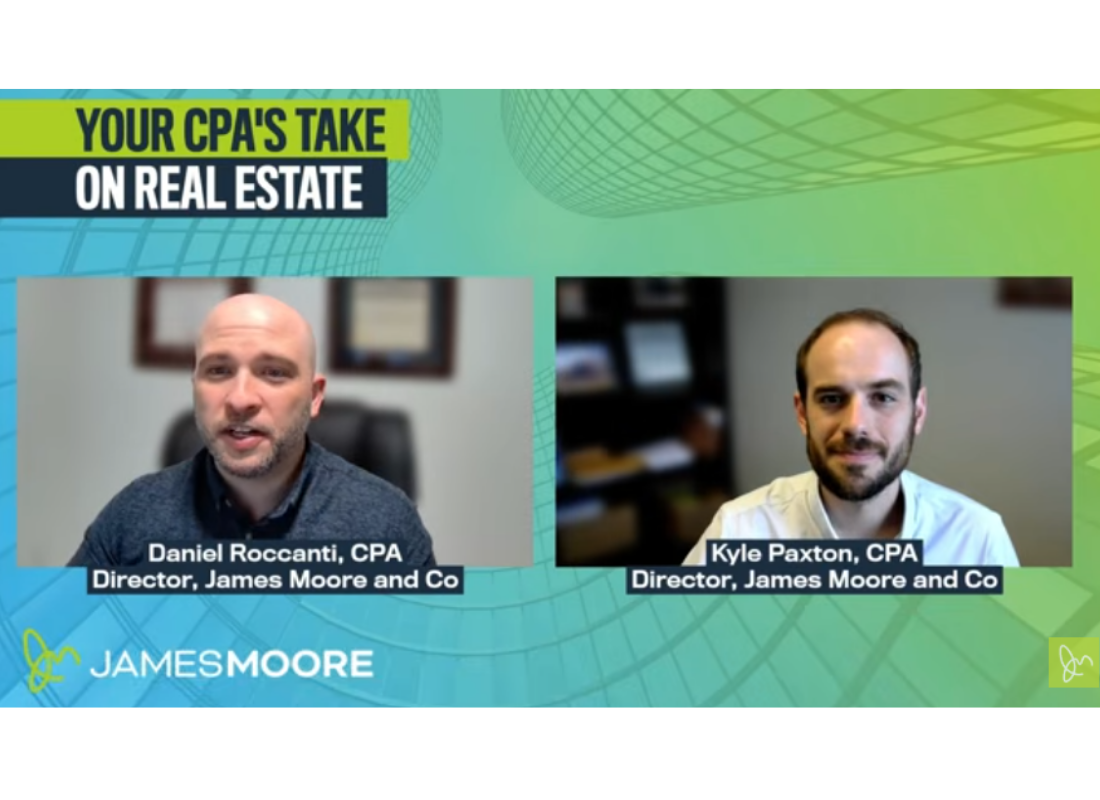
In this episode of the JMCO channel, Kyle Paxton, CPA and Tax Director at James Moore, breaks down the financial strategies that separate reactive business owners from proactive ones. From depreciation timing to entity structure to investor communication, Kyle shares what real estate operators need to know to protect cash flow and set themselves up for long-term success.
Resources
Full Transcript
[00:25] Faith: Hi and welcome to the JMCO channel. Today we’re talking with Kyle Paxton, CPA and Tax Director at James Moore. Today we’re talking about project to portfolio. Kyle, it’s so good to have you today.
[00:36] Kyle Paxton: Always a pleasure, my friend. Great to see you. Happy to be here.
[00:40] Faith: This is actually our first episode on the JMCO channel.
[00:43] Kyle Paxton: It’s very exciting.
[00:44] Faith: I know. All right. I was joking with Faith before this — this one’s going to be a scratch, a trial run. We’ll get better from here. But it’s always fun with you, Kyle, so I think we’re going to have a great time. Let’s just get into questions because we have a lot to cover.
[01:05] Faith: We’re going to start with tax strategy as a planning tool. What’s the difference between proactive tax planning and filing after the fact?
[01:15] Kyle Paxton: That’s a great question and one we’re dealing with right now as we enter the peak of tax season. Proactive tax planning is very important for cash flow. A big theme in my practice is avoiding surprises. Surprises are no fun. Sometimes they’re good surprises, sometimes they’re really bad surprises. So in total, we’re trying to avoid surprises. That’s what proactive tax planning is all about — making sure you don’t have significant negative surprises impacting your business.
Accounting historically, from the compliance side, is a compliance activity. It’s check the box. We filed the tax return, we move on to next year, and nothing really comes out of it. What we’ve been trying to do at James Moore is pivot away from just compliance. The reality is AI can do a good portion of most tax returns now. We’re taking the tax picture and using it to establish what we can do better going forward — parlaying that into more of an advisory system where we’re meeting quarterly. We meet on the back of that tax return, identify changes we can make, check in three months later on how those changes are panning out, and then address what we can do right before year end. It’s really creating that relationship where your accountant, who has a lot of visibility into your business numbers, can help drive and grow the business.
[02:59] Faith: I love that. How can tax strategy actively support expansion?
[03:05] Kyle Paxton: This is big. It’s a cash flow game. A lot of concepts in tax are timing differences — you’re playing with the time value of money. Generally speaking, I want to delay income as much as possible and push expenses up to free up cash right now.
I operate a lot in the real estate space. It is a really good time to own real estate for tax purposes. The Tax Cuts and Jobs Act and now the One Big Beautiful Bill have both really stimulated real estate from a tax perspective. When you acquire a multifamily property, you have the core building, the land, all the internal components, and a lot of times you’re making significant improvements to bring rents up to market value. Timing that project and being intentional about when it’s completed, and what tax strategies we want to implement around depreciation, can free up a lot of cash now — for both the operator and any investors involved.
Depreciation is the low-hanging fruit for me because it’s a deduction that’s not necessarily tied to cash. If you finance a purchase, you can still potentially get a tax deduction for the full cost in year one. You have a phantom tax deduction that’s not tied to a cash outflow from your pocket. Beyond that, we talk about the timing of owner compensation, your accounting method and how your entities are structured — all to make sure you’re mitigating tax and funneling income in the right channels to optimize your global cash flow.
[05:27] Faith: How should owners structure entities to support growth and protection?
[05:46] Kyle Paxton: This is big and one of the first things I unpack with new clients. I have to caveat — I’m not an attorney. I’m a CPA. I have to look at this through the financial lens. You have a whole other world of legal considerations, and entity structure ultimately defaults to the legal team first. That said, I love working with attorneys on entity structures and portfolio restructuring because how you structure your entities is number one in determining if your overall tax strategy is even going to work.
We run into this problem all the time with clients we onboard — they were given bad advice on a specific LLC and what tax election it should have made. Then they come to us with a big transaction in five days and need help minimizing tax. And it’s too late. Those conversations aren’t fun, and it puts me in the position of coming in as the bad guy at the start of a relationship.
We re-evaluate entity structure at least every couple of years through the tax compliance process to make sure we understand why clients are paying tax and whether there’s anything we can do to help mitigate that. The biggest thing is staying proactive — you’ve got to keep me in the loop as deals come up. A lot of times the LLC is formed, the transaction is executed, and then I find out after the fact and I’m trying to figure out how it fits in the global picture.
[08:13] Faith: How does poor planning create unnecessary financial stress?
[08:35] Kyle Paxton: The easy tax example is what we’re dealing with right now. I’ll gravitate back to real estate. Depreciation is a timing difference — you can potentially get a large deduction in year one. As you hold the investment you’re potentially having taxable losses every year, and then when you go to sell, you have a taxable gain. That gain isn’t just the spread between what you sold it for and what you paid. You potentially have to recapture that depreciation. Depending on where the property is, where your owners are and where your employees are, you may have state tax problems. Some states require the entity itself to pay tax directly to the state instead of passing through to the individuals.
Tax without proper, intentional planning and front-end projection work means you get hit with a form you weren’t expecting, or you don’t get good data on what’s going to be on that form, and it causes surprises. I also see tax become a problem through financial advisors and investments with the big-name brokers. You get your 1099 at the end of February for all the stock sales from the prior year — maybe you knew about some of them, maybe you didn’t — and there are often big surprises buried in there.
I say it a lot: I don’t like tax driving economic decisions. But it has to be part of the picture somewhere in your mind, and a lot of times it isn’t. That’s where the pain really comes from.
[11:31] Faith: When you meet a new client, what’s the first question you ask that tells you how sophisticated they are financially?
[11:40] Kyle Paxton: I tend to go with the flow, so I don’t have a roster of questions necessarily. But the biggest tell for me is two things. First, does the business owner have a good back-of-the-napkin pulse at 30,000 feet on how their business is doing? A lot of times when I’m reviewing financial results or tax returns, if a business owner can say, “Yeah, that feels right based on what I know,” I see that as sophisticated. We see a lot of people who can’t do that and are blindsided by surprises. It’s not just “do I have cash in the bank, yes or no.”
The other thing that’s become more prevalent is data availability. Right now we’ve never had access to more real-time data, and at the snap of your fingers you can get whatever data set you want with the right tools. A big tell for me is where is the business in terms of real-time visibility. You should have data for today for your business in one way or another. It doesn’t have to be perfect, beautiful financial records — if you use QuickBooks, you can import bank transactions and they classify 95% of them for you. We have a data analytics team at James Moore and build out a lot of dashboards internally. I really want to see that with the clients I work with. Are we having a conversation in July where we’re still not sure about what happened last December? That shouldn’t be happening right now.
[14:25] Faith: What’s one of the most common cash flow surprises you see?
[14:35] Kyle Paxton: A lot of the spaces I operate in have a heavy modeling component. Whether you’re getting ready to bid on a job or launching a new real estate fund, there’s always a model involved — and there are so many places where that model can go wrong. Your overhead gets out of whack. You have change orders mid-job that drive up costs. You have unexpected state tax issues. You don’t properly vet your professional teams. Attorneys and accountants aren’t cheap. Every year payroll gets more expensive and can cause a squeeze.
It’s about making sure the model is projecting for all of those potential catches and building in the proper buffer to stomach anything that comes up.
[16:05] Faith: What should owners be preparing for this year?
[16:29] Kyle Paxton: We’re in uncertain times economically — you can say that every year for the last 10 years, but there’s a lot going on. The AI and tech wave is going to have a colossal impact on every business. Business owners who aren’t embracing AI or figuring out how it helps their business are going to get left behind in some capacity. I’m sensitive to the different perspectives on that, but the reality is it’s here and it’s happening. 95% of our clients are implementing AI concepts in their business in some way.
Beyond that, a big focus is making sure your systems are optimized so you can get real-time data and make good proactive decisions. Life is changing rapidly and data is changing rapidly. Having fresh data is huge for making the right business decisions.
[17:27] Faith: So what you’re saying is it’s not normal to not hear from your CPA.
[17:35] Kyle Paxton: Right. I try to be invested and hands-on. A big part of onboarding new clients for us now is making clear that I’m not going to be the guy who just prepares a tax return for you and disappears for a year. I have a lot of knowledge across different industries and across our client base, and working with so many successful business owners with a great team around me at James Moore, being able to bring that expertise and help better your business is where we bring our value. I need to be an active part of your business to show you my value.
[18:35] Faith: How do you know when to say yes or no to a growth opportunity?
[18:49] Kyle Paxton: I’m a yes man — I like to say yes to things, so I’m not sure I’m the best person to answer this concisely. But it comes down to being intentional about growth. Our teams have a mix of people who really like change and people who really don’t. With any growth opportunity, changes need to be implemented specifically and in a way that everyone on the team can get behind. Have a core champion team that pilots it, irons out the kinks, and then gets buy-in from everyone else. From there, the question is: can I take on more work without sinking my team’s capacity? Am I freeing up capacity by implementing these strategies? Have I built in those buffers in my models to hit the target margin? And are the people in the right place with the tools they need to deliver well?
[20:20] Faith: What’s the best piece of advice you could give operators who want long-term longevity?
[20:40] Kyle Paxton: Keeping who is financing your operation happy is the key to your success. We see this all the time in the operator space. In real estate funds, you might be a general partner with a hundred limited partners who have each invested $100,000 based on your pitch deck. But then are you actually going to execute on the targets? The biggest thing comes down to communication.
A lot of investors putting money into deals may know nothing about that industry going in. They trusted a friend’s recommendation. And then they’re sitting in the dark on performance, on when they’re going to get their K-1 for tax purposes and on what number to report on their tax return. The same surprises that creep up for operators creep up for those investors who aren’t on the front lines of the deal, and that erodes investor trust. Word gets out and you have a PR nightmare. Getting those same people to reinvest in the next deal becomes very difficult.
So from a growth perspective, beyond just executing on your business plan, it’s about building trust with your financing relationships — whether that’s investors of various kinds or a strong banking relationship with clear lines of communication. I can help with that too. I can interpret a lot of the financial information for bankers and create trust between the operator and the lender. Building trust throughout your chains is huge.
[23:00] Faith: That’s awesome. Well, I really enjoyed speaking with you today and I know you’re really busy. I appreciate you taking the time.
[23:10] Kyle Paxton: Always a pleasure, Faith.
[23:16] Faith: We are actually going to have Kyle back on the JMCO channel for episode two, where we’ll talk about tax planning in a shifting market. And our next guest is Daniel Rakanti, a CPA who’s coming on Thursday, March 5th to talk about driving financial clarity in real estate. A lot of exciting things happening on the channel. Kyle, I always love talking with you.
[23:38] Kyle Paxton: Always a pleasure, Faith. And Daniel knows what he’s talking about — you should tune in.
[23:44] Faith: All right. We will see you guys next time.
Don’t miss the full episode. Watch Kyle Paxton break down real estate tax planning on the JMCO YouTube channel.
All content provided in this article is for informational purposes only. Matters discussed in this article are subject to change. For up-to-date information on this subject please contact a James Moore professional. James Moore will not be held responsible for any claim, loss, damage or inconvenience caused as a result of any information within these pages or any information accessed through this site.