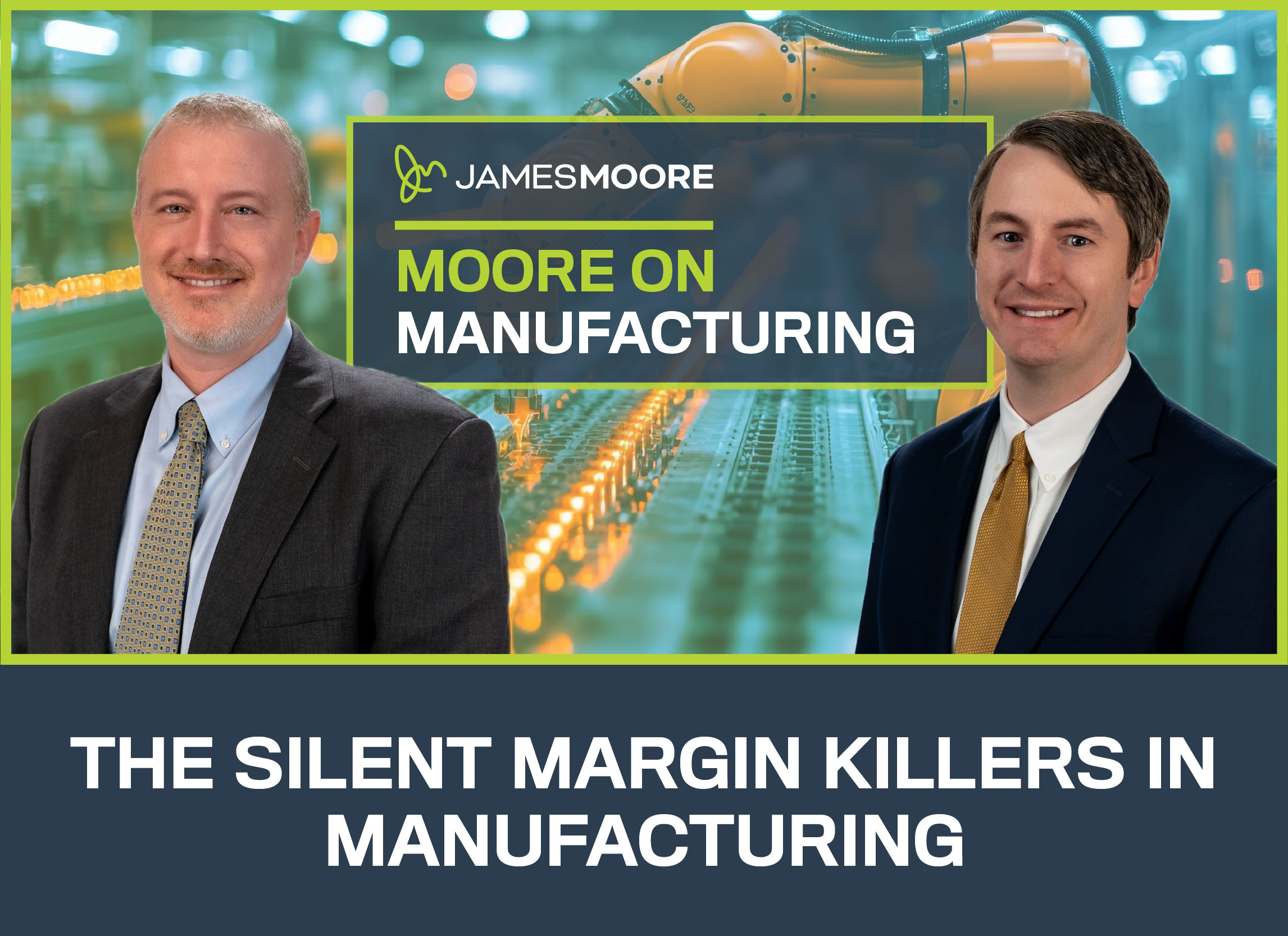
Understanding Manufacturing Profitability with Mike Sibley and Kevin Golden
Originally published on January 6, 2026
“If you’ve got maybe a lot of scrap, excess scrap, maybe inefficiencies there, maybe a lot of downtime, eventually it’ll show up somewhere, shape or form on those financials. But either A, it’s too late, or B, it tells just a symptom and not the root cause of really what’s going on.” – Kevin Golden
Subscribe to Moore on Manufacturing
In this episode of Moore on Manufacturing, Mike Sibley and Kevin Golden explore why your profit and loss statement doesn’t tell the whole story about your manufacturing business. They discuss the critical KPIs manufacturers should track, how to identify hidden costs and practical steps to connect operational metrics with financial outcomes for improved profitability.
Full Episode Transcript
[00:00:00] Mike Sibley: Happy New Year everyone. I’m Mike Sibley, partner at James Moore and Company and leader of our manufacturing group.
[00:00:06] Kevin Golden: Hey, I’m Kevin Golden, partner at James Moore and a member of the manufacturing group as well.
[00:00:12] Mike Sibley: All right, so as we kick off the new year here, Kevin and I are excited to talk about this topic of profitability beyond the P&L. But before we get into that though, I do want to suggest that if there are topics that you would love to hear from us, ideas, other things that you’d love for us to cover in these videos, please send us a message, comment on the video and we’d be happy to look at it and see if either us ourselves or maybe even a guest that we have can help cover those topics for you.
So kind of jumping into today’s topic, this is something that actually we see a lot with manufacturers. [00:01:00] They have an income statement, a P&L. It tells them what their profitability is. They can see what their margins are. But a lot of times the P&L can be not telling the whole story or not telling you why something is the way it is.
And so you have to drive to a level deeper. And so today we’re going to talk about a little bit why the P&L is in and of itself not the whole story, but also what are the things you should be looking at, how you should be connecting that to the P&L and how taking this different approach can really add value to your business. Find those missing costs, understand your pricing mechanisms and hopefully allow you to drive a more profitable business. Great topic. It’s an issue that we see with a lot of manufacturers and I think there’s a lot of potential value here. So Kevin, let’s jump into it. Let’s talk about the P&L first. [00:02:00] It tells us our profitability, but is that really enough? And why is it that it’s not enough?
[00:02:07] Kevin Golden: Yeah, you hit the nail on the head, Mike. It definitely is not enough. I mean, there’s the old running joke, accountants, financial people, whoever, they’re always behind. Why? Because they’re always looking at what’s happened, what has happened. And that’s exactly what a P&L or a set of financials is going to tell you what has happened. Right, and those may be indicators, but they’re not root causes of what’s going on. So somebody may say, well, how am I doing? Well, look at my P&L. It shows I’m doing really well. Okay. That could be over that time period, maybe, right? Then you’re doing well, but is that sustainable? Maybe you’re not doing well. Is that a timing issue or is there other underlying root causes?
So it’s, I guess it’s kind of like going to the doctor and saying, well, hey, it hurts here. Okay. Well, I mean, is that because you just ran into a table or something? Or did somebody poke you really hard and that just hurts right now? Or do you have something going on underneath there that we need to [00:03:00] take an X-ray and look at? Did you break something, did something happen? What’s been going on? And you do a little bit more of that. So I think some people need to, a lot of people need to remember that financial statements, specifically the P&L profit and loss statement, is a tool, but that’s what it is. It can provide a lot of value. We’ve talked about it many times on this show, but again, it’s going to show what’s happened, not necessarily why that’s happened or what those root causes are.
So if you’ve got maybe a lot of scrap, excess scrap, maybe inefficiencies there, maybe a lot of downtime, eventually it’ll show up somewhere, shape or form on those financials. But either A, it’s too late, or B, it tells just a symptom and not the root cause of really what’s going on. How are we going to fix that? Again, maybe you think the bottom line looks okay, but maybe your margins aren’t where they need to be. Maybe your costs are creeping in. Again, those are just a couple of examples of [00:04:00] your P&L can show some of the symptoms of that, but not the root cause. Right?
So again, it’s just not enough for you to really in real time make real decisions about am I pricing correctly? Do I understand all my costs and how those affect, maybe we talk a lot about wanting to transition out at some point, wanting to sell my company. If I don’t understand that myself, how am I going to explain that to someone else? How am I going to explain to them what truly is or isn’t working at my company? Right? So again, all those reasons, and I know we’ll dig into a lot more of the specifics, but all those reasons are why you can’t just look at your financials or your P&L and just say, here’s how I’m doing. You may be doing okay, but you may not be, or there may be opportunity, maybe you’re doing well, but there’s opportunity to do better, right? And that’s really where you’re going to make a real difference and see a real difference is in getting down to those root causes that simply a P&L is too surface level of a report and it’s historical.
[00:05:00] Mike Sibley: I actually got a great story that I think demonstrates your point on this really well. And this was years and years ago, but we had a situation with a client where over the course of a couple of months, we could see some deteriorating margins and it was unclear as to what was happening. You know, one month, okay, it’s down. Two months, okay, well now we’re starting to see a trend and you get into month three, starting to get real concerned. But there was no indicators anywhere else within the P&L, no real indicators, nothing that was really necessarily in and of itself saying, hey, this is what’s happening.
So as I started digging into it a lot more, I really was trying to understand what’s happening because none of our production managers were really saying anything, you know, at least top level. And I started looking at trending and said, oh gosh, our [00:06:00] trash bill is going up and the trash was based on weight. So the trash bill that we got was based on weight, and I looked at the trash bills and the weight was going way up over the course of a couple of months. And so I got with the CEO, he went and talked. Oh yeah, we’ve been throwing out a lot more of these molds because we were having this problem.
So basically they were having a production problem and they weren’t tracking the scrap and the trash in a way. They weren’t connecting thakevint piece to what it meant financially. And so we started seeing these little drips and it was ever so slight, but it was still a little drip that we couldn’t tell. It wasn’t until I started digging in and understanding our trash bill. Our scrap rates were going way up and they didn’t have a very good way of tracking that and then connecting it to what it meant to margins. So you know, that’s where the P&L again, it was ever so slight. But because we paid attention to those slight changes, the P&L just didn’t tell us anything. It just told us that something [00:07:00] was not as good as it was, but it didn’t tell us where or why without digging in deeper.
[00:07:06] Kevin Golden: Yeah, and I think in there, I don’t want to water down your financials or your profit and loss, those are still important. Again, by themselves, they’re not going to tell the whole picture. So like your example, you may have never noticed that, especially if it’s ever so slight. It wasn’t until you looked at other KPIs, reports, variances, whatever it may be, that then said, oh wow, we do have a problem here. Hey, we can make this better. Hey, we can kind of stop this and increase or improve our margins to where we expected them to be by knowing where to look, right? And so again, it’s still important. Just don’t let that be the answer. Let it be part of what you look at, part of what you focus on, not all of what you focus on. And so, Mike, I think that’s a great example of some KPIs. There are other KPIs that either with that client or someone else that you look a lot at [00:08:00] you’re looking at in coordination with financials or other operational reports.
[00:08:05] Mike Sibley: Yeah, and so manufacturers are kings of KPIs. They’ve got KPIs that seem forever, actually. A lot do, some don’t. And of course I’m going to start out by saying I’m a big fan of KPIs, but the right KPIs, because you can’t manage what you’re not measuring. And there’s a lot of different focal points for manufacturers and identifying the right KPIs is really important. Because you can get all sorts of noise with KPIs if you get a lot of KPIs and some of them may not matter, but let’s focus on the ones that do matter. And you know, I’ll talk about a few that I find very interesting because I think they tell something and so when we talk about what are the major costs for a manufacturer in cost of goods sold. We’re normally talking about direct labor, [00:09:00] we’re talking about material costs and we’re talking about overhead. Okay. So those three are the general, and of course there’s a lot within that of course. But you know, those are the major areas. So you know, let’s start with labor as something that you know, as a KPI.
And so one of the things I like to try to get to is labor utilization and you know, how much of my direct labor personnel are, how much of their hours are focused on true production and how much of it is downtime? Understanding now, nobody’s going to be at a hundred percent. I’ve never seen a hundred percent. You might be at 95% utilization, 90 or even 85. Let’s use 85 as maybe a starting point for a good benchmark, because you’re going to have you know, lunches or you’re going to have some training or you’re going to have some cleanup time, set up, some other things like that. But you know, so let’s use that idea as an 85%.
One of the things that I see [00:10:00] happen is there are often peaks and valleys in a manufacturing cycle. So when it’s really busy, people get work done faster. When it’s not so busy, all of a sudden you might see the same product take a little longer to get made. And I’m a big believer in the idea of work expands to the time available. So when there’s less time, so watching your labor utilization and then seeing, okay, my labor utilization’s 85%, but my productive output, the amount I’m producing is lower than what it was. So the number of widgets or whatever my product is, so my labor utilization looks a little bizarre right now, and then all of a sudden you notice your margin’s creeping down a little bit.
On the other hand, you know, if you do have cycles or you do notice that your labor utilization is more like say 70%, you might be [00:11:00] overstaffed. You might have one or two people overstaffed, and then when you mix that into this entire piece over time, now you could be looking at real inefficiencies in your process and where is that happening and why is that happening? So labor utilization and labor effectiveness and overtime are a couple of KPIs that I think are really important to measure. So you can understand your efficiency as it relates to labor. So that’s one big thing. You know, we’ve already talked about scrap and waste and rework. Those are really important because you know, it costs a lot of money. If your scrap rates are really high, why are they really high? Are we seeing material issues come in from our suppliers? So if we have issues coming in, it’s a supplier issue, now we’ve got a supply chain management issue that’s affecting our margins.
Or maybe we’ve got, you know, so maybe our training mechanisms for new people coming in [00:12:00] are not solid. And so now we’re seeing, we see more rework or we see more scrap. So understanding that can have an impact and measuring that over time. You know, of course you’ve got throughput. You know, where are there bottlenecks? Machine time. There’s a lot of things. Lead time, you know, we can go on and on and on about this stuff. And then I think looking at our overhead rates and looking at our overhead and understanding fixed versus variable overhead, you know, a lot of manufacturers have substantially fixed overhead.
And so that means how are you leveraging that overhead and what happens when your production time goes down? But truly understanding what drives overhead, because again, you might be able to manage it better. You might be able to say, okay, in this timeframe, because I’ve got cycles, I might be willing to leverage my margins down a little bit. Or if I know next year that when my rent is going up and my insurance is going up, I’ve got to consider that as part [00:13:00] of my pricing because all too often, you know, the pricing is lagging too much behind all of these different factors. So there’s a lot of different things that you need to measure in that side of things.
[00:13:10] Kevin Golden: I like, I was thinking while you’re saying all that, I’m like, golly, there’s just so much data and as things like technology continue to get better and increase, there’s just going to be that much more available, readily available, regardless of your size as available to you. So you could make this as complicated as you really wanted it to be with all the information thrown at you all the time.
[00:13:33] Mike Sibley: Right.
[00:13:34] Kevin Golden: I think the other thing to keep in mind is, well, I mean, Mike, you gave some of your more common or favorite KPIs to look at. But I think for a manufacturer just listening, what is this going to tell me? And what kind of action is that going to elicit out of it? So for example, in the labor effectiveness, what is that going to tell me? Oh, are my people being utilized [00:14:00] in an effective way? Are we utilizing most of their hours for actually producing? Okay. If we’re not, what am I going to do? I can change how they work. Maybe it even spurs conversations that you have with your workforce, because a lot of times they know where the issues are that you may not see because you’re not there day-to-day working on that and they are.
So it may not give you the clear picture, but it will help you start to ask the right questions. Well, why is that that way, well, why are we doing it that way? I think another one we’ve run into or I’ve talked with a manufacturer, is it had to do with changeover between shifts when they talked with it, it was as simple as if we pushed it back just 15 or 20 minutes in between shifts, there was a lot less downtime. That all started by looking at the right KPI to say, hey, these people aren’t being as effective. Had nothing to do with the work ethic, had nothing to do with they didn’t want to or they’re taking too long. Everything to do with just [00:15:00] organizational and process of when one shift’s coming in, when another one’s leaving and what that changeover looks like. Next thing you know, shaving all 15 minutes in between there had a ripple effect that exponentially helped them improve their margins and their bottom line. Right? So again…
[00:15:16] Mike Sibley: You know, I got another great story, Kevin, you reminded me. So you know, I’ve got a client where we have a once a month, we focus on gross profit and how we can improve that. And we look at a lot. We look at KPIs, we look at a lot of different factors and trying to make sure we’re driving improvement in gross profit. And through those conversations, you know, going back to labor utilization, we measure our non-productive labor. And actually the shift changeover was taking a really long time, and they were able to reduce that substantially. And it led to six figure savings in [00:16:00] labor costs because we were measuring it. Because, you know, our focus with that client is making sure the management team and department teams understand how what they do connects to the financial statements and margins. So we’re measuring something that’s meaningful and has an impact on the financials. So we’ve connected those dots and so they were able to take that and say, okay, how can we do better here? And we saw substantial improvement in our non-productive labor time and that changeover because what did it do? They were able to increase it and shift that to production. And so they’re producing more, so now our throughput has increased.
[00:16:38] Kevin Golden: Yeah, so I think the takeaway there on those KPIs is just there’s a lot you could measure. Look at what’s driving, what’s going to make the biggest, start with what’s going to make the biggest impact.
[00:16:48] Mike Sibley: Mm-hmm.
[00:16:49] Kevin Golden: Right? If labor’s driving great, we should be looking at labor effectiveness. We should look at what are the kind of biggest drivers. Because if it’s not providing value, there’s no point in tracking it. If it’s not going to elicit a response, you’re not going to do anything. Why are you trying, why are you wasting your time and efforts to do that? But [00:17:00] it’s going to help you make better decisions. So ask yourself the question of what is this going to provide me with and what am I going to do with it? Once I know that, a lot of times that’ll help you with, well, these are the metrics that I should focus on, and those may change over time or they may expand as, okay, now we’ve solved some of the bigger issues. Let’s look on, let’s continue improving, making that better. So keep that in mind too, that you need, if you’ve maybe used the same KPIs, you know, year over year and you’re like, well, hey, I think we’ve about solved it all. Maybe there’s some other ones that we’re not, you know, that maybe we start focused on to kind of drill down a little bit more there. So, but next topic we want to kind of talk about is costing, job costing, right? So you kind of hit on this by you know, looking at some of the costs and all that can sneak up on you, right? And some blind spots people can have first of all, just being aware of what your costs are. I mean, I think of this like Shark Tank. You go into Shark Tank and they’re like, okay, well how much does it take to produce that? And if you don’t know your costs like that, [00:18:00] or at least appear that you know them, you’re thrown out the door. Right? Because they can’t do anything with that. Right. Same thing for you as a business owner, as a manufacturer, you’ve got to understand, I just had a conversation with one actually this morning about that very item. They know the low hanging fruit, my raw materials and all that. But they don’t know all those other, how much labor does it take to produce that? How much overhead and other things does it take? They know that that goes in there, but they don’t understand that fully to fully understand that you don’t know, do we have a problem or do we not?
So I think it first starts with just understanding what those costs are before you get into, well, hey, am I pricing my product correctly? Or are there other overhead items that I just need to, maybe I’m over-leveraged. I need to buckle down on labor or whatever it may be to improve that. So first of all, start there. But beyond that is then once you’ve kind of got that figured out and you’re in tune with what those costs are is then comparing it, maybe a budget versus actual or what we will call variances, right? Okay, well I expect to make a profit margin of X on this product, or I knew [00:19:00] I had this amount to be ordered and delivered, you know, for a client during this month, I should, that should produce a certain profit margin. Now I’ve got Y. Is there a difference? There’s always going to be a difference. Now how much is that? Is that material? Yes, it is. Why is there a difference? Right. So I think looking at those variances on a very regular basis and help you start identifying like you did with the waste and so forth, will help you start at least asking the right questions. Okay, well, why is that? And when you think you’ve got that fixed, do it again and then do it again and do it again until you get a repeatable solution or repeatable answer that you were looking for and it’s more in line with the expectations. Now move to the next. So…
[00:19:45] Mike Sibley: Well, you know, Kevin, this is, you know, you’re highlighting, you know, kind of the pros and the cons of ERP systems and manufacturing ERP systems, [00:20:00] you know, is a lot of times this data gets loaded up, standard costs and all this stuff, and so many times I look at a P&L and we’ve got all these variances and the numbers are big, and you ask, what is that? How are you managing that? And a lot of times nobody even understands what those variances are telling them or what does it mean if it’s negative or positive or whatever the case might be. And you know, they’re just having the system, having the system go and you know, they, so I don’t know why our profitability isn’t so much better. I don’t know this, I don’t know why my profitability is good, but I have no cash. Or they, you know, they’re not connecting those dots. And I live in the variances and as part of what what I do and what we do is those variances are so meaningful and so it’s really worth [00:21:00] diving into understanding what those things are telling you, because they’re good or bad, it’s telling you something, and those are your red flags. When you see variances in your cost, in your P&L, those are red flags that you have to go after.
[00:21:14] Kevin Golden: Yeah, I mean, it is, sometimes I probably oversimplify a little bit to it, but if you were getting paid and someone says, great, I’m going to pay you, you know, $5,000 a month to do X, Y or Z job, and all of a sudden they send you a paycheck for 4,000, that’s a variance. You’re going to look at that and be like, what the heck? What is this? You shortchanged me by 20%. What’s up with that? I know it sounds silly a little bit because we’re talking about your paycheck, but your business is the same way. That’s your money, that’s your time, that’s your people, that’s your product. You should see the same thing. You know, hey, there’s a difference there. Even if it’s a good difference. And I think that’s overlooked as well. Sometimes people think, oh, well, it’s more than what I thought. Great. Well, okay, did we just budget too low? Are we, [00:22:00] you know, are we somehow, is our reporting incorrect? Are we, are we sure we’re pulling the right numbers in? Things like that. So I think again, understanding it doesn’t mean there’s always negative is bad, positive is good or vice versa. It just means do you understand what’s going on there? And the more in tune you are with that, you’re going to make better decisions, especially about the future. And you’re going to be able to make better, and the more you look at it, you’re going to make better decisions in real time.
So again, I think going back to, you know, kind of a cost standpoint, also got, I mean, a lot of things, especially ever since COVID, during COVID and since then has always been materials and pricing and the volatility that exists. Right? And as pricing continues to go up, we see it in our everyday purchases. Definitely see it in our supply chains and the products we purchase and consume. Again, sometimes people think I’m not making the profit margin I want, maybe I should just increase price. Well, maybe that is increasing price. Maybe it’s not. You don’t know until you measure it. Right? [00:23:00] Maybe it’s that slow trickle that’s just increasing a little bit that you’re like, okay, yeah, that’s not a big deal. Until you, until it is until now, it’s been such a big increase and you haven’t kept up with that to where now having to go to your clients and your customers and say, great, I need to hit you with a 20, 30% increase because this slow trickle’s been affecting as opposed to a more normal increase, a little bit to keep up with material pricing now is going to be a lot harder ask of your client.
[00:23:30] Mike Sibley: Well, and I’ll tell you what, so what we’ve been doing recently is we’re creating automated tracking mechanism for pricing changes to track that. And you know, I want to step back and say, you know, we’re a big fan. We implement dashboards as part of the process is that as we get into clients, when we work on dashboarding and you know, creating the most important dashboards that are right at your fingertips and [00:24:00] provide meaningful data, you know, and so it’s really important. And one of those pieces is the material prices, because oftentimes and I’m so glad you brought this up. Because oftentimes material prices will have minor fluctuations over time, and it’s really, you know, oftentimes they have so many different raw materials they’re managing. You may not have a good system for maybe updating that or approving it before it happens. Before you know it, your margins are being slightly eroded a little bit over time and it’s hard to understand why, which is why we’re creating, you know, some automated systems. It’s often really difficult for manufacturers to just increase their price every month or, you know, and so, you know, but giving that data is really important because now you get back to, we can do a whole session on supply chain, but do we need to go talk to our suppliers? How do we push back on that? How do we control that a little bit more? [00:25:00] You know, so using these methods and a lot of times, you know, ERP systems and other things are not set up in a way to give you these red flags, and so you’ve got to create other mechanisms to track the things that are most important to you.
[00:25:12] Kevin Golden: Yeah, and I think the last part, I mean, there’s a lot more we could go, but I think the last part on costing at least is again, when I said being in tune with your cost, it’s not just what it takes you to make material, but it’s all that overhead as well. Because you may be right where you are. Hey, yeah, I know what I make on that and I know what, but if we’re not taking into account all our other overhead, whether it’s overhead that’s indirectly involved in the production or just general and administrative overhead, we’re not going to net out where we want to be. You know, maybe fun at tax time whenever you don’t have a lot of profit at the bottom to worry about.
[00:25:47] Mike Sibley: Right.
[00:25:48] Kevin Golden: It’s not fun whenever your cash flow’s running thin. It’s not fun when you’re trying to build a company that then you’re relying upon that for your retirement or for future [00:26:00] generations and their jobs and their security. So again, a lot of times people will, they get too focused on just the direct costs and so forth and am I making enough on that? Yes, I am. They forget about all those other indirect costs that a lot of times are impacting what they’re making and how much they’re making on it, but then also are just impacting the bottom line so they don’t have enough leftover to really absorb that and come out with a net, you know, a net bottom line that makes sense, that is profitable, that helps them grow. So that’s another thing is just, again, it’s all your costs, how they impact you both as a company and your growth and your goals, but then operationally on the floor where you see those, all those costs, [00:27:00] shown through your production process and through your overhead and so forth. So all those items are ones that I think kind of, those are some of the most common ones that kind of sneak up on people or costs that, yeah, I know they exist. If you told me, yeah, I have overhead. But are we taking into account when we’re looking at the viability of our pricing, when we’re looking at our profit, when we’re looking at why are we having issues like cash flow and so forth? So…
[00:27:26] Mike Sibley: Right. So, you know, when you talk about cash flow, let’s jump into that for a minute. You know, we’ve got a couple topics we want to cover here, so I’ll try to, you know, so cash flow, you know, it’s not uncommon to say, hey, I’ve made a good profit, but I have no cash. And why is that? And you know, so building metrics around understanding working capital is really important. And where is my working capital? So, you know, working capital is basically, you know, if you take your cash or accounts receivable, your inventory, maybe some other current assets and minus out your payables and some accrued expenses, that leaves you with a number of what your working capital is.
And generally you want it to be higher than one. One is like maybe a [00:28:00] one-to-one ratio is maybe a C at best. You want it much higher than that because that’s your ability to liquidate liabilities based on that. So, but it’s also working capital is also your ability to fund future growth. And sometimes you have to supplement that with a line of credit. But you know what I see all too often hidden within working capital is a lot of inventory or buildup of inventory or lack of management around inventory levels. And that inventory is cash that’s sitting on a shelf. That’s basically non-usable, especially if it goes slow moving, if it’s obsolete.
But the other piece that’s missing is carrying costs. So if you’re carrying excess inventory, you’ve got, the carrying costs are around and you can Google this, 20 to 30% often of the inventory. So if you’ve got a hundred thousand dollars of excess inventory, you got $20,000 of carrying costs. Well, what does that mean? Well, we’ve got warehouse space. We’re using people that are moving it around. They’re counting it. [00:29:00] You may have interest on a line of credit, you know, all these different things. So really understanding your inventory movement. Again, this comes back to good dashboarding, being able to track your inventory, what’s moving, what’s not moving.
The other piece is your receivables. And do you have a really good collection process? I like to have a very, you know, my clients have a weekly call around cash and where is it going? Why is it going? And what’s happening in our receivables? Who’s late? Why aren’t they paying? How do we get that paid quicker? There’s a lot of, and so if your cash conversion cycle is slow, you can be incurring a lot of extra interest costs. And a lot of times companies are like, oh, my EBITDA is good. My EBITDA is good. Well, EBITDA is good, but in EBITDA is an add back for interest. And if you’re paying a lot of interest because you’re highly leveraged because your working capital really struggles, that’s cash that’s going out the door. So there’s more pieces there. So EBITDA isn’t necessarily the be all, end all when you start breaking it down like [00:30:00] that.
[00:30:01] Kevin Golden: Well, and even there, Mike, I mean it goes back to what we said at the very beginning. The P&L is not everything. Right. It is a tool. It can tell us some things, but it’s not everything. Because it’s not going to see where it’s tied up in inventory. It’s not going to show where it’s tied up in debt payments and so forth. Right. Those kind of things that definitely you feel it because you know, cash is out there. It’s not sitting in the bank account. But you don’t necessarily see it just by looking at a P&L, right? You may see parts of it or little bits and pieces, but you’re not going to see the whole picture. Also, I like to think of during COVID, whether you were, whether you were doing a good job at tracking your cash flow, everyone became at least a step above where they were in cash flow management. Why? Because you had to. Every penny, every dollar you had, especially if you were one of the businesses that were more affected, either through the supply chain issues or shut down or you lived in an area that maybe they’re just, people are locked in their homes. You had to be, because every dollar needed to be spent most wisely, [00:31:00] otherwise you may be out of business. You may have not made it through. Well, I think that’s an extreme example, but I think you take that example to each and every day that then prepares you for the next, hopefully not COVID, but something like that. Maybe your company or your industry’s just going through a slower point. Being in tune with that will help us know, well, how prepared am I for that? How could I make it through that? What decisions would I have to make? Knowing where your cash is coming and going and being in tune with that is going to help you make those decisions better. Or as I like to also look at, predict am I going to be a little thinner? Where am I going to be a little fatter when it comes to cash, so then I can make decisions. It’s kind of like the squirrel who, you know, buries a lot of nuts for the winter. Same kind of thing. How can I be prepared for that so I make good decisions about that cash, even in the good times, whenever it’s a little more flush. Right. And then also think about, and again, I like thinking about all these values. Because I mean, why would I want to look at this? Why is this important? Another one is when someone else is looking at you. You go to that bank and you’re like, hey, [00:32:00] I’m trying to grow. I want to get that line of credit, showing that, good cash flows, being able to explain that, showing how your process works, how when you order inventory and why you order the quantities you do and how you do that. Showing a good working capital in your financials gives the bank a lot of confidence in saying, oh yeah, we’ll do this, you are easily generating the cash needed to pay us back because that’s all they care about. It’s, can you generate enough cash to pay them back? Things like that. Any third party really looking at you for any reason. Those are the kind of things that would give them a lot of assurances on what they want to see. Whether you’re trying to sell your company, trying to get a line of credit or note, something like that to help you grow. All those reasons are great reasons to be looking at, focus on working capital and cash flow, which incorporates all those things, you know, Mike, you were talking about. So, I know we’re getting a little long here, a little close to our time, but we’ve talked about a lot so far. And again, a lot of this goes [00:33:00] centers around connecting financials, what you see in the numbers, what you see in the bank account, what you see on your inventory system and your KPIs and all these things we’ve talked about with what you experience and live through each and every day in your manufacturing company, right?
So I think some of the takeaways we can have so far of this is one, make sure that, well, a, always make sure your financial data is accurate and being updated accurately. Because without that, that’s your foundation. Everything else is just blown. Two, make sure you’re having regular conversations about it with a finance or operation team. Those key members, whoever that may be in your organization about this, right? And make sure, because again, if you don’t track it, if you don’t talk about it, nothing’s going to change. Make sure you are, to your point, you said you love dashboards. Make sure you’re creating, figuring out what are those critical KPIs and tracking them. And then over time, are those still as critical today as they were yesterday or is there something else that maybe has surfaced that I need to be tracking as [00:34:00] well? Right. Be looking at those variances. Right. If you have an ERP system, make sure you’re implementing it. Because they can do a lot of these things, but a lot of people don’t understand it to best utilize it. Right. And then even more importantly, train the people around you, the people who have a difference, to make a difference in your organization from on the floor to your financial people upstairs. Make sure everyone’s in tune with what do I do, how can I do it better and how does it impact how well the company does, how well we do profitably, how we meet our goals, how do we grow, how do we excel? What does that mean to them and to the company? And connecting those two, I think, will help people see that bigger picture and then start taking better ownership of, hey, I can really make a difference here, and here’s how. So…
[00:34:51] Mike Sibley: Yeah. You know, let’s talk about what steps can be taken and I, I’m [00:35:00] always full of stories, so, you know, to some of that. But, you know, I had a client a couple years ago, we got involved in our fractional CFO role. And one of the things I asked for first was a product profitability report. And the product profitability report, well, I mean, really it’s a great thing to have if you can produce it. Because it tells you by product, you know, what are my margins? And, you know, oftentimes, you know, you’ll see owners, hey, you know, I get margins of this, yet their financial statements show margins of that. And so that means there’s a disconnect.
So I got their product profitability report, their margin report, and it basically showed like 54% margins. I looked at the financial statements and the financial statements showed, you know, mid thirties on the margins. That meant there’s a huge disconnect between what they thought they were getting versus what was actually hitting the P&L. And the P&L was fairly accurate. I mean, we had to make some changes and stuff, but [00:36:00] ultimately the margins were in the high 30% range, which means we had a disconnect. So we had to start digging in as to why. And we did start identifying why and started making improvements and we saw their margins going up. And so, you know, that’s taking data from one system and saying, does this connect to my financial statements? So with these critical KPIs, one of the first steps that you can take is take the KPIs and draw a line to, does this agree? Am I seeing something in the financial statements and the P&L? And I would trend this P&L. You look at your KPIs weekly, monthly, look at your finances, trend out your financials and draw that line to the financials. Say, what happens when this KPI goes up or down? Am I seeing something in the financials? And if you’re not, I’ve got to start questioning that KPI or maybe how you’re tracking the data in your financials. It may not be what you think. You know, another step and I mentioned this gross profit [00:37:00] team we have at one client. And the first place we started when we got that team together was we started with identifying our lowest margin jobs and asking why they were so low margin.
[00:37:11] Kevin Golden: Right.
[00:37:12] Mike Sibley: Was it a material issue? Was it a pricing issue? Was it a labor efficiency issue? But we really dug in and started understanding those so we could improve our margins on those products or whether we should even be manufacturing those products at all. And maybe we got distracted. Maybe it’s not something that’s in our core competencies, but understanding that why on those margins is really important. And so, you know, beyond that, you know, so you can take that as one of the big steps. Understand your inventory, your at risk inventory, your inventory turns, your working capital. You know, those basic KPIs. I’m a real big fan of really making sure we got a good baseline for what matters and then start measuring those things. And then slowly over time, we want to really understand our overhead rates [00:38:00] and really make sure we’re building a proper overhead analysis so we can track that over time. You know, and so I guess stepping back into it and making sure that we take a look at our ERP systems, we look at those variances and I can’t stress this enough, but I think setting up a good dashboard that is simple and effective and connects to our financials is a great way to start managing a lot better and you’ll be able to drive change that’s meaningful in business. And if you can’t drive that change, understand why you’re not able to drive that change. What is happening? You know, if we made some decisions, is this, is this maybe this product just tough to get margins on? Should we be doing that? You know, there’s a lot of reasons that can come down, but, you know, I think by simplifying the data, [00:39:00] identifying what matters in our business, and that can expand over time. You don’t have to start with 30 KPIs, start with five to 10 of the most important ones and see how they’re connecting to your financial statements. And then I think you go from there. And of course, over time we really refine our ERP systems and other processes to really improve our margins and our profitability.
[00:39:24] Kevin Golden: And I like what you said near the end there, Mike. There’s a lot we could talk about. There’s a lot, you know, depending on the manufacturer and what you do and how big you are, this gets super complicated very quickly, but at the same time, that’s not where you have to start. Just start with, if you’re not measuring, be measuring. I mean, just start there, right? Pick one or two of them, right? Start measuring those, saying, hey, are we tracking this? Or how are we tracking that? How are we performing here? You’re better than where you were yesterday. So start somewhere. And then as you do this, as you start tracking, again, it’s kind of like a snowball, right? You’re going to start saying, well, why is that that way? Oh, well that leads to here. Oh, okay, well let’s change that. Okay, well [00:40:00] now that points out an issue that you had here. Okay, well let’s work on that. Now we fix that. Now it points out another, so and sometimes it’s almost too much at once. So you have to take a step back and, okay, well, where should we really focus? Where’s going to make the biggest impact? What has the biggest impact on keeping us from what our goals are, either financially or otherwise? Right. So if anything, you’re going to have plenty of things that are going to come out of that, and you just need to, and that’s where having the team is good to help focus on, here’s what’s important today versus tomorrow, right? So, but just start somewhere I think is important. If you’re not. And if you are just continue working on that and asking that why that leads to better and better improvement. And then of course, you know, be looking at how you’re doing that, how you did that yesterday may not make sense. Maybe it’s time. Maybe you need something like an ERP. Maybe you need something like a dashboard that can do, give you this information in more real time or more accurately or more quickly. So [00:41:00] whatever you’re doing, there’s always room for improvement. Whether you’re at the most basic level or the most complicated of manufacturer, the important thing is that you’re doing something so…
[00:41:09] Mike Sibley: Absolutely. So with that, you know, that’s, there’s a lot in this episode. I think, you know, I think we boil it down to a few simple steps and, you know, to Kevin’s point, not every manufacturer’s a little different, but the core concepts remain the same on how to get started. So as we said at the beginning, you know, we’re always open. If there’s a topic you want to hear that we could cover for you, just let us know. And once again, happy New Year. Really enjoyed the conversation today. And as always, feel free to reach out with questions or if you need help, reach out to us.
Want to dive deeper into manufacturing profitability strategies? Connect with Mike Sibley and Kevin Golden at James Moore & Company to discuss how you can implement these practices in your business.