Human Capital in a Machine World: Balancing Tech and Talent in Manufacturing
Originally published on February 5, 2026
“The people who know the job the best are the ones that are on the shop floor, not the ones sitting behind a desk.” — Julie Kniseley, President, James Moore HR Solutions
Subscribe to Moore on Manufacturing
Contact our Manufacturing Team
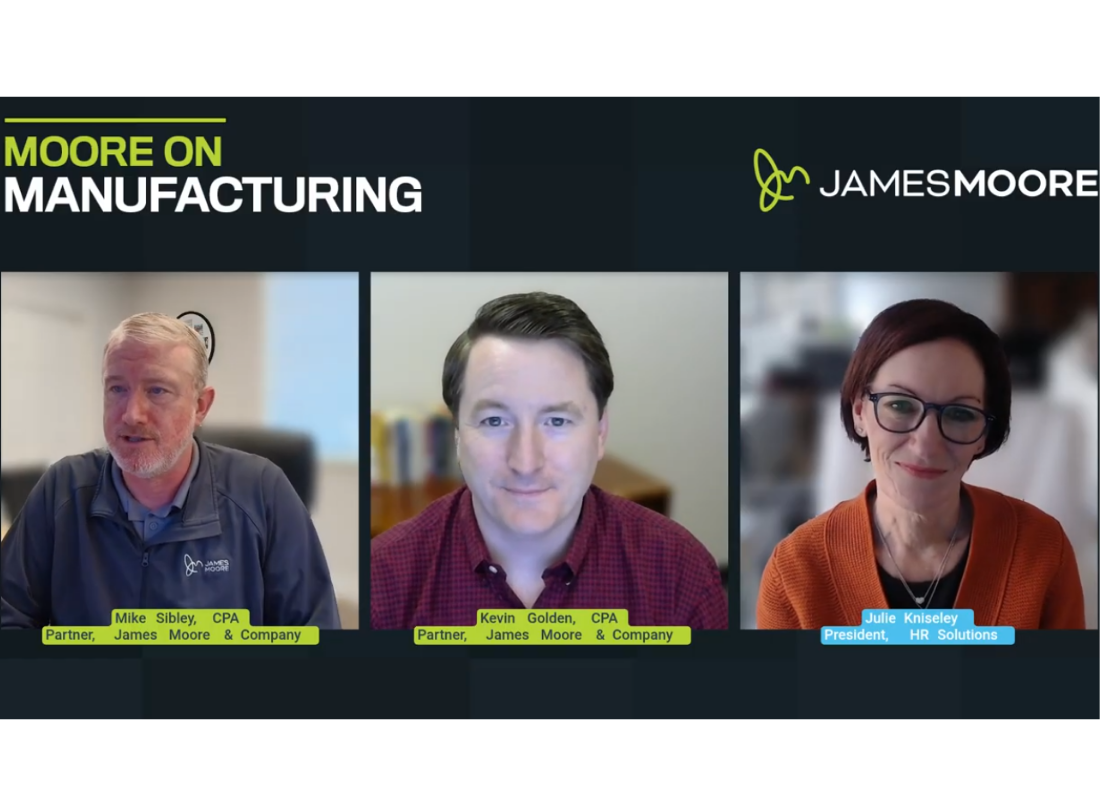
As automation, AI and advanced technologies continue to reshape manufacturing, organizations face a critical challenge: how do you adopt new technology without losing the people who make your business run? In this episode of Moore on Manufacturing, hosts Mike Sibley and Kevin Golden sit down with Julie Kniseley, President of James Moore HR Solutions, to discuss workforce development, retention and building a culture where tech and talent work together.
Resources
- James Moore HR Solutions
- Moore on Manufacturing Episode Archive
- Manufacturing Services at James Moore
Full Transcript
[00:01] Mike Sibley: Hi, I’m Mike Sibley, partner at James Moore Company and leader of our manufacturing team. I’m joined today by Kevin Golden, one of my partners and also member of our manufacturing team. And today we are excited to welcome our guest, Julie Kniseley. Julie is the president of James Moore HR Solutions where she works closely with manufacturers to help them with workforce challenges including talent strategy, compliance, leadership development, culture, performance management, all things HR related as we try to build off this human capital and improve the human capital within our organizations. And in fact, today’s episode is titled Human Capital in a Machine World. So as automation, AI and other advanced technologies continue to change manufacturing, a lot of organizations are struggling to align the use of technology and the investments with the people strategy.
[00:57] Mike Sibley: We hear it more and more every day. So today we’re going to dig deeper into that, explore more about retention, training, culture and how manufacturers can successfully blend tech and talent. So Julie, welcome to the show. Glad to have you on and your expertise.
[01:13] Julie Kniseley: Thank you for the invitation. I appreciate it.
[01:15] Mike Sibley: Sure. So why don’t you before we jump too much into it, why don’t you tell us just a little bit about James Moore HR Solutions and your role and kind of how you’re working with clients in this area.
[01:26] Julie Kniseley: Well, you pretty much kind of covered it in the introduction. Anything that has to do with human capital and the people part of your business is what we help with. Whether it’s from a strategic standpoint and kind of looking at future state of where you’re trying to go and trying to help you to get there as a business or figuring out where are you at now based on some things that have happened in the past and put together a strategy on how to get you where you want to go. Different companies are at different evolutions. So we meet our clients where they’re living now and try to support them as best we can. Not so much on pushing paper. A lot of people think HR is paper pushing and that is certainly a part of it, but our focus is really on helping business owners and leaders be able to get the best out of the people that they have there and bring in the best people and hold on to them.
[02:17] Mike Sibley: Well, I think part of that is defining what does that mean, the best people. It depends on the position and depends on where you’re going. Is your business changing, not changing? And I think sometimes you come across that where it’s really even difficult to say what is bringing out the best.
[02:38] Julie Kniseley: Right. Well, I would take it a step backwards too and say that sometimes it’s defining what is the person that you need. A lot of companies unfortunately haven’t done a good job of identifying what type of person they need for a particular position, the right skills, what background that person needs to come with. And nowadays, there’s going to be less and less people to do a lot of jobs in the future. So if they don’t start all the way at that beginning and having a really good definition of what the ideal job is and what the ideal candidate is for that job, then it’s going to be a disaster from start to finish because you’re going to put the wrong person in the wrong role. They won’t succeed. Then you’ve spent a lot of time, money and effort and not gotten very far. So I always take it back to what skill set does this person need to have?
[03:22] Julie Kniseley: And one of the conversations that’s happening a lot more recently is, for a really long time it was all about college degrees. All about college degrees. You got to have a college degree. Well, now my first question is why? What are they getting with that degree? Now, we’re not talking about very highly technical positions and things that you need to be certified like CPAs obviously. But sometimes you need a college degree because you have been able to manage a schedule and achieve certain set of knowledge that you need in order to do these roles. But there’s a lot of roles out there that you don’t need that college education, that in-person and on-the-job experience is a lot more valuable.
[04:18] Julie Kniseley: So given that a lot of kids are now making decisions not to go to school and not to have that debt dragging them down for the next 30 years, a lot of them are making decisions to forego college and go straight into the workforce. So the workforce, especially manufacturing, construction, some of these things, awesome, great. So now you have to change how you train them. You need to make sure that you’re doing constant training. Automation is going to change everything about everybody’s job. How are you going to change the training that you’re currently doing? It can’t be one and done, one day and done. It’s got to be continuous because the technology is going to keep evolving so fast.
[04:56] Julie Kniseley: I was talking to somebody at a manufacturing client the other day and we were talking about AI in particular. We weren’t even talking about it three years ago, even two years ago. It was brand new and now you can hardly have a conversation without talking about the applicability of AI and a use case. So imagine where we’re going to be a year from now.
[05:15] Mike Sibley: Well, I think what that’s building into and what we’re hearing at clients and talking to clients about is building out these skills matrices based on department, service line, depending on how your structure of your business is set up. Really starting to look at these skills matrices. And I think on top of that, what’s really interesting is most people are trainable in a lot of ways. It’s just a matter of having the ability to create or the understanding and say what does that need to look like.
[05:47] Julie Kniseley: Right. Exactly. And adaptability. The amount of change that’s taking place in organizations now, it’s moving so fast that really those are the skills that in a lot of cases I would be looking for, that adaptability, ability to adjust to change because it’s not going to be stagnant. My dad was at the same company for 35 years. Job didn’t change all that much in 35 years. Now it’s evolving every six months. So if you are not one that can handle that kind of change and you’re very set in your ways, you’re going to struggle. So how can we make sure that we’re bringing in the right people that have that adaptability? And if they don’t, how do we teach them and communicate with them to become comfortable in that because that’s the way it’s going to be from now on.
[06:37] Kevin Golden: So Julie, just out of curiosity then from the workforce you’re seeing today. I know you just mentioned what it was like when your dad or other generations before us worked 30, 40 years at one place, but from what you’re seeing today of the people you speak with, the manufacturers you speak with and their employees, does all the automation, AI, all the change that stuff that’s new today that wasn’t there three years ago and will be in the months and years to come, are they excited about that? Are they optimistic? Are they excited about what that may afford them to do that’s not even defined maybe as of today or is that more of a cautiously optimistic or nervous about that?
[07:21] Julie Kniseley: I think it’s a little bit of all of the above and some of it is generational and some of it is just protectionism. People will feel threatened about their job. Well, is AI going to take over my job? And you can picture in your head friends and family that you have in certain jobs, can an AI take that over even if it’s 80%? That’s of course very scary to people. Others will be like, hey, you know what, AI can make my job a lot easier. It’s going to make me more efficient. It’s going to handle things that are more transactional that I don’t like doing anyway and allow me to do higher level work or be better at it. I won’t have to work overtime anymore because the AI is assisting me. And then of course there’s always the ones that always have to have the latest iPhone. They’re all in. Give me the faster the technology is coming in the better.
[08:10] Julie Kniseley: And the challenge for leadership is to be able to educate and communicate in a way that’s going to cover all three of those personality types and get the ones that are not comfortable with it comfortable while also satisfying that what’s next syndrome for those that are really into the technology. And I say it a billion times, you can’t overcommunicate. You can’t overcommunicate. You can’t just develop a new technology or use AI or bring in some kind of automation and then just pass it down and say, “Here, this is what we’re doing now.” You need to be bringing all three of those groups into the process, communicate with them, ask for their input and feedback because guess what? The people who know the job the best are the ones that are on the shop floor, not the ones sitting behind a desk.
[08:59] Julie Kniseley: If you don’t bring them in, then one, you could be misusing that technology and not developing it the correct way. And you’re not going to get the buy-in from the people that actually have to use this every day. Those are the experts. Your experts are the ones actually doing the job. And you do a real disservice if you don’t bring them into it and communicate right away with that.
[09:16] Julie Kniseley: It’s like back in the old days, you bring in a bunch of software developers to develop a software and then you roll it out and you start selling it. Come to find out it doesn’t work for the people that actually have to use it. That was a hard lesson for some companies to have learned when the software wasn’t right. It’s not usable because you had a bunch of technical people who are extremely smart who don’t actually have to do that job. Same thing applies when it comes to AI.
[09:50] Mike Sibley: Well, interestingly, when we talk about automation and AI though, different companies are adopting these at different rates. And automation, for example, that can mean a lot of different things. It can mean perhaps process improvements. But to some companies, it could be major investments in machinery and equipment. And you see the smaller manufacturers, they’re not necessarily automating at the same rate as maybe a billion-dollar company. And I’ve seen differences there. So you could substitute automation for process improvement, trying to do things better.
[10:27] Mike Sibley: And even the same thing with AI. We are actually doing AI training for clients and helping move them along faster. And what I see generally speaking in the manufacturing realm is they’re having a hard time understanding where to even bring that in. But they kind of know, hey, we need to be using it. People are hearing it. So it’s a little bit scary or anxious or not sure. But it’s still having a slow adoption. But I think people need to also expand the idea of what AI is. It’s not just ChatGPT or Claude or Gemini. There’s AI systems, plug-in systems, system AI that will do purchasing for you. It’s a whole system.
[11:14] Mike Sibley: So now you’ve got to start thinking about it in terms of how do I get people using this stuff and not afraid of it and upskilling in a way that allows them to use these tools that are not necessarily going to replace people right now. But what it may do is actually slow hiring in the future which is probably, to your point Julie, where there may be less workers available in the future with birth rates and retirements and those kind of things.
[11:45] Mike Sibley: So let’s kind of shift gears and say, okay, knowing that there’s a wide variety here, every company’s still got to be looking back at that skills matrix in the future and saying training, upskilling, these are big concerns. It could be training and cross-training now that we may be thinking we’re going to use technology to supplement. So from what you’re seeing, what do you see companies doing well and maybe some that are not doing so well in preparing and training in this environment?
[12:20] Julie Kniseley: Not spending enough time, money and effort on the training itself. There’s still kind of that philosophy that you train them on the way in and then they learn on the job. But are we doing them a disservice by not having that continuous improvement, that continuous communication, that feedback loop? It should not be one and done. And then once a year you give them a performance evaluation after a year and you tell them everything they’ve done wrong. That is way too late. That is way too late to tell somebody that they’re not doing the right thing.
[12:55] Julie Kniseley: We also need to make sure the trainers know how to train properly. So sometimes who you’re being trained by, you’re being trained by whoever is one step ahead of you. They might be a little bit more experienced or one level, but that doesn’t necessarily mean they have the skill set to be a trainer and to know how to do that. So we need to be training the trainers too. We need to make sure they know how to impart wisdom and pass down information. And some are better than others.
[13:30] Julie Kniseley: So I really think that companies should do and can do a much better job on the investment. And we’re not talking big dollars. I’m not saying they have to spend $50,000 per employee on training, but we need to spend the time and make sure that we’ve got the right people training the people so that you hold on to everybody you bring on the bus. Because if they’re not the right people on the bus, then you’re going to have this constant revolving door where people don’t work out and then you’re back to recruiting and you’re trying to bring in new people and then they don’t work out. And that is not only expensive but it will kill your culture.
[14:05] Mike Sibley: Yeah, I think that’s a good point. One thing I will say and I’m going to speak to the executive or leadership levels here in terms of training, I just had this conversation the other day. Learning AI for example, or learning how to incorporate it or researching automation or doing those things, unfortunately a lot of times that’s not 8 to 5. In other words, you’re so busy that oftentimes that’s what holds you back as an organization. I look at the skill sets I’ve built in building AI and using different tool sets. I didn’t learn that between the hours of 8 and 5. I take a little time at night, take a little time on the weekends.
[14:42] Mike Sibley: And the reason I bring it up for the leadership side of things is sometimes it does take that little extra effort, extra time because if you’re not finding that time between 8 and 5, I’m just using that as kind of the standard hours, which is hard to do with how busy things are, just taking that little extra. I know for me personally and what I do and with the manufacturers I work with, it has saved hours and hours and hours every week when applied properly. But it takes some time to dig in and just spend some time on yourself upskilling yourself. So I think that’s an important thing to understand.
[15:25] Julie Kniseley: It is and I would certainly encourage everybody and every employee to want to do that. Some will, some won’t. And you’re going to get challenged at times with some who may say, “If you want me to learn that skill and to be reskilled and it’s relevant to this job, then it should happen during my normal work hours.” And if you are not using that time as the leader, if you’re not saying, “Okay, we’re going to carve out,” again, we’re not talking hours and hours and days sitting in a classroom setting. Make it part of the culture to have a 30-minute training like every other day or every morning. Start with something that is relevant to the job reinforcing something, some new technology or a new AI or something like that.
[16:10] Julie Kniseley: Sometimes it’s going to take if you want them to do the job and you want them to do it well, then to me it’s well worth an extra 30 minutes or the beginning of a workday to start with that. And then yeah, of course, make resources available for them. So if they do want to do all of that after hours or on their own time, put together a resource library. It can be on the internet. It doesn’t have to be physical. Put together a resource library. Give them tools on how to improve themselves. Show them how to go on YouTube and learn certain things. LinkedIn Learning, a lot of companies I know have LinkedIn Learning accounts where it’s just available to whoever wants to use it. They can take as many courses as they want.
[16:50] Julie Kniseley: And again, some of this is not, from a financial standpoint, incredibly expensive to do for a workforce. It’s just taking the time to figure out what’s going to work best for my workforce. And you can’t be one and done. It can’t be one method because everybody learns differently. Some give me a YouTube video, I’m good to go. Others need more hands-on handholding, more one-on-one training. And again, with these multiple generations in all of the workforces, you got to meet people where they live. Because again, if you don’t train them and reskill them to handle the technology and the changes and the AI or whatever else is happening, then you’re going to lose people in your workforce and it’s going to be that much more difficult to get some to come in.
[17:40] Mike Sibley: You know, it’s interesting. I had a client a few months back who invested in me. I came in and did what I call connecting operations with finance. And we took operational people, showed them how to read a balance sheet, a P&L, understood what EBITDA was. I did a Lego exercise for them to show them from really bad to really good. And I had them identifying the impacts on margins and EBITDA. They went back and I can’t tell you how many comments we got on, hey, I got an idea for improvement. I didn’t realize what impact this would have. So that four hours turned into all these ideas for how we can improve profitability. So you’re right, you may not necessarily be able to tie a specific financial outcome, but there can be financial outcomes to justify the cost or the ROI moving forward on this.
[18:35] Julie Kniseley: For sure.
[18:37] Kevin Golden: Well, and I think hearing all this and Julie, you hit on this well, but at the center of it going back to culture, is business leaders, key members of your organization all saying, hey, this is going to be part of our culture. So this isn’t a well, are we going to adopt AI or not, are we going to look for efficiencies like that? No, we are. Help us be part of it. So maybe speak a little bit Julie to that. Things are changing, we keep saying, faster and faster. The days before COVID, those are long gone. Things will never be the same. No different than probably two or three months or years from now they’re going to be different than where we sit today, hopefully for the better. But how do you embrace that culture or create that atmosphere at your organization to say, listen, this is not a question of if we’re going to get better and be more in tune or embrace technology, it’s we are. And getting kind of everyone in that same bucket to then hopefully have an outcome like what you’re talking about, Mike, of oh yeah, I see that now, I embrace that in my everyday to where now I’m seeing things I didn’t before. Coming up with ideas that may make us more efficient, make us more profitable, things like that.
[19:50] Julie Kniseley: Give everybody a voice at the table. Maybe not a seat at the table, but everybody needs a voice at the table. And I said this to an executive in an organization not that long ago. I said, if you took your leadership team and they all were on a cruise ship for a year without communication, would the company continue? Yeah, they could probably do it. Okay, now reverse that. If all you had was the leadership team and nobody else left, would the company continue? And the answer is absolutely not.
[20:29] Julie Kniseley: So people need to feel that they have a voice, that they can improve things. Nobody comes in every day to do a bad job. I’ve never met any individual who goes to work and says, “You know what? I’m going to do a bad job today.” So you want people to come in and feel that they have a voice that can impact that change. Don’t just be parents and say, “This is what we’re going to do now” without bringing them in and embracing their feedback, their opinion. Because like I said before, they’re the ones doing the job. They know better. In Mike’s example, they know better on how to improve things than people sitting behind a desk.
[21:07] Julie Kniseley: So bring them in early and often and listen to what they have to say. There’s no such thing as a bad idea. It may be an idea that yeah, that might be a little bit of a challenge for us, but we want all ideas and embrace it and appreciate it. Reward it in some cases if you can. The worst thing I see, the mistake I see companies make is they sit in a boardroom or with an executive team and they make a bunch of decisions in isolation and in a lot of cases they miss the mark unfortunately.
[21:40] Mike Sibley: Well, and I would agree. I think the companies that I see get the most engagement, and I think that’s the way to measure it, is employee engagement, are ones that do the training and, in my opinion this is a very important part like your opinion is, they also talk about the why. Why are we changing? Because I think people get comfortable but may not understand. The board hopefully if you have a board or you have an executive leadership team, they’re looking at the forward trends. They’re looking at what the market’s telling us. They’re looking at what costs are going. They’re looking at all these things saying, “We’re going to have to change in order to keep up.” And we all know if you’re not changing, you’re dying.
[22:18] Mike Sibley: But it’s important, I think, for people who are not necessarily part of those strategic discussions to understand more than hey, we just need to change. I think they need more of a, hey, this is why, this is what’s happening. Kind of create some transparency. I don’t know if you agree, but I think that’s the way I think of it.
[22:38] Julie Kniseley: Sure. 100%. And again, they’re the, again, I don’t like when companies make decisions in isolation and the more that you can communicate especially with more of the younger generations, they need that why. If they don’t understand why they’re not going to do it. They’re not going to buy into the mission or wherever you’re trying to go.
[22:58] Julie Kniseley: Using an example of medical manufacturers. You want to get some of the younger generation and people just coming out of high school or college to want to work in manufacturing. Well, their perception of manufacturing might be really old and inaccurate or what they’ve seen in movies. So you got to tell the story. So if you’re in medical manufacturing and you want to get people to buy into the mission and the strategy, well, explain to them how the part they play ultimately leads to something else.
[23:28] Julie Kniseley: So for example, medical manufacturer makes some kind of contraption that’s used for NICU babies. Okay. Well, explain how what the work they’re doing on a day-to-day basis, that this manufacturer is ultimately helping NICU babies survive. Tell that story and get them to buy into it. And also explain to them like you were saying, Mike, if EBITDA or some of the financial stuff is what’s important, tell them what the impact is. If we automate this or we speed up this process by this much, this is what it looks like down the road. This is what it can do for us financially which then puts money back in your pocket. It helps us give raises. It helps us give bonuses. It helps us do all these things. So the reward is there but they need to kind of understand what’s behind those scenes. Kind of like how the sausage is made a little bit.
[24:22] Mike Sibley: Right. Sure. Yeah. So let’s build off of, you mentioned one way to talk about attracting younger talent is that mission, leading with that mission and getting them to buy into the importance of what you do. And it doesn’t have to just be medical manufacturers. It could be manufacturers in any number of different industries that obviously provide great value to the global economy. But let’s bring, so we’ve been talking heavy about technology automation. How important is technology adoption and how leadership buys into that as part of this recruiting effort to attract younger workers?
[24:58] Julie Kniseley: I think it’s more of an expectation. The generations now have never been without a cell phone. They’ve grown up with iPads and laptops and they don’t know how to exist in a world that doesn’t have technology. So I think it’s kind of the expectation that there’s always going to be that evolution. There’s always going to be the next thing that’s coming.
[25:25] Julie Kniseley: So I think if you are an organization that is a little slower to adapt in a major way, okay, well, how do you keep them bought into it so that they don’t see that the grass is greener somewhere else that’s really more innovative? So I think it’s again communication, communication and communication. And while you might not as a manufacturer, maybe you can’t invest in multi-million dollar pieces of equipment that’s going to do all of the great things. All right, but what can you do? How can you use AI tools or other technological tools to improve the workday and the workforce? AI doesn’t have to be expensive. Some of these things don’t have to be expensive.
[26:05] Julie Kniseley: But I think the younger generations, it is just going to be an automatic expectation that the technology is there. So if somebody walks in and finds out there is none, there is none. Everything’s still on paper and they’re still punching a time clock, they’re going to wonder, wow, things seem to be a little bit behind. So again, everybody has to go with their own pace. Not everybody has enough money to be able to adapt as some other larger organizations, but it’s adapt or die. I say that all the time too. It’s adapt or die because a lot of organizations will really get left behind if they don’t at least try to put some incremental change in place over the next few years.
[26:48] Kevin Golden: Julie, would you say then, you said it doesn’t have to be a whole lot. Obviously, we have manufacturers of all different sizes probably listening. So would you say it’s probably more important on how you blend that technology, those people, the culture, all of that together with the talent, how you do that, how you communicate it more than what you blend?
[27:15] Julie Kniseley: Yeah, I think, I am a communication person. So to me, whatever you are doing at whatever pace you’re doing it, the more communication and bringing everybody in so that everybody has an understanding of where you’re going and what you’re doing is most important. And they need a voice. They need a voice. So if you are slower then bring them in and have that discussion. Have them understand what the long-term plan, the short-term goals, the long-term goals are for the organization and how they fit into it because we’re all about the same at the end of the day. What’s in it for me? How is this going to impact me? What’s my career trajectory going to look like under these circumstances? So if you’re not communicating whatever the pace is, then you’re going to lose people because they just won’t know what’s going on.
[28:08] Mike Sibley: You know, I have zero problem with the what’s in it for me mentality. As long as we’re working towards a common goal in the same process. In other words, you’re not putting yourself ahead of what needs to be done and creating problems in the workforce and all those kind of things. But along those lines, I look at that transparency of giving that information. And I know from my standpoint, I always look at how can I make myself more valuable to the organization. And if we can push that mentality throughout the organization, it could be upskilling, it could be wanting to take on a new thing.
[28:45] Mike Sibley: It doesn’t matter what level or what position you have within the organization, but if you build that transparency, and I know some leaders hear transparency and say, “Oh, you got to give them all this financial data.” No, you don’t. You don’t need to give them every last piece of financial data, but you can share key things about the organization where it’s going, key KPIs, maybe some financial metrics I know, depending on at least down to the margin level, those kind of things to build up that, hey, this is where we’re going and this is what’s in it for you. If you make yourself more valuable to the organization, oftentimes that means more compensation, more opportunity to progress or to take on different things, which I think is exciting.
[29:30] Julie Kniseley: Exactly. Yeah. Yeah. There’s nothing wrong with, it’s not selfish to want to be rewarded in your career, and I don’t mean just financially. Part of that reward is feeling that you’re being heard. And that your opinion matters or that your ideas really actually take off. Somebody has a great idea and it ends up saving a company a bunch of money. Well, fantastic. There’s all kinds of stories online about people that have just one simple little idea ends up saving a company millions of dollars. Well, that’s what you want as leaders.
[30:08] Mike Sibley: Yeah. So as we jump down that road, can you think of any examples of maybe some best practices when blending all these different factors together? I know you’ve mentioned communication as a big one. So any other kind of examples of best practices that you’ve seen that might give ideas to manufacturers out there on how to start moving this forward?
[30:35] Julie Kniseley: Continuous feedback. Continuous feedback loop as we were talking earlier. If you’re doing a performance evaluation once a year, well that’s a management problem. And the other issue is that you need to make sure supervisors, managers, leaders are trained on how to do that. A lot of people get promoted into management positions who do not have the skill set to be managers and we’ll go back to the training thing. Again, you got to train people on how to do that. It’s not a natural skill set and people are very afraid to give feedback.
[31:10] Julie Kniseley: Well, I hear this a lot in the last couple of years. “Well, if I gave them real feedback about how they’re doing, they’d quit and I can’t afford to have them quit.” Well, now you’re doing a disservice not only to the company, to that individual, but to the rest of the team. And it’s not the easiest thing sometimes to give feedback, but if you’re doing it often and you’re doing it in a respectful way because you’re really trying to help that person grow into the position that they have, well, then they’re going to appreciate that. They’re going to appreciate that.
[31:45] Julie Kniseley: Why did, if you wait six months or a year, it’s like, why didn’t you tell me? I’ve been doing the same thing wrong for the last year? So I think that we’re with a lot of organizations get so stuck on the one-year annual evaluation and check the box kind of thing. I would love to completely scrap a lot of that and just do more one-on-ones, coaching, continuous feedback loop, meeting regularly. Does it take time? Yes, it does. But it will be rewarded a thousand times fold because you’re catching things early. You’re making those course corrections in real time so that ultimately you get the best out of the people that you bring into the organization and then you get rewarded that way because the company does better.
[32:35] Julie Kniseley: The company does better financially. People are, the culture is better because people know that everybody is being trained and being supported in what they do. And you’re also holding people accountable. One of the worst things I see is that you take poor performers because they’re afraid they’re going to quit and you let them keep going. What impact does that have on the culture for the people that are doing their darnedest to do a really great job? So it can be like, it sets the bar, right? If Joe over here is getting away with low performance and not meeting what was described as expectations, and that’s all I have to do. So they’re the bar. I just have to do a tad bit better than them and I can keep my job. So now you’ve set that and think about what that does to your high performers that are truly trying to be high performers. Frustrates them, they lose engagement and you lose them somewhere else.
[33:40] Mike Sibley: Absolutely. And you get the creep, the rating creep because somebody doesn’t want to be the bad guy and so they keep giving them high ratings and then all of a sudden something happens and it really becomes a terrible situation. Not to be all compliancy, put on my HR hat for a second, but that also is a significant problem and it’s not fair. Again, it’s all about fairness and trust. If you want a high trust environment in your organization, then you have to communicate and communicate what’s going well and what’s not going well and then try to provide the right support.
[34:15] Julie Kniseley: If somebody’s not doing well or struggling, okay, do the best you can to try to support them and help them get better. And you can’t do that with a once a year check the box form.
[34:25] Mike Sibley: Sure. Well, and what I find is a little ironic, Julie, and you hit on this well, is in a day and age where we now have more and more technology tools and everything to get things quicker, better, more in time to help us make better decisions. It sounds like for the average business manufacturer out there, we still have maybe an accountability or performance review that is antiquated and is still based on after the fact feedback rather than that what we said real time, which is what we demand out of literally everywhere else in our lives in the work and in our personal lives. So it’s kind of ironic that that seems to be the one that’s lagging behind there.
[35:08] Julie Kniseley: Yeah. Interesting. I was at an IT expo last year and there was a discussion about bots, using bots for performance evaluation. And now yeah, you can just do a performance evaluation and the employee can sit with the bot and the bot will give it to them. How’s that for engagement? I was raising my hand going no, no, no, no. We’re not. That goes back to 101 about AI. It is a tool not the job itself. What does that say to the people that you want to have? It’s like we can’t be afraid of conversations. People think it’s a conflict. Nobody likes conflict. Well, there’s such a thing as healthy conflict and a performance evaluation meeting or a discussion about someone’s performance is not a bad thing. Your job is to try to help them. So I don’t know why we ended up with this negative connotation about performance when it should be completely the opposite.
[36:05] Mike Sibley: Well, if you think about it though, if you think about what happens and this is to me where it ends up, is okay, a period of time has gone by, they’ve provided no feedback, then all of a sudden I need to terminate you. Well, yeah, that is not very much fun. As opposed to, I heard it as the best thing, accountability shows you care for someone. Holding somebody accountable shows that, hey, these are the expectations I laid out. And I think that’s the most important step one, laying out the expectations, making sure they’re trained, and then holding them accountable to those expectations.
[36:40] Mike Sibley: And then if you’re meeting with them enough or if you’re having periodic and say, “Hey, you’re struggling with these two things. You’ve done great here. What do we need to do to help you get over the hump on these couple of things?” That’s accountability. That’s a good conversation. I think when you take it from the standpoint, I want to help you, it really takes the animosity off in my mind.
[37:05] Julie Kniseley: Right.
[37:07] Kevin Golden: So I know we’re kind of, this is a great conversation. Obviously, people are very important. Largest asset most companies have are their people. Like you said Julie, if all them were gone just the leadership, you don’t have a company. You don’t exist anymore. But as we kind of wrap up here, so we’ve got leading part of this conversation was, hey, we need to be invested in AI and automation, can’t shy away from that, it’s here, it impacts us every day. But at the same time we want our people to be engaged, we want to have a good culture, we want to make sure that retention is there with the right people doing the right things. And ways we could do, how do you juggle those? Would you say for manufacturers who hey, I want to invest heavily in automation or process improvement or anything that comes underneath that? But all at the same time, I don’t want to lose who I am. I don’t want to lose the people side of it that made people want to come work with us. Kind of flesh those two together into one moving forward.
[38:08] Julie Kniseley: Well, I think it needs to be part of the plan. So if you have strategic planning meetings, on the agenda is people impact. People impact. It has to. You have to keep it in front of your face similar to how you have to keep a budget in front of your face every month and you have to look at your financials every month. What did we do for our people this month? It needs to be measured just like anything else.
[38:35] Julie Kniseley: And that continuous feedback loop also comes back to the company. Am I getting, are the employees getting what they need? Get their feedback. Are you getting what you need? Are you feeling comfortable with the automation or the AI? What do we need to be doing better? What needs to be retrained or refocused? What other ideas do you have?
[38:55] Julie Kniseley: I would say that while you’re looking every month and you’re working on your budget and your financials, then you should have that people element. And if leaders get busy, everybody gets busy, but you should have somebody that you make sure is holding leadership accountable to that. So take one of those leaders and make sure that they are the one that, they are the people person whether it’s an HR person if you have one or whoever’s going to make sure that the leadership is being held accountable to all of the things that we were just talking about.
[39:32] Mike Sibley: Right. Julie, thank you for being on today. This is a lot in a very small amount of time, but certainly for anybody out there listening that has more questions, they can reach out Julie directly to you. You can email her at julie@jmco.com. Go to our website jmco.com. Call our main number. We can get Julie one way or another. Certainly reach out to me or Kevin as well with questions. This is a great topic. It’s such an important thing. So Julie, thank you for being on today.
[40:00] Julie Kniseley: Of course. Thank you. I appreciate it. Goes by fast, doesn’t it?
[40:05] Mike Sibley: It does go by fast. I think we could spend all day going off onto stories and everything else, but unfortunately, we got to kind of keep some guardrails on this thing. So for our listeners, thank you again. Any questions, as always, feel free to reach out. And if you have topic ideas or things you’d love for us to talk about, please also submit those. Hope everybody has a great day.
[40:30] Narrator: To learn more about James Moore Company’s manufacturing services, go to jmco.com. And don’t forget to subscribe to our Moore on Manufacturing series to receive updates when new videos and podcasts are released. If you’d like to be a guest or if there’s a topic you’d like to see covered on a future episode, contact us on our website. You can also follow us on social media for more news as manufacturing continues to change.
Watch the full episode above and subscribe to Moore on Manufacturing on YouTube for more insights on manufacturing workforce development, HR strategy and industry trends.