K-1s Without the Chaos: How to Deliver Timely Accurate Investor Reporting
Originally published on March 5, 2026
“Nothing destroys a culture, a team, the ability to want to do high-efficient, high-quality work, like just running around, trying to get everything done.” — Daniel Roccanti
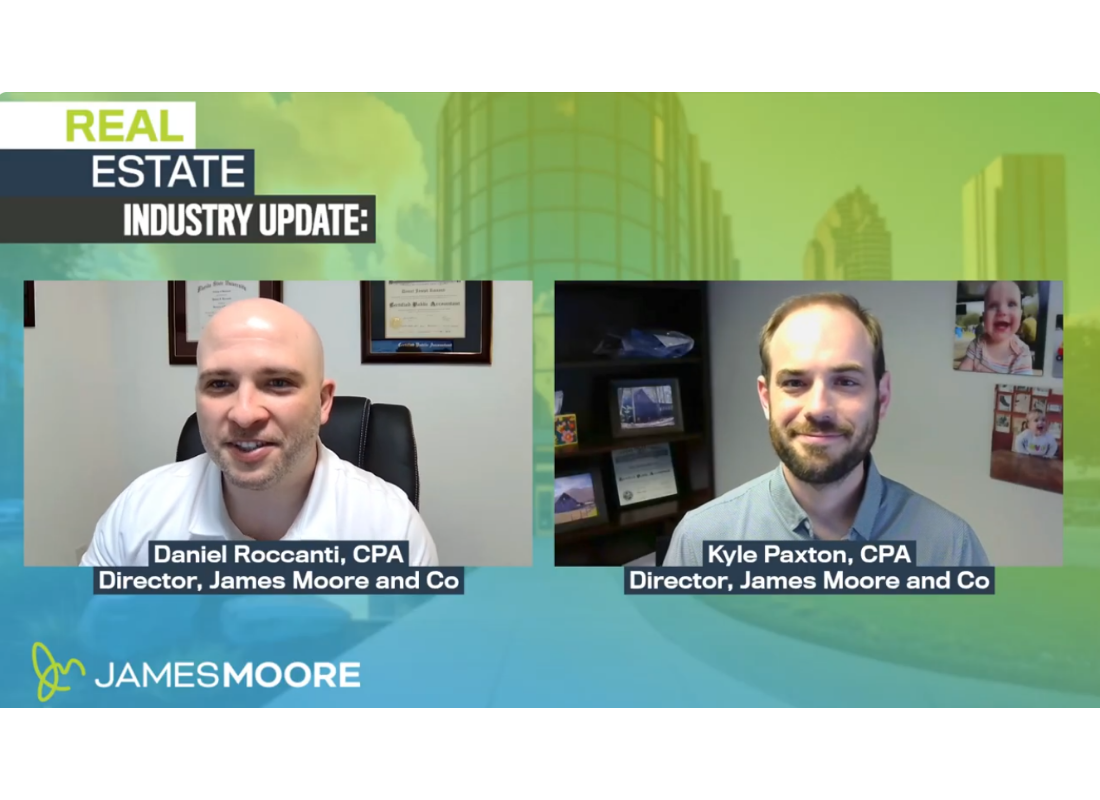
Tax season can feel like a pressure cooker for real estate sponsors and operators trying to get K-1s into the hands of investors on time. In this webinar, James Moore Tax Directors Daniel Roccanti and Kyle Paxton break down the systems, timelines and communication strategies that separate smooth K-1 delivery from last-minute chaos. Whether you manage a fund with five investors or five hundred, this session offers actionable steps to improve your process and strengthen investor relationships.
Full Transcript
[0:01] Janice Kaplan: Good afternoon everyone and thank you for joining our webinar. The title of today’s session is K-1s Without the Chaos: How to Deliver Timely Accurate Investor Reporting and Maximize Investor Relations. My name is Janice Kaplan and I’m with the marketing department here at James Moore. I’m happy to be here with you as we walk through some strategies to make your K-1 process as stress-free as possible. We’ll be getting started in just a moment, but a couple of quick housekeeping issues first. Feel free to ask questions anytime using the questions chat feature located on the top right of your webinar controls.
[0:38] Janice Kaplan: I’ll be monitoring that chat throughout the session. We’ll save time at the end for our presenters to answer as many questions as possible.
[0:47] Janice Kaplan: Item number two, we have the PowerPoint slides available in the materials section of your interface. You can download them now at any time or after the broadcast as well.
[0:57] Janice Kaplan: For today’s webinar, we have two outstanding tax directors to show us the way. We have real estate team leader Daniel Roccanti and real estate team member Kyle Paxton. Each of them is a wealth of information about all things tax in real estate. Trust me when I tell you, you are in good hands with this material. That’s all I have. That’s my big role here today. With that, I hand it over to Daniel and Kyle. They’ll tell you a little more about themselves and get us started. Gentlemen, go ahead.
[1:27] Daniel Roccanti: Thanks. It’s a pleasure to be here today. Kyle and I are excited to host this webinar. It’s a very timely topic. We’re talking about timely delivering of K-1s. Tax season is right around the corner and anyone who is thinking about K-1s and investors, you’re probably already thinking about it.
[1:51] Daniel Roccanti: Hopefully it’s not too late in the year to already get your timely K-1s in order, but if you’re a little behind, let’s go ahead and talk about what the steps are so we can make sure we make our investors happy. You can see a little bit of information on Kyle and I, but let’s go ahead and talk about what we’re going to talk about today.
[2:11] Daniel Roccanti: A little bit of today’s roadmap. A lot about when you’re talking about the timely delivering of K-1s, it really comes down to what does this mean actually? What is timely? What is the expectation of timely? And how do we get that? Usually success is defined by systems outcome. It’s not just some tax season miracle where all of a sudden something happens and then a CPA produces K-1s on time. It’s usually a lot of steps to get there.
[2:40] Daniel Roccanti: It’s usually about whether I can put the right systems in place so I can get the K-1s on time. The core messaging here is how do I produce these so I can get them tax ready, get my tax ready books to my CPA so I can get my tax return and my K-1s on time.
[3:01] Daniel Roccanti: Today’s roadmap, we’re just going to go through every single one: deadlines, the operating system, then the tax package and finally the investor delivery. Let’s move on to the first actual real slide here, which is the most important. Why does timely K-1s even matter?
[3:20] Daniel Roccanti: It really comes down to three people we’re trying to make happy here. One of the most important is the investors. Any deal, investors are going to be important. If you’ve ever talked to any investors, they think they’re the most important part. You really want to make sure that you’re happy when you’re doing your K-1s.
[3:40] Daniel Roccanti: When they’re getting their timely delivered K-1s, investors care about this because it really comes down to not wanting to extend their return most of the time. Investors like to file on time on April 15th or sooner and they really don’t want to deal with extensions. If they do have to file an extension, now they’re dealing with estimates of how much do I have to pay in if I owe taxes. There’s just a lot of things here that the average person really doesn’t actually want to deal with. This turns into better cash planning because if my investors know how much they owe or how much of a refund they can get, better planning meets expectations.
[4:25] Daniel Roccanti: Another big one with investors is the domino delay. I can’t finish my personal return until I get my K-1, but there’s actually even more of a problem like this. What if the actual owner investor isn’t another individual, but it’s another pass-through entity? Well, those have the same filing deadlines that our partnership does, and they need to get that return done before I can actually get my K-1 to file my 1040. So it’s actually a domino effect here.
[4:58] Daniel Roccanti: Getting those K-1s early for your investors, especially your more sophisticated ones that have a lot of pass-throughs, it’s important for them. We want to really make sure we’re meeting the expectations so that our investors are happy and investing on time.
[5:14] Daniel Roccanti: If you make them happy, this improves the overall investor experience. You’re going to increase the confidence in you as a sponsor. All this does when you increase the confidence in the sponsor is it gives you that competitive advantage because now you’re getting predictable K-1s. These people are going to refer you easily and it’s going to be easier for them to invest into you and to your other things. Making investors happy keeps building on that success, making not only this investment successful, but your future investment successful.
[5:49] Kyle Paxton: Daniel, I want to emphasize one of the points you made about the domino effect. Because like you said, a lot of the real estate funds we work with and different partnership structures have several tiers to them. You get in a scenario where I’m still recovering from September 15th in my mind from last year where at the final minute, you get this K-1 that could impact 5, 10, who knows how many returns down the line.
[6:16] Kyle Paxton: What ends up happening to me as a tax preparer, I get put in a bind at the last day because I’m trying to avoid my clients getting hit with late payment penalties, interests, late filing penalties on their 10 different tax returns down the line that are caused by just sitting and waiting on one K-1.
[6:36] Kyle Paxton: While it’s also just a general frustration from the timing and getting it all done, it’s a true compliance issue that has dollars attached to it. Like you said, that quickly erodes investor confidence and has a very material impact on getting the same investor in the door on future deals to continue to work with you as a sponsor team.
[6:57] Daniel Roccanti: Investors is only one part of this here. We want to make sure our investors are happy, but I think what a lot of times gets overlooked is let’s actually look at our own team, the sponsor team, the operator team. Timely K-1s is also going to improve that as well.
[7:13] Daniel Roccanti: Right off the bat, less fire drill. Nothing destroys a culture, a team, the ability to want to do high-efficient, high-quality work, like just running around, trying to get everything done. There’s no organization. If you’re doing this every year for your team, it’s just not a great culture for it. You’re not building in efficiencies in a winning culture and you’re not making your team happy.
[7:42] Daniel Roccanti: It’s going to be a really big headache. No one’s going to look forward to the next year because it’s going to be a time crunch of getting everything done. When your team’s going crazy, nobody’s happy. It’s not just the investors.
[7:56] Daniel Roccanti: But it’s more than just that. It goes on to fewer investor emails and calls. If you’ve ever dealt with investors, they want their K-1s or just anything, they’re going to start sending you emails. They’re going to start calling you. They’re just going to keep pressuring you.
[8:11] Daniel Roccanti: Millennials, if they start calling you, that’s a big problem. Because I swear I’m going to send you an email before I ever give you a call. If I give you a call, it’s a big problem. I’m really wanting my K-1. This is going to make it easier for your team. We’re not going to have to deal with all the complaints from the investors.
[8:31] Daniel Roccanti: The one that I think gets overlooked the most here, I don’t know if Kyle can talk a little bit more about this, is fewer amended K-1s. As a CPA, this is where it gets really bad for the sponsor. When you’re rushing, you don’t have completed information and we’re having to amend returns. It gets costly. Now my preparation costs are significantly higher.
[8:56] Daniel Roccanti: Thankfully the IRS came out with the audit partner regime a little while back that basically says we can amend at a partnership level and not have to go give K-1s to every single one of our partners. But it does make amending those partnership returns significantly more difficult. It’s actually a very timely process. It does help your investors. Investors don’t have to go back and amend all their returns and everything.
[9:33] Daniel Roccanti: This is really important to know that when you’re doing this, I feel like from the sponsor side, you really want to avoid amended K-1s as much as possible. I’d actually prefer you tell all your investors that we’re going to take a little bit more time and get it right than actually do an amended return. Kyle, you probably have some stories about some amended K-1s.
[9:56] Kyle Paxton: Yeah, I can chime in here real quick. One thing that we do that is low hanging fruit at our firm is every partnership return that we have that has a lot of K-1s, they get extended regardless of whether they get filed. The reason why we do that is that allows us to still actually supersede that tax return and make changes to the return through the extended deadline, September 15th, without necessarily having to go through all the amended procedures.
[10:21] Kyle Paxton: That is great if you have to update one investor’s K-1 information. If we got the payee or the beneficial owner wrong, there’s an address that needs to be updated, something like that, easy update. It’s annoying for me, but easy update and we can make that change.
[10:38] Kyle Paxton: Where the kicker is, if there is an impact to the K-1s with how income is allocated to each partner, that is really where you will erode trust. Even whether it’s a beneficial change to partner A or partner B, if you have to go back and change that, it’s a really bad look. That puts a lot of strain on the sponsor team.
[11:00] Kyle Paxton: Like Daniel said, it creates an environment where the sponsor team and the investors are at odds and the sponsor team has to constantly be on their back heels. That’s not a good work environment for anybody.
[11:13] Daniel Roccanti: Yeah, and like I was saying before, when it comes to amended K-1s, it can be a big mess. We really want to make sure that we’re saying, do we really want to amend these K-1s? Is this really material to amending? It’s better just to get it right the first time. High quality of fund and timely delivery is what matters.
[11:31] Daniel Roccanti: A few of the other things for the sponsor team. Usually if you’re doing timely K-1s, that just means you got better internal reporting. We’re actually going to go into this a lot, which just turns into better decisions for you as a sponsor. We already talked about the competitive advantage, but if you’re doing timely delivered K-1s, this just makes fundraising easier, retention easier, dealing with your investors is much easier.
[11:51] Daniel Roccanti: The last one is us, the tax preparers. This one probably gets overlooked a lot.
[11:57] Kyle Paxton: Don’t forget about us, please.
[11:58] Daniel Roccanti: Yeah, don’t forget about us, but it does matter. Timely K-1s means this is a well-oiled machine, a great client, so this means less back and forth, superior quality. Why is that important? Because if we are giving you timely K-1s, that means we have the time to spend to properly get these K-1s and these tax returns correct.
[12:20] Daniel Roccanti: Less scope creep. Nobody likes scope creep. No one likes to be like, hey, have you ever gotten a bill for something and it was higher than you thought? No one likes that. This basically lowers the scope creep of anything being like, why is my bill higher than I expect?
[12:37] Daniel Roccanti: Reduce notice exposure. No one likes dealing with the IRS. The more times we can get timely K-1s, the less we can actually have to talk and deal with the IRS.
[12:46] Daniel Roccanti: This increases the ability for advisory and planning. We all love tax preparation and compliance. It’s what we have to do, but really where I can add some of my best value is actually on the advisory side and the planning side for my client. It’s more difficult to plan if I haven’t gotten your tax return done or I’m still having to deal with your tax return. The more timely I get your tax return, the more we can spend more time on advisory and planning and really add that value.
[13:12] Daniel Roccanti: This is just a better client experience and relationship. Everyone has favorite clients, right? CPAs are no different. If I have a client that gives me everything on time, gets it done, you’re a favorite client. I’m going to help you out. Not that I don’t help out all my clients, but when I’m responding to someone, I’m always going to respond to my favorite clients first, deal with their issues, go a little bit overboard on all of them. It’s a good idea to have a great client relationship with them.
[13:41] Daniel Roccanti: At the very bottom here, I kind of just put in there: speed is a bookkeeping problem, K-1s are a tax problem. A lot of people think I’m not getting timely K-1s because of my tax preparer or getting my tax return prepared. It’s really most likely bookkeeping because that is what’s the number one issue.
[14:00] Daniel Roccanti: Let’s kind of go into the next steps of how I actually can get a timely K-1. First thing we need to realize when we’re doing a timely K-1 is actually the deadlines.
[14:12] Daniel Roccanti: For partnerships, which is most of what we’re dealing with here when we’re talking about K-1s, we want to deal with what are the actual deadlines, and then we want to build a timeline based on these deadlines. This really doesn’t have to do a lot with K-1s, but I gave you the 1099 one at the end of January, just because when you’re trying to get your books ready for tax report, you also have a 1099 deadline.
[14:38] Daniel Roccanti: A lot of times your internal accounting routine has a little bit of double duty here. So understand that you’re doing two things at one time. March 15 is when business returns are done. We need to make sure that we’re getting our returns timely done by March 15, or we got to extend them by March 15. If we’re extending it, let’s do by September 15.
[15:02] Daniel Roccanti: Next is an actual practical timeline here. We figured out our deadlines and now let’s work ourselves back into how can we actually meet these deadlines.
[15:14] Daniel Roccanti: This is what a practical timeline would be for most real estate funds that are trying to get their K-1s by March 15th. If you kind of look here at the bottom, we’re giving you some dates of what needs to be done. This is really a timeline and a K-1 kind of pipeline, what needs to be done.
[15:38] Daniel Roccanti: In January, I need to be closing my books, my monthly accounting, my year-end close. It needs to be all done, probably by the middle of January. For a lot of people that seems really too soon. You’re like, there’s no way I’m not closing my books until end of January at the earliest, beginning of February. And the reality is that’s actually putting you a little bit behind. We’re going to probably talk about how can we help you close earlier.
[16:11] Daniel Roccanti: Then I put the 1099 deadline in there. So you realize this is still happening simultaneously. It’s commonly overlooked, it is a thing that has to be done, and it takes time away from your accounting team.
[16:26] Daniel Roccanti: Then you got your February 15th CPA package date. Why we put that on there is like, you really want March 15 K-1s, you need to have everything to your CPA to prepare your return by February 15th. That’s the final deadline, not the earliest deadline. A CPA really needs a month to file to properly file these returns at the quality.
[16:47] Daniel Roccanti: Kyle knows, as I know, partnership returns are really complex. So if you have a partnership return with 100 investors, waterfall allocations, we purchase real estate, we got a cost segregation, this takes a lot of time. No one’s a miracle worker.
[17:05] Daniel Roccanti: All CPAs are already working a lot of hours during tax season. It’s not like we have more time in each day. What we really need to do is make sure we’re getting a cutoff date. We do this with all of ours, Kyle. Talk about how, why is a cutoff date so important?
[17:22] Kyle Paxton: Yeah, I’m glad you opened this door because this is a misconception. I have it, it’s a misconception. Clients have all the time when you talk about, it could take us a month to prepare a tax return. Oftentimes it can be in a shorter timeframe than that if we’re organized and have our ducks in a row and all that kind of stuff. But chaos can enter the system in so many ways.
[17:40] Kyle Paxton: Really in looking at this, a lot of times we’ll enter tax returns with very strong bookkeepers. The bookkeeping is clean. We just have to make two or three adjustments. Maybe it’s around depreciation, adjusting equity to tie to the tax return last year, things like that that are pretty straightforward on the surface. So the actual bookkeeping part is not a big lift.
[18:02] Kyle Paxton: But then to your point, the part that really takes us a lot of time and we have to be really thorough with is making sure that every investor is happy with their K-1s. It’s scrutinizing how the K-1s are reported, how the waterfall allocations are calculated. People see the tax return itself and then schedule K-1s. They think the numbers magically flow. There is a method to that madness and what numbers land on which K-1 are extremely important.
[18:26] Kyle Paxton: We already talked about how, if you have to go back and make an adjustment to how income is allocated to partners, it can be a disaster for trust and investor relations. So we spend a lot of time scrutinizing that.
[18:40] Kyle Paxton: Whether it’s James Moore or any reputable accounting firm who’s doing this type of work that is impacting a lot of people, we have several layers of review and compliance checks and everything else within our process so that you have several different CPAs looking at the tax return. I like to think I’m perfect, but I miss stuff sometimes. So Daniel checks behind my back and makes sure we catch all the nuances and things.
[19:04] Kyle Paxton: But ultimately that’s a big deal. And then there has to be time where, and Daniel, we baked it into the timeline here a little bit where there’s going to be some back and forth with the client at the end. Because you get the tax return and when you’re reviewing it, clients can have questions. We need to have time to work through those things.
[19:22] Kyle Paxton: Maybe we got bad data on the front end and they know that back of the napkin calc you do of what you expect the end result to be. It looks a little different than the tax return. We have to work through that.
[19:34] Kyle Paxton: A lot of times there’s misconceptions on how income is allocated to all the partners based on what was presented on the pitch deck, what I have kind of in the back of my head versus what the operating agreement says.
[19:50] Kyle Paxton: Us as tax preparers, we live and breathe that operating agreement and bifurcating that can take time. And again, a lot of layers of review and kind of making sure that happens.
[20:00] Kyle Paxton: All that on top of making sure we’re servicing all of our other clients timely, everyone’s trying to do their tax returns at the same time. So we have our nice peak that creates a system where it takes a couple of weeks to get through.
[20:17] Kyle Paxton: Having that leeway really helps the whole process. Like Daniel said, we like February 15th as that kind of final day, but if you can get in front of it, our teams have capacity right now. We’re waiting on the tidal wave so we can hammer out a return in a couple days.
[20:34] Kyle Paxton: I’m exaggerating a little bit, of course, but the point there stands. To the extent you’re organizing kind of on the front end, that can give you a competitive advantage that we kind of already touched on.
[20:45] Daniel Roccanti: Yeah, and Kyle makes a good point here. We at our firm do a February 15th deadline, which is pretty standard for just CPA and getting tax preparation. But a lot of people know that, and so a lot of people are giving us their stuff February 15th, February 14th.
[21:02] Daniel Roccanti: If you can actually provide earlier, February 1st, you’re beating the crowd. We’re able to get to it because we have to file a lot of returns in a short amount of time. You’re not our only client. We like to think that, but it’s not true. We have to do a lot of these at the same time.
[21:17] Daniel Roccanti: We try and always get this work earlier in, and a lot of times we can get this to end February, like very beginning of February, we can actually easily beat this timeline. We can get you a K-1 before March. Then your investors are really happy because you’re not only just giving them timely, but you’re beating all the competition by far.
[21:43] Daniel Roccanti: But it’s important that we understand that CPA package that comes on February 15th between the client closing into that CPA package, that’s really all the client. CPA is not doing really a lot of work until we get that package.
[22:01] Daniel Roccanti: Then once we get that, the timeline kind of looks like how I have below. We want to try and make sure that we’re giving the client a draft tax return beginning of March, so that the client can do its own internal review, see if there’s anything going on. These are complex returns. We want to make sure K-1s look good, look like how the operator and the sponsors expect it so that the investors are happy.
[22:25] Daniel Roccanti: Are there any fixes that we have to have? In the real world, there’s fixes all the time. Rarely does anything ever perfect the first time just because I can’t know everything. Then we want to make sure that we have enough time to fix that and then get the K-1s out by March 15th and then they can be delivered to the investors.
[22:47] Kyle Paxton: Yeah, and Daniel, when we’re talking about working backward, I can pick off several of these items that we can do in November or December of the prior year. We can go ahead and update those investor lists for any ownership changes, changes in the address, all that good stuff.
[23:04] Kyle Paxton: Sponsors that have a live method of fielding those updates and getting them aggregated on a monthly basis help streamline our process. You’ve already acquired most of the assets you’re going to acquire for the year as of the end of November, from a fixed asset perspective. We can go ahead and update those things, get that depreciation number close, do all of that.
[23:26] Kyle Paxton: That helps with projections on what taxable income is actually going to be for your internal modeling. And it also gets us just a jumpstart on this whole process.
[23:34] Kyle Paxton: Obviously we’re talking in hindsight here in January, but to the extent you can get out in front of this, this is what we talk about kind of working backwards from the filing deadline, and what can we do to spread that gap to where we’re not trying to crank something out on March 15th, where in full transparency, my brain’s not the sharpest. So it helps in so many ways to get a jumpstart on this.
[23:59] Kyle Paxton: I think the partnerships that have the most success in investor relations, this is a big part of it because it’s one of the most obvious things investors see. When was the expectation communicated I’m going to receive my K-1, which hey, by the way, I need to know that as the tax preparer. And then when does it actually deliver?
[24:20] Kyle Paxton: What’s the under-promise over-deliver? Easy, easy, low-hanging fruit on an investor’s side to have your act together.
[24:31] Daniel Roccanti: It’s true. Now that we have kind of a timeline, now we can actually then start taking our action steps. How can we do our first action to make sure we’re getting our timely K-1s?
[24:44] Daniel Roccanti: First thing you want to do is basically you’re creating this kind of assigned ownership. I’m using RACI here. There’s other things out there, but RACI, it’s nice because it’s basically Responsibility, Accountability, Consulting, and Informed. Who’s really in charge of everything to get done?
[25:06] Daniel Roccanti: If you are an operator or a sponsor, you’re the A, you’re accountable. No matter what happens, even if you’re not responsible for actually doing the task, you’re accountable for it. You’re the head coach. You get all the praise when you win, you get all the bad stuff when you lose.
[25:26] Daniel Roccanti: If Carson Beck throws an interception with one minute left in the game to lose the national championship, it’s your fault because you’re the head coach. Brutal. I know all the Miami fans die a little bit, but hey, they at least made it to the national championship, a lot better than some other teams.
[25:44] Daniel Roccanti: It’s truly understanding as the operator, I’m the head coach here, I am accountable for everything. Then who’s actually responsible?
[25:55] Daniel Roccanti: You’ll notice here on the chart I have mostly who’s responsible, it’s actually going to be your controller bookkeeper. When we’re trying to close the books, the month and the year end, that’s the bookkeeper. And the CPA should be informed.
[26:14] Daniel Roccanti: Sometimes the CPA is your bookkeeper, but a lot of times you have your own separate bookkeeper, so there should be some kind, that’s their responsibility and we’re making sure we’re informing the CPA once it’s closed.
[26:26] Daniel Roccanti: Then that’s not where it ends. We need to make sure we’re doing all our reconciliations, we need to make sure that we have our fixed assets and our capex and everything. We are making sure that investor capital, ownership changes and all this, this all comes down to the bookkeeper and the controller.
[26:43] Daniel Roccanti: Your internal accounting team really needs to make sure that all of this, this is part of that CPA package we’re talking about. The CPA is here to help you, so please inform them or be consulted with, but it’s not their responsibility to do.
[27:00] Daniel Roccanti: Once you have all of this done, this goes to that nice CPA package that we talked about. And now that responsibility changes to the CPA. It’s my time now to file the tax return, to do reviews, do the e-file, the K-1s, everything. And then the controller and bookkeeper turns into more of the consultant, and they’re the ones that we’re consulting with to make sure that we’re preparing it correctly.
[27:26] Daniel Roccanti: So let’s jump into the first actual action item once we have assigned ownership, which is the monthly close. The first one is the biggest one.
[27:39] Daniel Roccanti: If you want to get your K-1s on time, you really need to get a faster close. Monthly close, year-end close, all of that stuff needs to happen faster.
[27:53] Daniel Roccanti: A lot of times what’s holding people back for timely delivering K-1s is that their normal day to close is almost the full month. They’re getting it done at the end of the month and really they need a 10 day close, maybe 15 day close. Anything after that is really too late.
[28:12] Daniel Roccanti: If you’ve never had one of those, you’re probably like, how do I do this? I get it, but really the year end close shouldn’t feel unique. It should just feel like month 13. It’s making sure that you have everything in place and you’re not waiting to end of the year to kind of finish this.
[28:35] Daniel Roccanti: It’s very doable for a lot of our people but that means that you’re actually reconciling, you’re doing a lot of these things before the actual close happens. We’re having a timeline and a date and an actual task of like, hey, I need to get my reconcile. I don’t wait till day 10 or 15. I wait until January 2nd and I get all my reconciles done.
[29:01] Daniel Roccanti: That’s a day one task. You can do that a day after the month ends. I said January 2nd because January 1st, hopefully you’re celebrating the new year with your family, so we’ll give you a day.
[29:13] Kyle Paxton: I’ll work over here.
[29:16] Daniel Roccanti: Oh, I’m doing it now. January 2nd, we want to make sure that we’re reconciling everything.
[29:24] Daniel Roccanti: A big one is locking the month. Kyle, we can talk forever on locking the month. You can’t go back. There’s got to be a period where I’ve locked the month and we can’t go back. Keep going back and making journal entries and changing the numbers, going back in the month is absolutely hurting your close.
[29:44] Daniel Roccanti: It’s what expands it. So many people go back and just keep changing numbers. You got to make sure you’re getting to the point where I’m locking that month in and we’re not going back. If we do go back, it better be significant and it better be material.
[30:00] Daniel Roccanti: At the same time we’re doing all this, we’re maintaining our capex fixed asset logs, we’re doing any of this. If you’re into doing the form 8825 map properties, this is a great time to do it too. This is kind of more unique. It’s not every client likes to do this, but the ones that really want to see how does my P&L, my profit and loss, how does that actually map to the form 8825 on my tax return, especially if I have multiple ones, this is a really good time to do this.
[30:31] Daniel Roccanti: It just provides an extra layer of telling your CPA, this is how I want things grouped. So if I got to talk to investors or have anything. If you don’t, then your CPA is going to group it based on whatever they think best.
[30:46] Daniel Roccanti: Yes, we do a lot of these, so we’re probably going to group them, but the reality is if you give this to 10 different CPAs, you’re going to get 10 different groupings. That’s just how everything is. Some clients like to do their own groupings. It’s actually kind of nice because then we don’t have to do a lot of thinking. We group it how the client wants us.
[31:07] Kyle Paxton: Yeah, that’s all good stuff, Daniel. Like you said, I want to emphasize, year end shouldn’t look much different. The biggest thing here I think kind of falls back on the operator as the quarterback and understanding what is your property. If you have someone else managing your particular assets within a partnership, you have a property manager involved, what are they doing? Who’s involved? How can we streamline that process?
[31:27] Kyle Paxton: How can we streamline our communications from our fund level team with the property manager team to alleviate any mismatch and expectations there and streamline both processes? That’s a lot of what we see in prep for a year end is just making sure all of that’s aligned and we’re ready to go come into the year.
[31:46] Daniel Roccanti: So once we have our monthly close, we’re trying to finish basically our CPA package. Let’s talk about that.
[31:54] Daniel Roccanti: This slide we’re probably going to be on for a little while, so let’s sit down and talk. It’s getting, I’m chugging water over here, get something to sip on.
[32:04] Daniel Roccanti: What this really looks like is this is what truly what a CPA package looks like. When we say we need everything by February 15th, we mean not just the books.
[32:16] Daniel Roccanti: People sometimes think, oh, I just need books. Need to send it to them. I’m like, well, that’s part of it. And that’s a very important part. But for a lot of these funds and bigger and more complicated partnerships, we really need a lot more information than that.
[32:30] Daniel Roccanti: The core financials that we have down here, this is kind of back to what we were talking about with the monthly close. A lot of this should be already done, then providing your CPA the trial balance, the general ledger, all the bank recs and support. If there are going to be any book to tax adjustments that you are aware of, that should be part of it too, but we kind of mostly have gone over that already.
[32:59] Daniel Roccanti: Same thing with the real estate support. I got my books done, now it’s time I need to make sure that I’m providing my CPA all the support that is necessary with that when it comes to your capex and your fixed assets. Fixed assets is a big one. That’s one that we see a lot where it can hold up a return.
[33:14] Daniel Roccanti: If you’re not properly maintaining and supporting all your fixed assets, same with debt. And then I like to always include significant transactions. It’s really nice when a client is able to provide us some kind of significant transaction list. Think like, hey, this is what happened through the year so we know what to expect. Because sometimes these general ledgers are ginormous. It’s hard to look at everything.
[33:42] Daniel Roccanti: Now, the biggest one that I want to spend some time on is the investor partnership. This is actually probably where we see most K-1s get held up after the books are done.
[33:57] Daniel Roccanti: This really needs to be done that whole time when you’re closing the books until when you can get that CPA package. This all needs to be done before that.
[34:09] Daniel Roccanti: We wouldn’t need it in a wrap though. We don’t really want to just get piecemeal things. That really slows down how fast we can finish your tax return. This is probably the number one reason why we have to amend things, is this section right here.
[34:25] Daniel Roccanti: The investor partnership one, it really comes down to having your cap tables and your roll forwards. When you bring on a new investor, there’s all this information that you have to get: names, tax classifications, tax ID numbers, addresses, everything like that. CPA needs that.
[34:47] Daniel Roccanti: There should be some kind of cap table master record where all this information is. New investor comes on, I need you to fill out a W-9. I need to get this information. But then more importantly, that’s not where it starts. Every year there needs to be an update of information again.
[35:08] Daniel Roccanti: People move, people’s marital status change, they move states, they change how they are holding their classification. Things happen. Mostly it’s addresses afterwards. But it’s important because I need to know what state these people live in because that state residency matters when I’m filing a lot of these partnership returns.
[35:29] Daniel Roccanti: Even though my real estate’s in Florida, but my investors are in New York, New York still requires that I file a New York return. So I have the New York K-1s. Tax law gets really complicated when we start having 50 states as well on top of that. It’s important that we have this information.
[35:47] Daniel Roccanti: The cap table is really important for us and usually what I want to see from people and I want to see some kind of walk, like a roster walk, okay? Like a cutoff date.
[36:00] Daniel Roccanti: Hey, new year comes out, probably even before the new year. Maybe you want to probably do it in December and say, hey, here’s all your personal information. We need to make sure this is right. Please give us this information back by January 15th.
[36:16] Daniel Roccanti: If you get us to after January 15th, we’re locking it, and they’ll get updated for next year. Which is their fault if they’re not giving you that communication and time. Like, hey, I moved to a different state.
[36:33] Daniel Roccanti: We really want to make sure that we’re creating deadlines here and locking that in, because this is where we see most of the problems is ownership changes and the information that comes with it.
[36:45] Kyle Paxton: Yeah, Daniel, I want to emphasize the chaos here. A couple things. Number one, like you said, the state filings are a nightmare right now, period, across the tax world. And that infiltrates in these partnerships.
[36:56] Kyle Paxton: A lot of times, like you said, you have a multifamily property located in Florida that has a partnership with 100 partners. You say, I’m in Florida, no state income tax, no state filings. It’s way more complicated than that, where you have employees, where your general partners live sometimes or the limited partners live can drive what states you need to file in.
[37:16] Kyle Paxton: An investor moving can have a significant impact on the partnership itself that can turn into compliance issues and fees and penalties and so on and so forth. Huge issue.
[37:27] Kyle Paxton: We’ll touch on the state stuff more in a second on kind of the exit and the sale of property that adds more chaos to the system.
[37:34] Kyle Paxton: But then the other thing that is still a misconception years later after this change, I think it came out in 2019, was that now the IRS requires on schedule K-1 that the beneficial owner is listed as the partner. It is ultimately the idea of what tax return this K-1 is going to.
[37:52] Kyle Paxton: So if I, Kyle Paxton, own an LLC, Kyle Paxton LLC, and I say Kyle Paxton LLC is the partner, I’m the 100% owner in Kyle Paxton LLC, that reporting is incorrect. I actually have to myself Kyle Paxton as the partner and then there’s a disregarded entity line down below.
[38:10] Kyle Paxton: This gets messy with entities owned by IRAs and things that even add more complexities here but a lot of times there’s back and forth with investors on the back end of the K-1 and hey the partner’s wrong and then it takes seven instances of no it’s not it’s correct here’s the rule that we finally drive that point home.
[38:28] Kyle Paxton: A lot of this is in a lot of deals with large pools of investors, you have a lot of times, and we’re using real estate as a lot of examples here, you have people who are investing in real estate for the very first time, and a real estate partnership for the very first time. They’re a physician, they don’t know anything about real estate, and this is the first time they’re going into it.
[38:52] Kyle Paxton: There’s a lot of unknowns, both from the tax concepts and the actual economics of a real estate deal. Educating your investors on the front end saves so much headache on the back end. It can be to that granular level of here’s what you’re going to expect on schedule K-1, here’s what you’re going to see and here’s why. That really helps streamline some of that process.
[39:08] Kyle Paxton: Like you said, this is the primary driver in my eyes of the noise in large partnerships that have a lot of investors is just everything related to how the results are presented to the investors.
[39:22] Daniel Roccanti: Yeah, and Kyle made a good point. The disregarded entity is always a confusion when we’re filing. If they’re filing, if the true investor is a disregarded entity, just know we have to know the disregarded entity’s information and who is the actual reportable entity, which is usually going to be the individual.
[39:43] Daniel Roccanti: Both of that has to go in the K-1s. Basically the IRS wants to know who’s truly actually reporting this, not just the entity who owns this. That’s a lot of ones. And investors, a lot of times, they mess up their W-9s.
[39:57] Daniel Roccanti: The W-9 should tell you, give you all that information. It should say, oh, this is a disregarded LLC. This is the true owner information. They mess up all the time. So it’s important that when you’re getting your W-9s, you’re not just throwing them away. You’re analyzing it. Is this truly correct? If you don’t know, talk to your CPA about it.
[40:17] Daniel Roccanti: Then there should be some kind of one master record where all this information’s stored so that we’re not looking at 100 W-9s, we’re going to look at a spreadsheet basically and get that information entered in them.
[40:30] Daniel Roccanti: Because when you’re talking about 100 partners, there’s always going to be some kind of changes and people are coming in and out, which brings us to our next one. We need to make sure we know the ownership changes.
[40:39] Daniel Roccanti: We need to know when it happened, the date, all the information, if there’s a price that went into it, and then there needs to be a tracking basically of all the allocation support when it comes to the waterfall. What’s the contributions that came in? Where’s the distributions? Is the distributions return of capital? Is it profits?
[41:02] Daniel Roccanti: What’s the ownership class of each of these people? When’s the transfer effective dates? This all matters because it’s important because if we don’t have this information, this is actually going to delay your tax return or it’s going to make your K-1s incorrect and cause basically investor relation problems.
[41:22] Kyle Paxton: Yeah, absolutely. One more point I want to make and then we’ll hustle. We’re getting kind of far along here. We like to talk about this stuff.
[41:29] Kyle Paxton: One more point on the investor is that in a perfect world, what I see here is in the fall you get your investor table updated. You have clear communications on here’s how you make updates to your K-1s. That is all dealt with in the fall.
[41:42] Kyle Paxton: Then once the tax return is delivered, you set good timelines on, hey, investors have 30 days to open their K-1 that they received for the first time. Look at it, is the low hanging fruit correct? Is your name, your address, whatever? And if not, you have 30 days to make a change.
[41:57] Kyle Paxton: If not, unless it’s something super mission critical, we’re going to kick it to next year and just update it on next year’s K-1, right? So setting good, clear expectations around how to make the updates and the timing around that is really helpful.
[42:12] Kyle Paxton: Last but not least is kind of state special items. If you do have state filings, it’s a great idea to get out in front of that. What states? Are there new states that I need to file? Is there withholding payments?
[42:22] Kyle Paxton: A lot of states will require non-residents to file some withholding payments if there’s income in that state. Is there any notices or correspondence that we need to deal with?
[42:33] Kyle Paxton: Not on here, but another special item is any kind of third-party report. If I’m going to get a cost segregation, remember, if someone has to prepare that, we need that timely information.
[42:43] Kyle Paxton: You need to make sure if you’re doing any third-party reports that you’re getting out in front of that, getting that information at the beginning of the year because when tax season starts, people that prepare cost segregation reports, guess what, that’s when everyone needs them. They get backed up too.
[42:58] Kyle Paxton: It’s making sure you’re getting all that information and timely handing it to your CPA by February 15th.
[43:05] Daniel Roccanti: Daniel, we need to drive home the withholding payments on the state. Because in partnerships, a lot of times you have taxable loss through the life. If it’s real estate underlying and you sell, you have income.
[43:16] Kyle Paxton: With the income, you both have a surprising taxable gain because you’re recapturing depreciation, you got the tax benefit for in the past. So the gain can be higher than the amount of cash you got out of the deal, first of all.
[43:30] Kyle Paxton: Then secondly, to your point, states require that you withhold funds from the sale on behalf of your partners who don’t live in that same state. That decreases the amount you should be distributing to your partners on exit.
[43:46] Kyle Paxton: There’s nothing worse than having to go back to your partners after the deal’s done, everything’s distributed and say, hey, look, so we got to remit $20,000 to State X and I need that money back so I can withhold it on your behalf and you claim it as a credit. A mess.
[44:01] Kyle Paxton: That’s something that catches sponsors off guard sometimes and it’s a huge deal.
[44:06] Daniel Roccanti: Absolutely. Then kind of the last action step is investor communications. It’s important, getting timely K-1s matters, but reality is setting expectations and setting it earlier is actually most important.
[44:20] Daniel Roccanti: You’ll be surprised how many investors are actually okay with extending returns as long as they’re expected to and get it as early. What they don’t want is, I’m going to get your K-1 done, I’m going to get your K-1 done, and then they’re like, where is it? It’s April 1st, and they’re like, you’re going to have to extend.
[44:37] Daniel Roccanti: As early as you know, you need to tell them. If you know right off the bat, talk to your CPA, figure out that, hey, we’re not going to be able to meet the K-1 date, you need to tell them.
[44:50] Daniel Roccanti: Which basically means in early January, when we’re talking to our investors, there should be some kind of communication that comes out that says where our target date is. You also need to talk about your portal process or however they’re going to get their K-1s.
[45:04] Daniel Roccanti: Then this is also when you contact them about the address change, email changes, anything. I actually think this should be done in December, but January, early January at the latest. It needs to definitely be done by early January.
[45:20] Daniel Roccanti: Then you got to give people a status update. Once that CPA package is delivered, now it’s time to let everyone know, hey, the tax preparation has started. Is there anything that unique once you’ve been talking to your CPA, like a new state or some complexities like a K-2 or K-3, this is the time to let your investors know.
[45:41] Daniel Roccanti: If they’re extending the timeline or anything, as soon as possible. Whatever the soonest you know that either your delivery target date changes and there’s going to be an extension, whenever there is, when you need to know and you need to explain why and you need to give a new target date or range of when it’s going to be done.
[46:02] Daniel Roccanti: This will go a long ways with your investors. Most people realize that we live in the real world, nothing goes 100% planned. It’s okay, but what’s not okay is you hiding it from me.
[46:16] Daniel Roccanti: Then last but not least is K-1 delivery. Once it finally happens with the K-1 delivery, you need to be sending out email so that they’re available.
[46:25] Daniel Roccanti: Normally how K-1 delivery works is realize that your CPA is not sending the K-1s to investors. The CPA’s job is to prepare the tax return and give the K-1 to its client, which is you, the sponsor or the operator.
[46:40] Daniel Roccanti: It’s your job to basically make sure that each investor gets a K-1. Sometimes a CPA may have a portal that lets them easily download or easily send them. Like our portal, you can literally go in there and just type in their email addresses and send it on. It makes life easier.
[47:01] Daniel Roccanti: Some people have a portal where they can enter it, take it out, do it. There’s a lot of different ways, but just realize the actual responsibility. Once the K-1s have been delivered to the sponsors, it’s actually your responsibility to make sure that each investor gets it.
[47:16] Kyle Paxton: Yeah, and a couple of things there, Daniel. I think a perfect communication around this from my eyes is that, hey, we have to extend. Here’s why. Here’s what the impact to you is. You have to extend your personal tax return.
[47:33] Kyle Paxton: If we can, getting down to the level of detail, here’s an estimate of the income or loss that’s going to be allocated to you from this partnership. And by the way, new this year, you’re going to get a New York K-1 with $0 income on it. That level of detail really helps.
[47:47] Kyle Paxton: Make sure that at the personal level, if individuals have filing requirements or additional filing requirements with that new state, that they’re able to file extensions and avoid compliance issues.
[48:01] Kyle Paxton: You don’t want compliance issues at the individual level or the tiered partnership level that come back to you not doing your job or doing your job timely.
[48:11] Kyle Paxton: A big misconception is the extension thing. It is super normal in our business to file extensions for any number of reasons. Sometimes my brain isn’t the sharpest on March 15th, so there may be a benefit in general for quality to file an extension.
[48:26] Kyle Paxton: But that communication being crystal clear is super important. For me, when I’m representing investors that are in partnerships, when I get that communication, I feel so much better about the accounting firm preparing that tax return. I feel so much better about the sponsor team representing that partnership.
[48:45] Kyle Paxton: I can tell my client, hey, I think you’re in good hands here. Economics aside, these people are caring about you as an investor and doing what they need to do.
[48:57] Kyle Paxton: Daniel and I work with a lot of partnerships. We can help with those communications. We can help communicate tax topics on what’s on the K-1 and the timing of the process and everything like that. Lean on the experts around you to do that. It makes everyone’s life easier.
[49:14] Daniel Roccanti: All right, so let’s move on here to the usual suspects. Which is not only just a great movie, but these are basically the repeat offenders. Like why K-1s are not getting delivered on time?
[49:27] Daniel Roccanti: Anyone in the webinar, this is the time, if you’ve got questions, go ahead and start writing them in the chat because we’re almost done here.
[49:36] Daniel Roccanti: Basically we’ve talked about a lot of these, Kyle and I, but we just kind of want to go over them again. Tie it up in the back.
[49:44] Daniel Roccanti: A lot of times what happens here is that when you’re trying to do your close, closing doesn’t happen on time. A lot of times the recs are lagging because you’re starting them too late. You don’t have all the information that’s lagged, which is lagging your close.
[50:02] Daniel Roccanti: If you’re using property management, they’re a lot of times sending their packages, those things arrive late, or they’re not matching your books. If you’re keeping some kind of books, property management, you need to make sure you’re getting those property management as soon as possible and they should already be tying, there shouldn’t be any issues once you’re getting.
[50:21] Daniel Roccanti: I already talked about this a lot but back dating entries is one of the biggest, it’s usually one of the biggest things when it comes to closing areas, just keep going back, you keep making changes. You really need to be closing it and locking it and not making changes unless it’s absolutely necessary. A lot of the changes people make is actually immaterial.
[50:39] Daniel Roccanti: Back on the fixed assets here. We talked about a little bit. Make sure your capex, you’re keeping that it’s always rolling, it’s always on time. Biggest next one is the cost segregation, the third-party studies we talked about. These are coming in late because you didn’t plan to get your cost segregation done in time.
[50:57] Daniel Roccanti: This needs to be on the operator and the controller. Hey, I want a cost segregation. We need to get out in front of this, get this report early in time.
[51:05] Daniel Roccanti: Then one of the ones that’s the worst we talked about, fixed assets is another big one that holds up K-1s. All sudden we’re preparing the return and then there’s all these depreciation set issues. Nothing matches. Now we’re having to rebuild depreciation schedules. This can really tie up your return.
[51:26] Daniel Roccanti: Back to the investor stuff we’ve talked a lot about this already in the other slide but basically it comes back to your cap table and not having, missing information, investor information, and having to deal with your waterfalls.
[51:41] Daniel Roccanti: Make sure that that information is pretty tight, and that should be delivered with your whole CPA package. Too many times people want to send us the books, but we’re missing this information. This is important, we need this. We need this to finish the return.
[51:54] Daniel Roccanti: Then if there’s any kind of state complexities, almost always going to add additional time to your return. Please make sure when you’re doing in your state because every state has different rules. Depreciation schedules might actually be different than what the federal depreciation schedules. States can really be a big reason why everyone is getting their K-1s held up.
[52:23] Daniel Roccanti: We’re running out of time. I’m just going to quickly go through the next ones. We usually just have our ready scorecard. For a lot of them, there’s needs some kind of scorecard, a checklist, just kind of go through this.
[52:34] Daniel Roccanti: What do I need? Basically, when we talk about anything to that CPA package, we’re checking it off. We’ve got it all done, and we’re able to basically get that CPA package in a timely manner.
[52:46] Daniel Roccanti: Now it’s the CPA’s fault, as long as I’ve given them 100% information. Don’t give me 50% and be like, I’m done. No, it needs to be 100% information by February 15th.
[53:00] Daniel Roccanti: Then the last thing, if you really do need help, this is kind of an ideal 30-day of how you can kind of upgrade your processes with helping you with it.
[53:09] Daniel Roccanti: Everything that we just went over, it’s just basically a recap of assigning people with ownership, creating deadlines, creating checklists, and then getting that clean investor data all up front.
[53:23] Daniel Roccanti: So I can give this package to my CPA, and then it’s just basically reminders and keeping correspondence and things with your CPA and with your investors to get it on time.
[53:35] Kyle Paxton: Yeah, January 22nd is a good time to start if you’re in that boat.
[53:40] Daniel Roccanti: All right, we’re coming to the end, so I guess it’s going to be questions time.
[53:45] Janice Kaplan: That’s correct. We’ve got a couple of them here. I’m just kind of flying through for some quick ones here. Here’s one. We always extend. Is that bad?
[53:55] Daniel Roccanti: To the point, absolutely not. Kyle mentioned this earlier. Lots of clients extend. It’s actually not bad at all.
[54:03] Daniel Roccanti: You really need to come down to expectations, what’s your investor’s expectations. You’re going to have a more difficult time convincing someone with 100 plus investors to extend, but there might be a really good reason.
[54:18] Daniel Roccanti: Like when we had tax law changes, and the IRS is way behind, government is way behind, we didn’t have final regulations. The difference between filing a return early or filing a return late can be literally millions of dollars in deductions. That’s a good reason. I can convince a lot of people that that’s a good reason.
[54:40] Daniel Roccanti: Others are just complexities. Say you have a more complex fund where you’re getting K-1s from other people to complete your return. Now you are the pass through is getting other K-1s. I have to wait on those. There’s not much I can do.
[54:55] Daniel Roccanti: A lot people extend. The more investors the more difficult. But if it’s like a family office where you only have five people and we know that everyone’s situation is really complex and they’re going to have to extend anyways, then we can take our time and get this done in the offseason.
[55:15] Daniel Roccanti: I don’t have to rush it with all the rush. There’s not a bad reason to extend. It’s just when you’re dealing with a lot of what I would say is your standard investors that are not used to extending, then they’re going to want to get theirs done by April 15th. You need to make sure you have a good reason and then meet their expectations as soon as possible and communicate it to them.
[55:32] Kyle Paxton: Yeah, and Daniel, just like to your point, loop us into that process, because like you made a great example. Every, it feels like every 10 minutes, we have drastic tax law changes that significantly change the tax environment and it impacts our timelines.
[55:45] Kyle Paxton: We’re having to learn, drinking through a fire hose, the tax law changes and things like that. It is frustrating at times when we onboard new clients or do something that have presented to their investors in a pitch deck or something like that.
[55:58] Kyle Paxton: Hey, you’re going to get K-1s on a certain date and maybe it’s not feasible based on you’re not doing all the things you need to be doing to meet that. That creates an environment of stress for the sponsor team, for me, for the investors that gets the relationship off to a wrong foot and can create problems.
[56:13] Kyle Paxton: Looping us into that process and setting those expectations is helpful.
[56:19] Janice Kaplan: All right, one more question. We use outsourced bookkeeping. How do we keep track of the process?
[56:29] Daniel Roccanti: Good one. Kyle, you take this one first.
[56:34] Kyle Paxton: Well, again, it’s quarterbacking, right? So now you have three bodies, meaning yourself as the sponsor operator, CPA preparing the tax return, outsourced bookkeeping.
[56:48] Kyle Paxton: It’s got to be a three-way, the conversation has to be going all directions to make sure we’re meeting expectations and timelines and things like that.
[56:57] Kyle Paxton: A lot of times, surprise, the fund operator can be a bottleneck. Opening up the door from the CPA preparing the tax return and the bookkeeping team, the outsource bookkeeping team, can really help streamline that process, work out issues between the two of them, where the middleman’s not holding the process up.
[57:18] Kyle Paxton: It really is just truly being that quarterback, settling into that role, making sure expectations are aligned with all parties involved in the process and then removing any bottlenecks from the bookkeeping inputs in to the tax prep team. Those are the biggest things I think to move it up.
[57:44] Daniel Roccanti: I will add that having an outsource bookkeeper is not unique. I’d actually say it’s more likely. The majority of people actually are doing outsourcing keeping these days than internal bookkeeping. It’s just a lot of work and you have to go find bookkeepers and they leave. It’s just getting to the point now where outsourcing is common.
[58:03] Daniel Roccanti: Even us at James Moore, we do a lot of our bookkeeping for even our own clients or our funds. We use Yardi and things like that to do the bookkeeping for our clients. It’s actually just very standard.
[58:09] Daniel Roccanti: It’s just making sure again this goes back to that RACI thing. Whose ownership is it? If you are the sponsor, then you’re accountable for everything. You’re the head coach.
[58:21] Daniel Roccanti: Then you need to make sure everyone knows responsibility and timelines. If I’m telling my bookkeeper everything has to be done by the 15th, then they already know. Now what resources can I give you? What do we need to do to make sure you can get your job done by the 15th?
[58:37] Daniel Roccanti: If you can’t, why is the reason for that? It really just talks about going out in front of that.
[58:43] Daniel Roccanti: If your bookkeeper is like, I can’t do it by the 15th, there’s got to be a good reason. If there’s no good reasons, then maybe it’s time to find a new bookkeeper. The reality is most likely there’s some kind of constraint, there’s some kind of restriction that’s stopping it, and you’re not doing your part.
[59:01] Daniel Roccanti: There has to be ownership in this. Everyone has ownership. Just because it’s someone else’s responsibility, it doesn’t mean that I can’t be doing something better to be helping the process and setting strict expectations of when deadlines need to be done.
[59:17] Daniel Roccanti: I love talking about this stuff. If there’s more questions, our emails are here. I’m happy this excites us. I appreciate y’all being here.
[59:30] Janice Kaplan: Exactly. If anyone has any other questions, because we’re out of time, feel free to reach out to the presenters. You’ve got their information there. Their contact information is also available in that slide deck that we put on the interface.
[59:43] Janice Kaplan: Before you sign off, make sure to download that if you haven’t already done so. With that, we’ll close out today’s session.
[59:49] Janice Kaplan: Thank you, Daniel and Kyle, for your time and your knowledge today. I’m sure we all appreciate it. Thank you all for spending your afternoon with us. We hope you found everything here helpful, and we look forward to seeing you again at a future session. Thank you very much and take care, bye-bye.
[1:00:05] Daniel Roccanti: Thank you.
Connect With James Moore
Ready to improve your K-1 delivery process and strengthen investor relationships? Contact Daniel Roccanti or Kyle Paxton to discuss how James Moore can help your real estate fund achieve timely, accurate investor reporting.
Watch the full webinar recording to get additional insights on CPA package checklists, state filing complexities and strategies for improving your year-end close process.