How Timely K-1 Delivery Builds Investor Confidence and Reduces Tax Season Chaos
Originally published on March 6, 2026
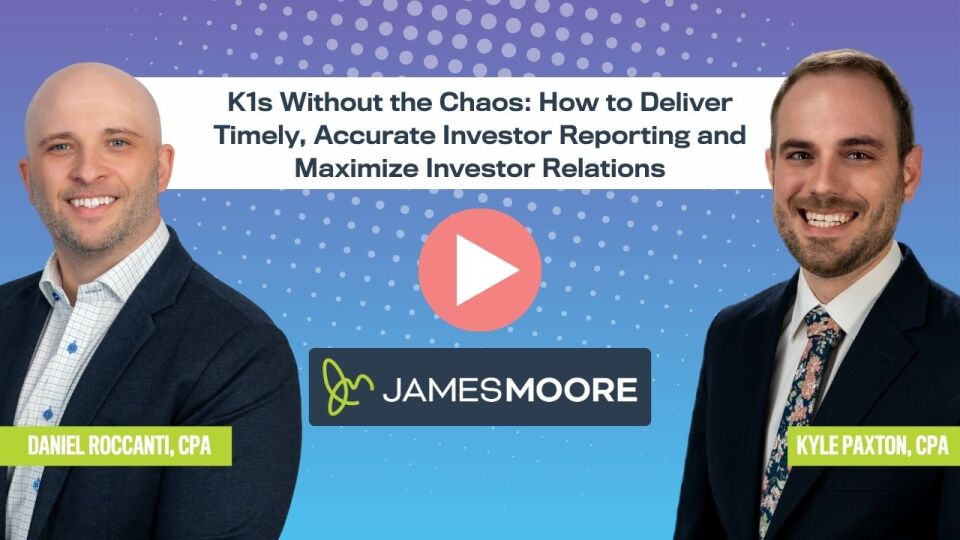
Late K-1s do more than frustrate investors. They can erode trust, trigger compliance issues and cost your team countless hours fielding angry calls. During a recent James Moore webinar, Tax Directors Daniel Roccanti and Kyle Paxton shared practical strategies for achieving timely K-1 delivery that keeps investors happy and your operations running smoothly. Their discussion highlighted why the path to stress-free tax season starts months before the March 15 deadline and why communication matters just as much as execution.
Why Timely K-1 Delivery Matters for Everyone Involved
The pressure to deliver K-1s on time extends far beyond simple compliance. For real estate sponsors and operators, the stakes involve investor relationships, team morale and your reputation in a competitive market.
The Investor Perspective
Investors care deeply about receiving their K-1s promptly because delays create a domino effect in their own tax planning. As Roccanti explained, “I can’t finish my personal return until I get my K-1, but there’s actually even more of a problem: What if the actual owner investor isn’t another individual but another pass-through entity?”
These tiered partnership structures mean that one late K-1 can hold up dozens of returns down the line. Paxton emphasized this point. “At the final minute, you get this K-1 that could impact five, ten, who knows how many returns down the line. And so what ends up happening to me as a tax preparer is, I get put in a bind at the last day because I’m trying to avoid my clients getting hit with late payment penalties, interest, and late filing penalties.”
When investors receive their K-1s on time, they can file by April 15, avoid extension headaches and plan their cash flow with confidence.
The Sponsor Team Perspective
Beyond investor satisfaction, timely delivery protects your internal team from burnout. Roccanti noted that “nothing destroys a culture, a team or the ability to do high-efficient, high-quality work like running around and trying to get everything done.”
The benefits extend to fewer investor complaints and reduced costs from amended returns. When sponsors rush to meet deadlines with incomplete information, errors happen. Those errors lead to amended K-1s, which Roccanti described as particularly problematic. “When you’re rushing, you don’t have complete information, and we’re having to amend returns. It gets costly.”
The Practical Timeline for March 15 Delivery
Achieving consistent K-1 delivery requires working backward from your deadline. The presenters outlined a clear timeline that every sponsor should understand.
January: Close Your Books Early
Year-end close should not feel like a unique event. It should feel like month 13 of your regular accounting cycle. Roccanti recommended completing your monthly accounting and year-end close by mid-January, which feels aggressive to many operators. “To a lot of people, that seems really too soon. You’re like, ‘There’s no way I’m not closing my books until end of January at the earliest, beginning of February.’ And the reality is that’s actually putting you a little bit behind.”
The key is maintaining discipline throughout the year. Lock your months and resist the temptation to backdate entries. As Roccanti put it, “You can’t go back. There’s got to be a period where I’ve locked the month and we can’t go back.”
February 15: The CPA Package Deadline
Your CPA needs everything by February 15 to deliver K-1s by March 15. This means more than just the books. The package includes core financials like trial balances and bank reconciliations, real estate support documents including fixed asset schedules and cost segregation studies, complete investor data with cap tables and ownership changes and any state-specific items.
Paxton emphasized why this timeline matters. “Partnership returns are really complex. So if you have a partnership return with 100 investors, waterfall allocations, we purchase real estate, we got a cost segregation… this takes a lot of time. No one’s a miracle worker.”
The Advantage of Getting Ahead
Sponsors who deliver their CPA package by February 1 instead of February 15 gain a significant advantage. Paxton explained, “Our teams have capacity right now. We’re waiting on the tidal wave, so we can hammer out a return in a couple days.”
Common Pitfalls That Delay K-1s
The presenters identified several repeat offenders that cause delays. Late monthly closes top the list, often caused by starting reconciliations too late or waiting on property management packages that do not match your books.
Investor data issues represent another major bottleneck. Missing W-9 information, outdated addresses and confusion about beneficial ownership can all hold up returns. Paxton noted a persistent misconception. “Now the IRS requires on schedule K-1 that the beneficial owner is listed as the partner. So if I, Kyle Paxton, own an LLC (called) Kyle Paxton LLC, and I say Kyle Paxton LLC is the partner, I’m the 100% owner in Kyle Paxton LLC… that reporting is incorrect.”
Third-party reports like cost segregation studies also cause problems when ordered too late. These providers face the same tax season crunch as everyone else.
Communication Makes the Difference
Setting expectations early proves just as important as meeting deadlines. Roccanti recommended reaching out to investors in early January or even December to confirm addresses, explain your target delivery date and outline how they will receive their K-1s.
If you need to extend, communicate immediately and explain the impact. Paxton described the ideal approach: “Hey, we have to extend. Here’s why. Here’s what the impact to you is. You have to extend your personal tax return.”
Build Your K-1 Process for Long-Term Success
Timely K-1 delivery is not about tax season miracles. It’s about systems, ownership and clear communication throughout the year. As Roccanti summarized, “Speed is a bookkeeping problem. K-1s are a tax problem.” Get your books closed early, deliver a complete CPA package by mid-February and keep your investors informed at every step.
The sponsors who master this process do more than avoid complaints. They build the kind of investor confidence that drives referrals and repeat investments.
Watch the Full Webinar
Want to dive deeper into K-1 best practices and hear more from Daniel Roccanti and Kyle Paxton? Watch the full webinar recording to get additional insights on CPA package checklists, state filing complexities and strategies for improving your year-end close process.