Real Estate Professional Status for Spouses: Tax Strategies for Married Couples
Originally published on January 5, 2026
“Getting the real estate professional status for your spouse is a powerful tax strategy. Just make sure you understand the rules and you’re keeping logs so if the IRS ever audits you, that you’re able to have all the supporting documentation you need.” — Daniel Roccanti, CPA
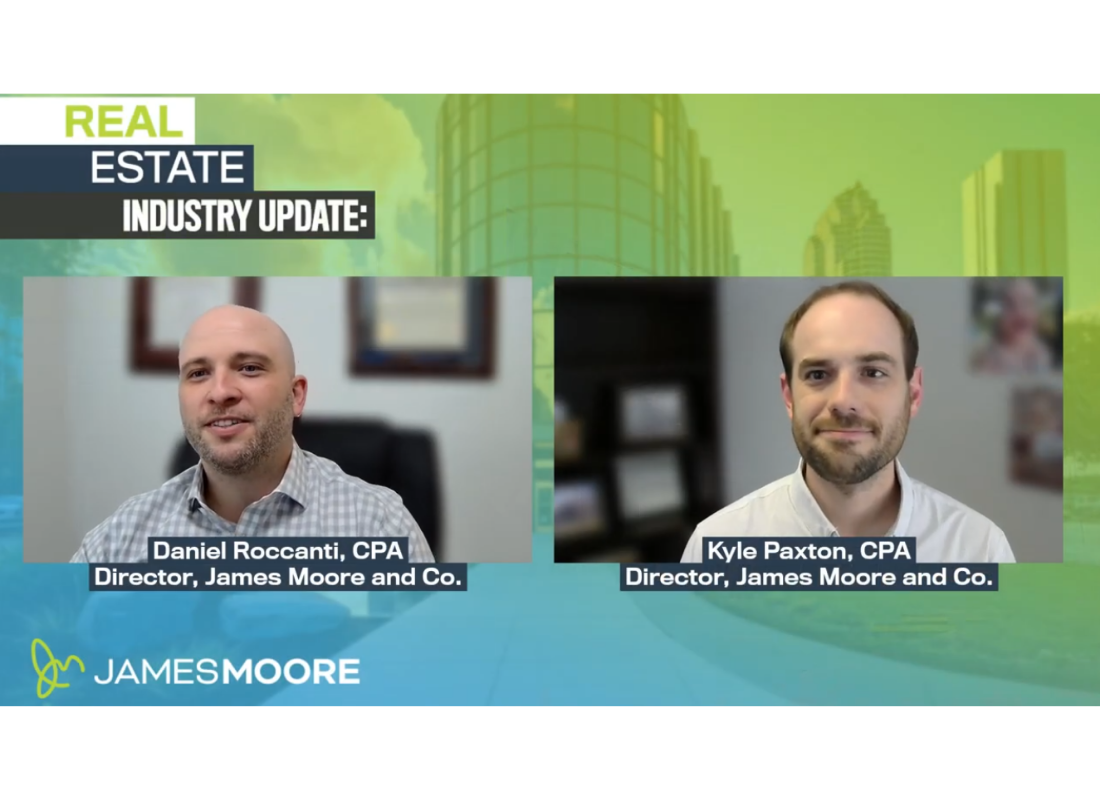
In this episode of the Real Estate Industry Update, hosts Daniel Roccanti and Kyle Paxton answer a viewer question about how married couples can qualify for real estate professional status. They break down the IRS requirements, explain where spouses can combine hours and share planning strategies for high-income earners looking to offset W-2 income with rental real estate losses.
Resources
- Real Estate Industry Update Video Series
- James Moore Real Estate CPAs and Advisors
- Real Estate Accounting Articles
Full Episode Transcript
[00:02] Daniel Roccanti: Welcome to another Real Estate Industry Update. I’m your host Daniel Roccanti here with Kyle Paxton. Today we have a subject that we’re going to talk about just because somebody in our comments of one of our videos kind of requested it. We love the ideas and the topics. Kyle and I always have to think of what’s a great topic to talk about based on our experiences. So anytime one of our listeners can just give us a topic that they want to hear about, if we can accommodate it, we will. But today’s topic is going to be on real estate professional status for spouses.
[00:38] Daniel Roccanti: So how does that work when you’re married? How can you qualify for real estate professional status? How can your spouse help out? Can you both get the benefit? We’ve heard from a lot of people—you probably heard from them too—that says, “Hey, I hear if my spouse can get real estate professional status that it helps me out.” So how does that work, Kyle?
[00:57] Kyle Paxton: Yeah, and just take a step back real quick. This is a really hot topic right now. It’s a great time to own real estate and be a real estate professional if you meet the criteria for tax purposes. Those kind of advantageous provisions around real estate were bolstered and renewed with the One Big Beautiful Bill Act. So this is a topic that I have been talking about almost daily here over the last several weeks as we kind of wrap up our 2025 tax planning and look forward to 2026. This is something where there’s big potential here if you do it right.
[01:18] Kyle Paxton: I want to caveat—it’s a nuanced area. There’s a lot of moving parts, so make sure as we work through this, you’re consulting with your tax advisor and how it works into your picture. But here’s how this works.
[01:42] Kyle Paxton: So when we’re talking about real estate professional status, the definition and kind of the point of real estate professional status is it takes your rental properties, which inherently for the average taxpayer—I’m an accountant, I am a W-2 employee—real estate is passive to me. So one of the major provisions of real estate professional status and kind of how this benefits is if I have losses on rental properties, I am severely limited in my losses as an accountant. Real estate professional status kind of shifts that character of the rental properties such that those losses now get more non-passive treatment and I can offset my other items of ordinary income. That is real estate professional status.
[02:37] Kyle Paxton: You can just look at the taxpayer itself, but then there’s also provisions that bring in taxpayer and spouse, and we’re going to talk a little bit more about how that works.
[02:45] Daniel Roccanti: Yeah, I mean really what we’re trying to do here is the real estate professional status just unlocks this benefit of taking your rental real estate losses against your non-rental income. So your active income—if you have a W-2 job, you can’t just offset that against all these rental losses. So the real estate professional status allows you to do that.
[02:57] Daniel Roccanti: So let’s give a basic kind of refresher. How can you even meet real estate professional status? There’s a few tests, and these tests are a year after year test. Just because you qualified for one year doesn’t mean you qualify next year. You have to qualify for it every year.
[03:16] Daniel Roccanti: So the first one is two key tests. It is you have to have more than 750 hours of services in real property trade or business, and then more than half of your personal services must be performed during the year in those real property trade or businesses. The key thing here is this has to be determined at the individual level, not the couple level. So what that means is you can’t share hours. One individual has to meet both of these tests. So 750 hours and then more than half of your hours have to be in the real property trade or business.
[04:07] Daniel Roccanti: And then there’s the material participation layer, Kyle, where you can help out with your spouses. So Kyle, what is material participation?
[04:07] Kyle Paxton: And one more thing I want to add in the real estate professional status before I jump in is the catch that gets most taxpayers is the more than half of your personal services. So I use the example of me as an accountant. I’m a full-time accountant, and while I focus in the real estate space in accounting, that is not deemed a real property trade or business for this purpose. So it would be really hard for me to stand in front of the IRS and say more than half of my time is spent on not my full-time job. Right? Tough sell.
[04:46] Kyle Paxton: So usually when you have W-2 income for a full-time position that’s not in one of these deemed real property trades or businesses, this is a high barrier to meet. As Daniel mentioned, this is just looked at the individual level. And so that can catch a lot of taxpayers here.
[05:04] Kyle Paxton: After you hit these two key tests for real estate professional status, you get to the material participation layer. So meeting real estate professional status by itself does not unlock this non-passive treatment on the rental properties. You have to hit real estate professional and then hit the material participation layer as well.
[05:24] Kyle Paxton: There’s a seven-part test, pretty nuanced. I’ll go over the big ones. And this is looked at with both taxpayer and spouse. So this is the test where you can bring in both taxpayers on your return to meet these tests.
[05:46] Kyle Paxton: The 500-hour test in the rental property—you participate in that activity for more than 500 hours during the year. If you’re hitting 750 for real estate professional, you should be hitting 500 hours for material participation. There’s a substantially all participation test—your participation is substantially all of the participation in that activity by all individuals, owners and non-owners. And then there’s a few other smaller tests.
[06:14] Kyle Paxton: And then number seven is the good old catchall facts and circumstances test. So if you don’t meet any of the six preceding tests for material participation, you can meet material participation with facts and circumstances. And that really just says you’re participating in the activity on a regular continuous basis. And the regulations generally say you would need more than 100 hours in the activity. But you know, we have some gray area we could play with on that facts and circumstances test.
[06:34] Kyle Paxton: So two pieces to this—real estate professional status which you have to look at individually, and then material participation in each particular activity which can be looked at with both taxpayer and spouse if you’re married.
[06:53] Daniel Roccanti: Yeah. So I think that’s an important caveat because most people think we can just use hours for everything. It’s actually very specific on which hours. But if you are able to meet it, this can be a great benefit to you on the tax return.
[07:00] Daniel Roccanti: So like high level, how does this look? If I’m basically a taxpayer and we’re married filing jointly, I have a high W-2 and I’m unable to qualify for real estate professional status or REPS if you want to shorten it. Then my spouse who can basically qualify for it because they qualify as a real estate professional, they materially participate in the rentals. Now I’m able to take these losses against my W-2 all because my spouse was able to qualify even though I wasn’t, because we filed married filing jointly. So all our income combines and we jointly get the benefit here.
[07:40] Daniel Roccanti: Do realize if you file married filing separate, you’re going to have a harder time. It’s not like it’s impossible, but your losses basically get locked into each separate return. We don’t usually recommend it. So if you are going after this, you really need to make sure you’re filing jointly.
[07:57] Daniel Roccanti: But it’s a great way that one spouse cannot qualify but makes a high earning, and the other spouse is able to qualify and maybe basically able to take those rental losses against non-passive income.
[08:07] Kyle Paxton: And one point I want to make here as we’re kind of talking about these rental losses and material participation is by default that material participation seven-part test I walked through looks at each rental activity you have individually. There are grouping elections available where you can aggregate together rental properties for purposes of meeting the material participation test. So that’s something to keep in mind and will make it easier to meet the test as a group as opposed to each rental individually. That’s something to keep in mind there. Again, that applies to that material participation test.
[08:41] Kyle Paxton: And one other point I want to emphasize in what Daniel said is if we are able to meet these tests and able to unlock real estate professional status, the benefit for our rental properties—that W-2 income can be anything. It can be an accountant. It can be a physician. It can be whatever it is. And you can offset that ordinary income totally unrelated to real estate with losses driven by real estate, which often just function off of depreciation and time value of money type of stuff and accelerated deductions where we can.
[09:10] Daniel Roccanti: That’s good clarification there. And let’s drill down now to the actual hours and how this works because there’s a lot of common misconceptions here, and this is going to get into the technical nuances of what hours actually count.
[09:25] Daniel Roccanti: So the first test we talked about was the 750 hours and half of your activity and hours have to be in a real property trade or business. This has to be met at the individual level. So spouses cannot help each other out here. Why does this matter? Because the 750 hours has to be met all by one spouse.
[09:45] Daniel Roccanti: So if one spouse is a W-2 person not working in a real property trade or business, that means the other spouse has to have at least 750 hours in a real property trade or business. The rules state that it only counts if you have at least 5% ownership in that real property trade or business. So this is where I see a lot of people basically kind of mess up.
[10:06] Daniel Roccanti: I have one spouse, high W-2 wages. They own all the real estate directly. And I want their spouse to basically be able to qualify for real estate professional status, but they don’t actually own any of the real estate directly. They don’t own any real property trade or business. So they need to be like a real estate agent basically.
[10:30] Daniel Roccanti: This is how a quick fix would be—okay, even though my spouse doesn’t own any of the rental real estate directly, they got to be a real estate agent who can get 750 hours in that way. There has to be some ownership here for the spouse to be able to qualify for the 750 hours. If one spouse has all the ownership and the other one has no ownership, you’re going to just have a difficult time.
[10:54] Daniel Roccanti: So you need to understand the little nuance here of hours count, but I have to have ownership. The reason why a lot of times people will not have ownership in both spouses’ names is because, as Kyle knows, it creates a little bit more of a complex tax situation because you created partnerships. Partnerships means extra filing, extra fees, extra whatever. But it might be worth it if you can’t meet real estate professional status. And so just make sure you understand that that first part has to be met at the individual level and each individual has to have at least 5% of ownership in a real property trade or business to get the qualifying hours for the 750.
[11:35] Kyle Paxton: And Daniel, you made an important clarification there we hadn’t directly touched on yet where the 750 hours doesn’t have to be in the rental properties themselves we’re trying to unlock. That can be any real property trade or business like a real estate agent, broker—you know, the list goes on and on. But you can meet the 750 hours in those kinds of activities like an active real estate operation. And then the material participation test is actually pointed at those rentals we’re trying to unlock. So two different things with a lot of overlap here.
[12:00] Kyle Paxton: You can meet the 750 hours just managing your rental properties, or you can have that separate real estate operation. So how you slice this can look a lot different. But those tests are real estate professional, real estate operations as a whole; material participation, more pointed at what we’re actually unlocking here.
[12:13] Daniel Roccanti: Right. And it’s important—Kyle mentioned this—that the 750 hours is in a real property trade or business. So it can be a separate trade or business like being a real estate agent, being a broker, owning a company in the real estate space. It could also count towards your hours managing your rental properties. But if it goes towards managing your rental properties, you got to have ownership in it. Direct ownership in it. That’s the biggest difference.
[12:49] Daniel Roccanti: But where the spouse can help out is at the material participation level. Basically, if you meet the first test—the 750 and more than half your time—now you have to materially participate in those rental properties. Each spouse can basically combine their participation here.
[13:13] Daniel Roccanti: So if one spouse has 300, the other spouse has 200—doesn’t matter if only one has direct ownership or not. That doesn’t matter. We can combine it here for these purposes. And now both spouses can basically have 500 hours and can materially participate even though one didn’t do it at the individual level. Again, the qualifying real estate professional has to meet the 750 hours on their own. So you can combine for material participation, you can’t combine them for the first 750-hour test.
[13:45] Kyle Paxton: All good stuff. Let’s talk about some planning strategies. So when we’re looking at how we plan around this, it really becomes how do we designate one spouse as a real estate spouse, right? Or what does this look like?
[14:03] Kyle Paxton: So this happens a lot. I walk through these conversations quite a bit. You have professionals that are kind of around retirement age maybe or sell a business or something of that nature where maybe they’re a successful physician—using an example—they’ve acquired a pretty large real estate portfolio. And they transition—maybe they sell their practice or whatever that looks like—as they transition out of that healthcare space.
[14:30] Kyle Paxton: Now we’re just sitting on all this real estate that we’re actively managing. And so we’re looking at how do we structure this, arrange this married couple who’s newly retired or maybe one spouse is still working. How can we structure your new roles to hit some of these thresholds? And then all this real estate that we haven’t traditionally been able to get the full tax benefit of necessarily, we can unlock this.
[14:59] Kyle Paxton: So I find this conversation comes up quite a bit in those transition stages. You can use a midlife crisis as an example—”screw my day job, I’m going to go do real estate.” So we look at what are our goals, what does each spouse want to be doing for the next one, three, five years, and how can we structure those roles to make sure we hit these thresholds.
[15:23] Kyle Paxton: So around planning, it is really—I mentioned like we should designate one spouse as that real estate spouse. To the extent they can, they should focus all of their efforts on the real estate holdings of the family and as little as possible on everything else, and then push any of that everything else to the other spouse.
[15:46] Kyle Paxton: So keeping clear documentation between the two really helps establish this is the spouse who meets real estate professional status. They have the 750 hours, more than half the time. And then when we look at these individual properties, now both taxpayer and spouse are involved in those properties and meet those thresholds.
[16:03] Kyle Paxton: Under audit, the IRS is going to look for time logs, especially if there’s gray areas or you have other sources of income that aren’t just from real estate spaces. Again, another big planning thing we do here is look at how can we group these activities together for the real estate professional to meet real estate professional status, optimizing the losses and everything else and trying to make sure it all flows cleanly as we make this transition. Daniel, do you have any other thoughts there on planning or things to consider?
[16:31] Daniel Roccanti: Yeah, it’s very important like Kyle was saying—you need to designate one spouse as the real estate professional. And then you need to understand the rules to how to get them there.
[16:47] Daniel Roccanti: And make sure that the spouse is on board. I’ve had conversations where the spouse doesn’t want to do all the work, and it’s like that’s fine. You’re not going to meet real estate professional status. But it’s probably more important than adding that stress onto your relationship. So just make sure both spouses understand—all right, do you want to meet real estate professional status? And then you need to have a plan in set.
[17:04] Daniel Roccanti: Meeting it is great, but then you need to actually understand what buying real estate looks like if you’ve never done it before, how the deductions work, how you can accelerate the deductions and everything. So it’s important to understand that.
[17:15] Daniel Roccanti: And documentation, like Kyle was saying—documentation is important if you ever do get audited, which these cases do get audited sometimes. That is what the IRS is going to be looking at. Time logs, making sure that you are tracking the time that you do.
[17:32] Daniel Roccanti: So common kind of pitfalls, red flags in these situations that we’re looking at. All right, if both spouses have full-time jobs basically in non-real estate space. So yeah, you’re going to have a hard time meeting this. All right. So if you’re interested in this, you need to understand probably both of you cannot have a full-time job in non-real estate.
[18:05] Daniel Roccanti: And a reminder—if you meet the 750 hours, you have to be a 5% owner in that real property trade or business. So even if I have a W-2 job in a real property trade or business but I’m not an owner of it, it doesn’t count. So I have to own at least 5% of the business of the real property trade or business to get it. So that’s the next step.
[18:25] Daniel Roccanti: If I’m just a normal employee of this real property trade or business, like a construction company or something, not going to be able to meet it. So we need to understand—all right, let’s make sure we understand the hours, half my time has to be in it. By just understanding that little nuance there. But if you can’t cross that one, don’t even worry about the other stuff.
[18:51] Daniel Roccanti: We already mentioned kind of time logs and things like that. You need to be prepared for an audit. People going down this route that have high W-2s that are offsetting it with substantial real estate losses—look, you just got to understand that you’re going to be higher on the list of getting audited when these things kind of happen. You’re not doing anything wrong—actually within the tax law and this is an absolutely normal thing to do. Just be understanding that there’s a lot of people unfortunately out there who don’t understand the rules, who are taking these deductions incorrectly. So just make sure you have documentation.
[19:25] Daniel Roccanti: When also—another one that I want to talk about is please understand short-term rentals and the real estate professional status have a whole different set of rules. This is not a conversation for short-term rentals, but it’s different. That strategy is a different strategy. You actually do not qualify for real estate professional status. The whole short-term rental loophole is you’re actually not treating it like rental real estate.
[19:55] Daniel Roccanti: So if you have a lot of short-term rentals, it could actually sometimes make you not meet real estate professional status. So you want to make sure that you understand that the real estate professional status is for rental activities, long-term rentals. It’s not for short-term rentals. That’s a whole different thing where you don’t have to meet real estate professional status. You can still take the deduction, but they could have a negative consequence on your real estate professional status here.
[20:14] Daniel Roccanti: So those are kind of the common red flags that I kind of just see in my time. And then, let’s kind of get into a very quick high-level case study. Really quickly.
[20:25] Daniel Roccanti: All right. So let’s say you have a high W-2 medical—on the healthcare kick in this video, so we might as well lean into it.
[20:33] Kyle Paxton: This happens a lot. Medical, finance—these are probably the top two categories I see for these people. You know, high W-2 wages. They can’t meet real estate professional status. There’s just no way. But they’re trying to find ways to offset this high W-2. It can be in excess of a million dollars sometimes, some of these W-2s.
[20:55] Kyle Paxton: Let’s be clear—I don’t want my surgeon to be able to meet real estate professional status. I need them bettering their craft. Sorry, go ahead.
[21:04] Daniel Roccanti: Right. And so they have a spouse who either doesn’t work, does part-time work, sometimes been the homemakers, take care of the kids, things like that. Now they’re interested in this. They start getting serious into real estate investing because they’ve heard of all the tax benefits.
[21:24] Daniel Roccanti: So when we’re dealing with this, we go, okay, we need the spouse to be the designated real estate professional. And now we have to say, all right, how do we get to 750 hours? How do we have more than half the time? How do we make sure that we’re meeting material participation?
[21:39] Daniel Roccanti: So they need to handle all the rentals. They manage the rental opportunities. Maybe they become a real estate agent, do some real estate agent stuff on the side. If they’re not doing anything like that, then it’s important that they have some at least 5% ownership in these rental properties.
[21:55] Daniel Roccanti: Sometimes all the rental properties will be in the medical professional’s name. And so the spouse doesn’t actually have any direct ownership and that could cause problems there. So does it make sense to create, give some ownership—you can transfer ownership between spouses easily. So creating a partnership or transferring one of the rental properties 100%—they just have to have some kind of ownership in this kind of thing.
[22:21] Daniel Roccanti: That is just kind of a high-level scenario. Then they’re buying rental properties, potentially looking at cost segregations so that they could take hundreds of thousands of dollars of depreciation right away. And now that million-dollar W-2 that they have maybe now only looks at about half a million dollars in taxable income and wipes away a substantial part of all of their taxes aimed at the highest tax rates possible.
[22:45] Daniel Roccanti: That’s important to consider. Wiping away all income is not always the most effective way of tax savings. You want to make sure you’re wiping it away at the highest tax rate. The lower the tax rate, just the less effective it is to wiping away all your taxable income.
[23:03] Kyle Paxton: There’s that juicy tax refund that everyone talks about with that. All right, let’s wrap up here. So a couple key points I want to make before we get out of here.
[23:10] Kyle Paxton: Real estate professional status is met individually, and then the married couple together can meet material participation in the individual rental activities or a group if you bring them together.
[23:22] Kyle Paxton: For real estate professional status, that’s 750 hours, more than half your time. You cannot stack hours between the two spouses. Again, that’s a material participation concept.
[23:35] Kyle Paxton: And then all the tax planning around this is whether—how do we meet both real estate professional status and the material participation. Once we do that, okay, how do we generate these real estate losses that we talk about to offset ordinary income? Cost segregation is a very—feels like low-hanging fruit way to do that.
[23:56] Kyle Paxton: And then as Daniel pointed out, we play around with the timing. So if you have 10 different properties, you probably don’t want to cost segregate all of them on day one when you meet this status. You want to stagger it so we can optimize—where are we getting the most tax savings, what years do we have maybe unusual sources of income we need to mitigate?
[24:10] Kyle Paxton: There’s a lot of planning that goes into that and it’s a lot of back and forth with your tax advisor to make sure that we’re fully optimizing that. And so that’s big in what we do kind of right around year-end—a lot of those conversations.
[24:25] Kyle Paxton: And then keep in mind with cost segregations, you really have until you file the tax return to complete these things. So that’s not necessarily something—no part of this decision has to happen at year-end. Be mindful as you’re gathering your tax documents, thinking of that sort. I mean, the planning should be done well in advance for the time logs and everything else, but there’s still opportunity to bring up some of these conversations as you get your tax return prepared. So keep that in mind as we dive into spring here.
[24:55] Daniel Roccanti: Yep. Getting the real estate professional status for your spouse is a powerful tax strategy. Especially with 100% bonus depreciation back, just make sure you understand the rules and you’re keeping logs so if the IRS ever audits you, that you’re able to have all the supporting documentation you need.
[25:10] Daniel Roccanti: Thank you for tuning in to today’s episode. We hope you found our discussion insightful and valuable. If you enjoyed this episode, please subscribe as we produce frequent videos related to real estate. Join us next time for more expert insight and tax strategies to help you maximize your real estate investments. Till then, stay informed, stay proactive and happy investing.
[25:30] Announcer: To learn more about James Moore and Company’s real estate accounting and business solutions, go to jmco.com. And don’t forget to subscribe to our Real Estate Industry Update series to receive updates when new videos are released. If you’d like to be a guest or if there’s a topic you’d like to see covered on a future episode, contact us through our website or email us at info@jmco.com. You can also follow us on social media for more news as the landscape of real estate continues to evolve.
Have questions about whether real estate professional status could work for your situation? Contact our real estate tax team to discuss your specific circumstances and develop a tailored tax strategy.