How Manufacturers Can Survive and Stabilize During Rapid Growth
Originally published on March 11, 2026
“Rapid growth can feel like chaos. The whole point is to bring that chaotic feel to more clarity.” — Kevin Golden, Partner, James Moore
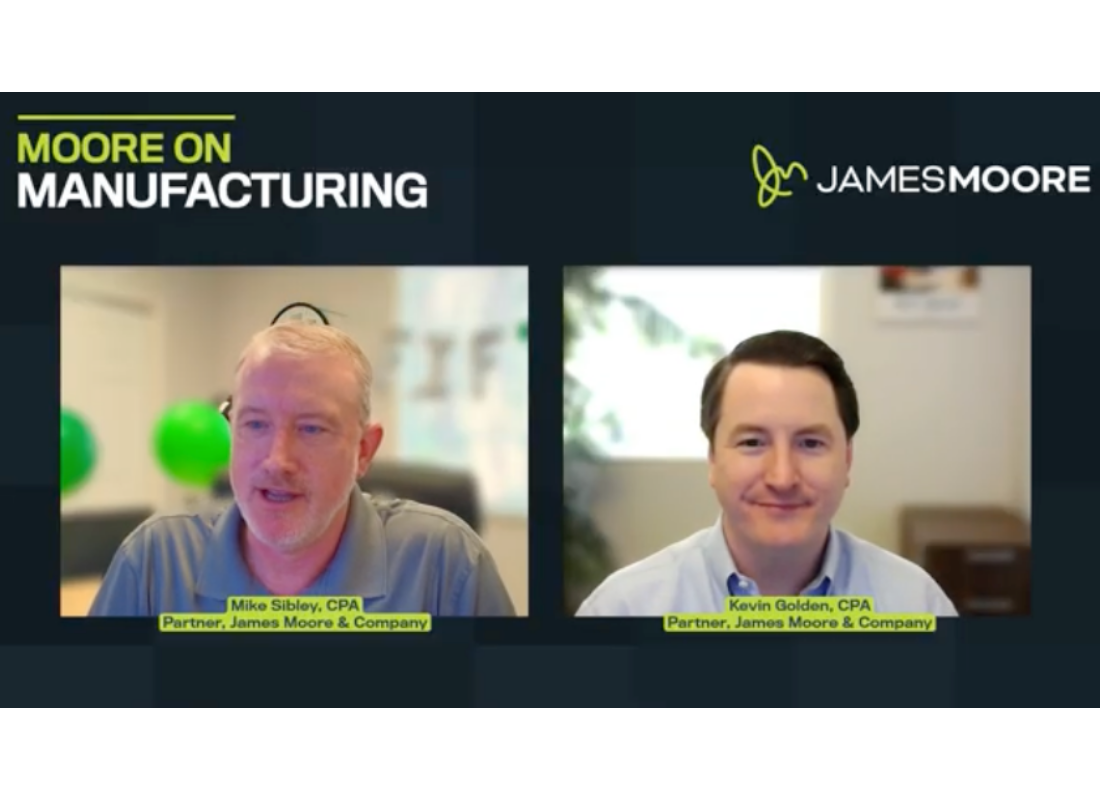
Manufacturing growth is a good problem to have until the systems meant to support it start breaking down. In this episode of Moore on Manufacturing, James Moore partners Mike Sibley and Kevin Golden break down the operational and financial warning signs that manufacturers often miss during periods of rapid expansion, and what to do about them before small problems become serious ones.
Resources
- Manufacturing Advisory Services – James Moore
- Fractional CFO Services – James Moore
- Moore on Manufacturing Playlist – YouTube
Full Episode Transcript
[00:03] Mike Sibley: I’m Mike Sibley, partner and leader of the manufacturing team here at James Moore Company. I’m joined by my partner and also member of the manufacturing team, Kevin Golden. Today we are talking about a challenge that would make most companies really happy but aren’t necessarily always prepared for. We’re talking about rapid growth, and rapid growth can be defined in any number of ways for a company. It could be 20% in one year, it might be 10% or 30% in one year, depending. There are a lot of challenges that can come about because of rapid growth. It exposes weaknesses. It can really strain systems, and often times management or ownership is experiencing it but not sure what to do with it, or even what the telltale signs are.
[00:45] Mike Sibley: The other piece with rapid growth is it doesn’t necessarily mean growth in one year. It could be rapid growth over a period of years, or it might be sustainable growth that’s been happening so long and you’ve been busy but not necessarily looking at infrastructure and the pains that come with it.
[01:16] Mike Sibley: Today we’re going to discuss the scaling pains we see and share some examples of how manufacturers stabilize during that period. We’re actually going to do this in a two-part series because there’s so much Kevin and I could talk about all day long. We’re going to cut this into two parts. The first part here we’re going to cover operational strain, cash, inventory and systems, and then next time we’ll talk more about job costing, hiring, protecting margins and things of that nature. Kevin, welcome as always. Looking forward to a good conversation.
[01:53] Kevin Golden: When we talk about this, sometimes you hear a country song, there’s no such thing as too much money, too much fun. But when we think about growth, there can be too much growth. A lot of times it’s not that we don’t want that growth, but are we ready for it? What got us to where we are today is not necessarily going to get us to tomorrow working on the same systems. You see yourself very busy, but you’re not prepared to handle that type of growth, whether it’s expected or not.
[02:32] Kevin Golden: While we may say too much growth can be a bad thing, I think too much growth without any other changes, without preparedness, without infrastructure, is really what we’re talking about. That can make you feel disorganized, running all over the place but not really getting anything done. More importantly, you should always be building value in your company. Being busy and growing, that’s great, but are you actually building value with your company more so than you were previously?
[03:03] Kevin Golden: When we start talking about systems and processes and companies growing, a company that’s a $5 million company is very different from a company that has become a $10 million company, $15 million, $20 million. It seems like every $5 million there are these institutional changes that need to happen in how you’re operating.
[03:50] Mike Sibley: What ends up happening is that when you have a lesser amount of throughput, it’s easier to get your head around things. It’s easier to see it, easier to touch it, maybe manually move things through. You have more control. But as transactions start increasing, it’s harder to have your finger on the pulse of everything. Transactions are increasing faster. Customers want better lead times. They want things sooner. So everything starts going faster, but our systems are often still back where they were when we were smaller.
[04:35] Kevin Golden: Let’s talk about some signs that growth is outpacing your infrastructure. We see things like cash flow getting tighter despite revenue growth. Working capital is really getting tight. Everyone says, “Your sales are growing, you must be flushing cash.” Not necessarily. It doesn’t work that way because of the working capital timing and those pressures.
[04:55] Mike Sibley: Another area, we might have more quality issues, production errors, missed deadlines. We might have inaccuracies and stockouts. I hear this a lot with growing companies where they can’t produce whatever it is because they’re waiting on parts, raw materials or something critical. You get to a point where you have to stop, or you have a whole line that’s down because you don’t have those parts. Now you’ve got downtime, excess overhead costs, inefficiencies and utilization issues. What happens is you start taking hits to your margin. That starts leading to profit leaks, and the problem is you may not even see it unless you’re really in tune to your margins and changes in margins.
[06:16] Mike Sibley: If as an owner or your leadership team you’re just firefighting all day long as opposed to strategy planning and really working on the business, you’re going to find yourself falling behind because you’re not having the opportunity to work on proactive corrections.
[06:40] Kevin Golden: A statement I’ve heard people say, especially on this kind of growth trajectory, is, “I know it looks good on paper, but I didn’t make any money.” They don’t really mean they sold their items at a loss. What they mean is there’s no cash to show for it. That’s what you feel when the bank account is low. Maybe you had a lot of capital expenditures, and do you have clarity into when those should have been made? Do you have clarity into what the real price point of growth is? What are all those increased costs, those profit leaks? Your cash is just tied up elsewhere. Or is your pricing up to date? We saw a lot of that during COVID where things took an unnatural spike. If we’re not ready to adjust accordingly, there goes another profit leak. We’re working on yesterday’s numbers with today’s sales.
[08:00] Kevin Golden: It’s also a stressor. Think about the good old days when you were operating under $5 million and doing really well. Now you just feel really stressed out, in addition to cash flow tightening and all these other things. If it’s stressing you, it’s probably also stressing the people working for you. Growth is not a bad thing. It’s unchecked growth that makes you feel like you’re doing more but not really keeping up with what it takes to do that. You’re stressed out, cash is tight, and work isn’t as fun as it used to be.
[08:57] Mike Sibley: Let’s start with working capital because it’s literally your cash, your accounts receivable and your inventory, what you can convert to cash, less what your payables are to vendors. Think about what happens when production increases. You have to buy inventory. You might have 30-, 45- or 60-day terms with vendors. You have to pay people to make the products, pay supervisors, pay overhead, rent and utilities. All that cash is going out.
[10:22] Mike Sibley: Maybe it takes a couple of weeks to make a product for a customer. Now you’ve got all that cash tied up. You ship it out, and maybe the customer has 30-to-60-day terms. You could be paying cash and being out of cash for anywhere from 45 to 90 days before you finally get paid. The more you grow, the more working capital gets tied up, and it really affects your cash. One of the biggest missing things in companies from zero to $100 million is a true working capital management process. It doesn’t need to be the most sophisticated process, having that management process around working capital, 13-week cash flows and a process around accounts receivable collections can get you going in the right direction.
[11:20] Mike Sibley: I can’t tell you how many clients we work with where they don’t have an actual accounts receivable follow-up process. The cash comes in whenever it does, and customers with 30-day terms get trained that 60 days is okay because you don’t follow up with them. Instituting a working capital management system highlights the areas of concern and gets you control.
[11:45] Kevin Golden: You hear from owners and key employees, “I’m too busy. I can’t focus on things.” It’s actually quite the contrary, you can work yourself out of business. You can work yourself into a hole where you have to make drastic changes. Instead, think of that time as more of an investment. You can’t afford not to. As you’re growing, revenues and all those numbers look good on paper but they can mask those underlying issues. It’s like a slow drip. You don’t have a flood because you’ve got a few droplets of water. Over time, as those droplets become more frequent and bigger, next thing you know you’ve got a big water issue on your hands, as opposed to cutting it off when it was just a small drip.
[12:51] Kevin Golden: I would encourage any manufacturer who says, “I’m just too busy for that” that’s the time to step back and ask: What structure do I have? What people do I have? Why don’t I have that? You have to spend some time on these things, or hire the right people around you who will. There’s one thing to be a manufacturer, and another to run the company. You can work yourself into quite a hole. My takeaway is you literally can’t afford to ignore these items, and waiting for it to become a huge issue means sometimes it’s simply too late.
[13:12] Mike Sibley: Pricing is a really important concept. An easy way to look at things is your material cost as a percentage of sales. You start seeing that get higher, meaning raw material costs are rising, and pricing is not keeping up with what’s happening in your cost system. Raw materials go up, wages go up, utility costs go up, but if your pricing is remaining flat, you’re minimizing that margin. That margin eventually turns into cash. If your costs are creeping up and your working capital is getting used up, you’re producing less cash. It’s about having the systems in place to evaluate this over time, the KPIs, the dashboards, the easy ways to look at something quickly and know you’ve got a problem.
[14:47] Mike Sibley: Your revenue might still be going up, but your margins are going down. Rapid growth is great. Rapid growth with declining margins can be really bad.
[15:33] Kevin Golden: One sign that you have a problem, whether in pricing or other profit leaks, is to ask: what’s your profit margin on the products you manufacture? Then go and actually look at what your profit margin has been on those. A lot of times they’re not going to be the same, and sometimes not even close. It could be in pricing. It could be in rising costs you’re not aware of that are creeping into your margins and eroding them. The first thing is knowing you have a problem. Ask yourself: how much am I making on this product? Then go actually look at your financials. You’d be surprised how that simple question starts you down a path of, “Well, that’s not what I expected.” Then you go back and forth with your team and find costs you didn’t realize were in there. It’s usually not overnight, it’s slowly over time, all these moving variables giving you an outcome you weren’t expecting.
[16:54] Mike Sibley: Let’s step back for just a second. We’ve talked about working capital, cash and revenue. Things happen over time. Often times you won’t see your margin go from 50% to 40% overnight. What happens is it goes from 50% to 49.8% to 46%, and it slowly declines almost imperceptibly because your revenue is going up, your dollars are going up, but you’re not paying attention to the percentages. Growth in revenue doesn’t equal growth in every other category. It could mean growth in costs and loss of margin. We have to put in the systems to make sure we don’t experience death by a thousand cuts.
[18:29] Mike Sibley: Now let’s transition into talking about inventory. We’ve talked about cash. Let’s talk about the inventory issues manufacturers may face. Kevin, do you want to take this one?
[18:47] Kevin Golden: On inventory, a lot of what got you to where you were is not necessarily going to take you where you need to go. Some signs of an inventory breakdown: a lack of visiblity. Where is my inventory? What’s coming in? What’s going out? Where is it in between? That leads to not knowing what you need in the future and whether your supply chain is aligned with that. You may also experience excess stock, or worse, orders you have to rush through the system, which naturally leads to errors, rework and things that cost money. Maybe you’ve got manual processes that worked at $5 million but you simply don’t have the time or capacity to do manually at $10 million. You may be working on an outdated system that needs to be automated or updated.
[20:35] Mike Sibley: I might make the most obvious statement ever said on any podcast, cash is your most valuable resource. What we’re talking about is establishing systems to secure, save and protect that cash. We’re not saying don’t use cash. Cash is necessary to grow. But it’s how you use it. We need to protect our most valuable resource that’s going to keep us in business. You can borrow cash for a while, but at some point that borrowing catches up with you and you run out of cash and out of ability to maintain it. We want to generate profits so we can generate cash. We want to turn our receivables into cash, our inventory into cash, buy capital equipment that will make products that build cash. Everything we’re talking about is preserving and building cash for the future.
[21:37] Mike Sibley: Forecasting is very difficult, but there are ways to do it, getting forecasts from customers, being more proactive with customers, or using statistical analysis to help plan. But think about this: if you buy too much inventory and you get a 5% discount for buying a year’s worth, but you’re into your line of credit at 10% interest, and if that inventory goes obsolete, you’re spending more than you saved. You literally took your cash, threw it in a barrel and threw it away. Carrying costs on inventory can run anywhere from 20 to 30%, which is just a general average. If you’re also borrowing heavily on your line of credit, that adds to it. We have to look at these components and ask what actually makes sense.
[23:53] Kevin Golden: One thing to add on purchasing, you often hear, “Why do we buy this amount? That’s just what we always do.” Get away from that. Challenge the status quo, whether it’s on process or purchasing habits. Even if you don’t have a problem today, stress test it. If we have an aggressive growth goal of 10% a year for three years and we actually achieve that, what does that mean to our systems? How do we handle that with how we’re currently purchasing and spending cash? What does it mean to our people? You’ll see very quickly where the shortcomings are going to be in the future so you can start making small changes today that won’t become a big undertaking later.
[25:10] Kevin Golden: Stay ahead of that growth curve by looking at your ERP, how you’re tracking all your processes and procedures. Does it make sense, or are you just working off of “that’s what we’ve always done”?
[25:42] Mike Sibley: You do have to work on the business and look ahead and prepare to handle the growth. If you’re in a period of rapid growth and you feel like you can’t think about three years from now, I get it. But as you’re doing it, let’s put some basic systems in place that can be built upon.
[26:12] Mike Sibley: Going back to inventory for a minute, I remember working with a client and we were analyzing their inventory. I said, “You’ve got about three months of this part on hand. How long does it take to get it from a supplier?” They said two weeks. So they could literally wait two months, then order and still be fine. That very same day, a purchase order came through for that part number for another $50,000, and they already had three months on hand. The order wasn’t needed at all. It was errors in the system, falling back on old habits, a lack of control over the ordering process. Creating visibility around orders and actual needs is critical.
[27:27] Mike Sibley: On top of that, often you hear about minimum order quantities or bulk discounts. We have to work with suppliers where we can. Sometimes they’re larger than you and you don’t have that leverage, but how do you build those relationships to deal with minimums and pricing? With discounts, you have to do the math. Is it worth it? How long will it take to use that inventory? Carrying costs, borrowing costs, all of this hurts your profit, strains the business, hurts your cash and can affect your ability to deliver on time to customers.
[28:51] Kevin Golden: Where does this lead us back to? As a manufacturer in rapid growth, ask yourself: Do you know where your inventory is? Do you know how much you have and how long it’s going to last? Are you finding yourself having to make a lot of exceptions you didn’t used to? Are you able to see in your systems how much you’re actually making on products, and how does that compare to the past? These are basic questions that lead down paths of, maybe that process needs to change, maybe we need to reevaluate our vendor relationship or our purchasing policy. It doesn’t have to mean recreating the wheel. But if you don’t make these tweaks during expansion, at some point you will have to recreate it by force, or worse, you’re going to lose a lot of money.
[30:23] Mike Sibley: Evaluating all along and making those tweaks as you go will lead to more long-term success. As we come to an end here, you’re going to start seeing these pains early. They’ll show up in your cash flow, inventory issues, systems and reporting, and you’ll feel your leadership team or yourself going from planning to firefighting. As you start experiencing that, take the time to put some of these things in place to protect yourself. That’s why people like Kevin and me and others at James Moore are there to help. But you’ve got to take those steps.
[31:40] Mike Sibley: As I mentioned, this is a two-part series. Part two will go deeper into job costing, margin compression, hiring, maintaining margins and KPIs. Kevin, any final words?
[32:21] Kevin Golden: Rapid growth can feel like chaos. It’s a good problem to have, we want to be more profitable, we want people to want our products. But it can feel chaotic. The whole point of this is to bring that chaotic feel to more clarity. You’re still busy, you still have a lot to do, but at least there’s some clarity that brings confidence to you, your vendors, your stakeholders and any third party now or in the future who may be looking at you and saying, “They’re building it the right way. They’re building that value. There’s a lot of clarity here.” That’s where your ultimate value, both currently and in the future, is going to come from. Taking that chaos and making it clear.
[33:03] Mike Sibley: Chaos to clarity. Thanks, Kevin. Thanks to all of you for joining us. Be sure to look for part two as well. As always, if you have questions or thoughts, please feel free to reach out to us.
Want to hear it straight from the James Moore manufacturing team? Watch the full episode on YouTube and subscribe to the Moore on Manufacturing channel so you never miss a new episode.
All content provided in this article is for informational purposes only. Matters discussed in this article are subject to change. For up-to-date information on this subject please contact a James Moore professional. James Moore will not be held responsible for any claim, loss, damage or inconvenience caused as a result of any information within these pages or any information accessed through this site.