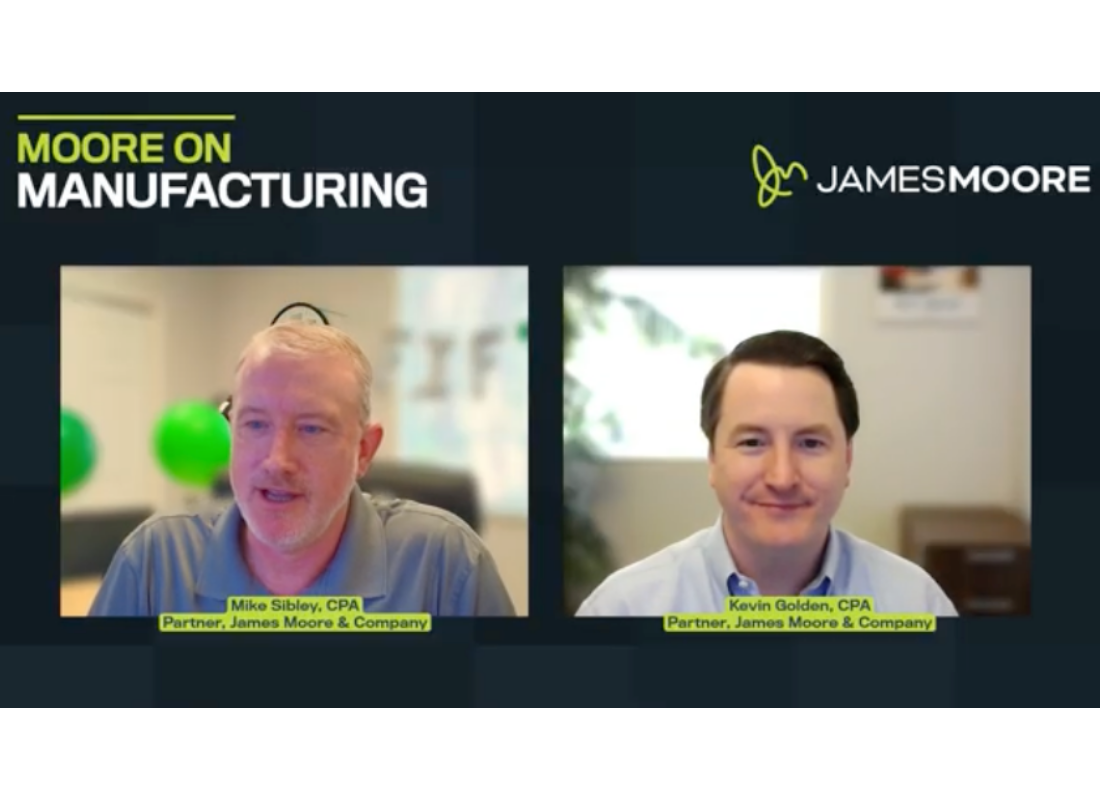
Connecting Operations and Financials with Kevin Golden
Originally published on March 9, 2026
“If we don’t have some of these foundational issues fixed, forget trying to fix supply chain. Forget trying to tie operation to finance.” – Kevin Golden
In this live episode, JMCO manufacturing expert and advisor Kevin Golden breaks down how strong financials and strong operations are inseparable, why inventory is one of the biggest make-or-break areas for manufacturers and what early warning signs show up fast when the foundation isn’t solid. They cover common blind spots like cash flow, inventory visibility and supply chain risk, plus why “that’s how we’ve always done it” can quietly turn into costly problems over time.
Full Episode Transcript
[00:02] Faith: Hi everyone and welcome to the JMCO channel. I am with Kevin Gold today. He is a manufacturing CPA and strategic adviser at James Moore. It’s so good to have you Kevin.
[00:12] Kevin Golden: Thanks for having me. Glad to be here.
[00:14] Faith: We’re going to have a great conversation today. We’re going to be talking about a manufacturing CPA’s knack for numbers versus an advisor perspective. I think because we have a lot to cover, I’m just going to jump right in and just kind of go down the list and ask you some questions so we can get some of your expert advice on everything. So right at the beginning, what do you actually help manufacturing clients do day to day?
[00:42] Kevin Golden: Well, day to day a lot of times manufacturers, they know what they know really well about what they produce and they often see everything else as separate from that. So in this case, finances are separate from operations. And that’s really not the case. They’re all intertwined. One affects the other. So really, if you want to boil it down, we try to work with them to help them make those connections. There’s a lot of different ways to do that. But ultimately, if their workers, if everyone can understand what they’re doing on the floor, in the offices and so forth, how that affects their financials, now we’ve connected those two together. They’re going to have a much better understanding of how they can help the company be profitable or prosper or meet their goals.
[01:18] Faith: I love that. What is the first number that you look at?
[01:22] Kevin Golden: I think that kind of is contextual depending on why I’m looking, but let’s say I’m introduced to a manufacturer and maybe I’ve got their financial data in front of me. The first numbers I’m looking at are generally two things. Revenues and then their total assets, specifically focusing on their inventory. Why? Because every manufacturer has inventory. And that’s where there can be so many problems, pitfalls, but also kind of just gives me a good idea what kind of size of manufacturer are we talking about. Why? Because with every different level, you’re going to have different types of problems, different types of pains that may exist at a higher level don’t exist at a lower. Those are more advanced or more “I’m just starting up a new manufacturer” types of problems. So really, it puts me in perspective. Okay, where is this person coming from? What kind of problems may be existing in their company? Put in the right mindset before then we jump into problem solving or what can we do to help.
[02:31] Faith: I know that was a pretty broad question. All right. What signals trouble quickly?
[02:38] Kevin Golden: Well, so I like to start foundational. As basic as it sounds, just your financials. Do they make sense? So let’s take inventory for example. Do I just see one line item for inventory and that’s it? That is what it is. What makes that up? Well, a lot of times if that’s not presented properly, it’s probably because they don’t track that or they’re not sure what makes that number up or it feels like just an arbitrary number. Whereas in reality it represents real stock that we have which represents cash. So to me, because it’s so consistent across no matter what type of manufacturer you are, you’re going to have inventory and because it affects everything you do, inventory is usually where a lot of the pitfalls are going to be whenever you’re looking at it. So kind of a red flag is, is inventory broken out or is it just one line item on there? Then you look for things like, okay, does our balance sheet make sense? Both in the numbers, but also how long it is. When we’re looking at these and there’s accounts all over the place, things look like they haven’t changed in ages, things like I don’t know that I’m looking at live data. I may be looking at stale data here. So these are just kind of red flags that tell me, okay, if we don’t have some of these foundational issues fixed, forget trying to fix supply chain. Forget trying to tie operation to finance. We’ve got to kind of get your foundation set because everything else is based upon that.
[04:11] Faith: I love that. What is the first behavior or decision you notice from an advisor perspective?
[04:28] Kevin Golden: First of all, I think we go into a lot of questioning. When I come in and talk with them, yes, I know about manufacturing, but I don’t know about your manufacturing company. I have to put myself in your shoes. So I’m just going to start, I’m going to learn as much as I can just like a new person working on the job. I’m going to ask a lot of questions. And so that is going to tell me really quickly based on how you answer, the type of things that you answer, here’s areas we need to focus on or not, or maybe areas that are problems or not. And you’d be surprised if you just simply listen. People will talk. People will tell you, especially when they know you’re just trying to help them. So again, just learn as much as you can. That’s my first behavior before we just get into what my assumptions may be on our problems or not problems. I’ve got to learn a lot about them first, then start applying my experience of manufacturing or my expertise as an accountant and my tax knowledge in there.
[05:32] Faith: So what are like early red flags you’ve seen or what do you think could be a pretty big warning sign?
[05:40] Kevin Golden: In those conversations, I’ll ask things like, “Well, what system do you use to manage your inventory?” “Oh, well, we write it on a piece of paper that we hand around every day,” or it’s on a very manual system, Excel, things like that. I’m not saying that can’t work. It can, but it’s just a red flag. Because how often is that being updated? How much manpower is that taking to be updated even if it is correct? Another question I like asking is, okay, for whatever product you make or set of products you make, how are your margins on this? What’s your profit margin? Because I tell you what, almost every single owner is quick to say, “Oh yeah, it’s 20%, it’s 40%, it’s whatever, it’s 10%.” And then you actually look at the profitability by product and or just the margins overall and they’re not there. That right there tells you something’s wrong. Either you’re basing that off of old numbers or your numbers are wrong. Something in there is a red flag to say, “Hey, maybe we’re not in tune with what our actual costs are.” Asking for things like a bill of materials. I mean, that just tells you what goes into your product. Are you aware of that? You’d be surprised at people who know or think they know but then they can’t produce a bill of materials. So usually that’s a red flag. Maybe there’s hidden costs in there that have crept up over time. But yeah, you’ve got the basics of raw materials and things like that go in there, but there’s a lot more that goes into manufacturing or making your product than just simply raw materials.
[07:16] Faith: No, it’s totally true. So we’re going to kind of shift over to where manufacturers struggle. What are the most common blind spots?
[07:24] Kevin Golden: I think if I had to highlight three, for example. One, cash flow. I mean, it’s so working capital intensive. So much of it can be tied up in other areas within your organization that cash flow is always a problem. We always need more cash and we need it now. So cash flow. Another blind spot is inventory. It’s not just is my number correct, that could be one facet of it, but am I aware of the demand I need on my inventory? Am I carrying too much? Am I carrying too little? Am I carrying the wrong thing that’s now getting outdated and stale? And that’s a waste of money. Maybe that’s causing some of my cash flow issues. And then that feeds right into supply chain. Am I aware of what those are? Do I know even what my supply chain looks like, where my concentrations are? Do I know what their terms are, what the demands upon maybe my vendors are? Because that’s going to trickle down to me as a manufacturer. Again, what kind of relationship do I have with those vendors? Do I have multiple vendors? Those are all types of areas that again, you kind of get used to doing the same old same old. And while that may have been tried and true and worked, we live in a totally different environment today than we did even just last year. So being in tune with those types of things when you’re not signals a red flag that maybe those are areas that simply we’re just not paying enough attention to that could be impacting us in many ways.
[08:41] Faith: Well, this is like a great lead into this next question. What small issues tend to become costly over time?
[08:50] Kevin Golden: Yeah, I actually just talked with somebody about this today. It’s applying, I hate the reasoning, “Well, that’s the way we do things” or “That’s why we’ve done it.” I mean, manufacturing today is not your grandfather’s or great-grandfather’s manufacturing that people think in their minds. So why should your process, your procedures, your thoughts about it be the same either? I’m not saying that you have to recreate a wheel every year, but really if we just say, “Well, why do we do that?” and we say, “Well, that’s just the way we’ve always done it,” then yeah, okay, maybe immediately it’s not going to be doom and gloom. But over time, what makes sense if you were a million dollars in revenues may not make sense now that you are five million, 10 million, 20 million in revenues. It’s just a system that doesn’t work anymore underneath those set of criteria or even the environment of your customers, of your vendors and what that looks like. So again, I like questioning that a lot. And if I get a response of, “Well, that’s just how we’ve always done it,” okay, well then you could probably expect results the way you’ve always done it as well. So again, it may not be immediately, “Oh my gosh, now everything’s gone.” But over time, ignoring those little things like an update to process and procedure to make sure your drivers are actually driving what you think they are, that can lead to some bigger issues that are forcing us to rethink all those things.
[10:31] Faith: And this is another good question. Do owners typically call you before or after a problem arises?
[10:38] Kevin Golden: Most of the time they’re going to call you after it arises or there’s at least something. Think of it like a doctor. I don’t usually just call the doctor and say, “Hey, how’s it going? It’s a nice day today.” I call them and say, “Hey, my stomach hurts. Hey, I’ve got a bad headache I can’t shake.” And it seems pretty easy, right? Like they’re not. But what they don’t know is really the root cause of that. So most of the time people are chasing after symptoms. “Oh my gosh, cash feels tight. Oh my gosh, I can’t get jobs done quick enough.” Things like that. But really the root cause of it may be some of those other issues around supply chain, around inventory management, cash flow management. But they don’t feel that unless they have a great team around them and surround themselves and talk about it regularly. They may not feel that. What they feel is the pain of “I’m running short on cash” or “I’m running short on inventory.” Then they say, “Hey, why is this happening?” Hey, we need to have a conversation, and not only a conversation today, but on a very regular basis about these types of things to make sure you stay on top of that.
[11:43] Faith: When can numbers be misleading?
[11:46] Kevin Golden: Well, when they don’t actually match your operations. Think of it this way. If you were to go sell your company today, or the IRS audits you, or a bank wants to look at your financials or look at your company to make a loan, any of those, some third party looks at you for some strategic reason, and they point to something and say, “What is this?” and then you aren’t able to answer that, well, that creates a problem.
[12:25] Faith: We’re going to go on to the next one. We have so much to cover. What metrics must owners truly understand?
[12:34] Kevin Golden: First of all, I think I could answer this generically, but I think first of all, you have to understand what really drives your company and manufacturing. A lot of things to look at are inventory turns, for example. There’s some things that are going to apply to every single manufacturer. Inventory turns: how quickly am I turning that raw materials and so forth into ending inventory that then I can sell, that then turns into cash. And that’s your whole cycle. So you’ve got to be aware of each of those metrics within there that then turns your inventory back into cash and then you start the whole cycle again. So your cash cycle, your inventory cycles, how quickly those are turning off, how quickly you are having to order inventory. So being aware of that demand and those metrics around those. Your profit margins as we mentioned earlier. Along with that also comes contribution margins that allow you to say, “Well, how much do I have left over to cover my overhead?” Things like that. The other metrics you get into around inventory are really what are the true costs of inventory. As I said earlier, it’s not just raw materials. What about your labor? What about your overhead? Those may not have as direct an impact as say your raw materials, but it definitely has an impact and can slowly be eating away, or we like to call them profit leaks. So again, being aware of all those various metrics are vitally important and what’s more important is figuring out which of those are either A, you’re struggling with, or B, the biggest drivers behind your organization, to say, “These are the ones I’m going to really focus my time on.” Because there can be a lot.
[14:25] Faith: I like that. One last question for this segment. What decisions should never be made on gut instinct alone?
[14:34] Kevin Golden: I mean, I think a lot, but I would say the one that I see the most of is pricing. “Well, hey, that’s just what I got to sell it for because of what the market says” or “Because that’s just what feels right.” You know, when you’re talking with a customer, “That’s just what feels right.” That can get you in trouble. You may be right. But that can also get you in trouble because as we saw, the last several years all costs are just all over the place. Think of just the common goods you go out and buy every day. How much that’s changed in the last few years. Labor’s the same way. It’s hard to get good workers that want to work and that are skilled. So those are changing constantly. So I say your pricing. While your gut may lead you in the right general area, being more in tune with what that actually is and not just relying on your gut, because when you price it wrong and now you sell a lot of widgets at a wrong price, you’re stuck with that. And that’s going to hurt in a hurry, especially if you have overhead and labor and things that keep creeping up.
[15:35] Faith: I love that. We’re going to kind of shift into what strong leaders do differently. So what traits do top operators consistently share?
[15:48] Kevin Golden: First of all, they’re very clear and transparent about what they don’t know. I think the signs of any great leaders are who they surround themselves with. And that could be people internally, people externally. They know what they don’t know and they’re honest about it, but they look for ways to improve that. And most of the time that’s through surrounding themselves with the right people, but being informed. So again, you can’t do it all yourself. It is hard to manufacture and run a company and be the CFO, the CEO, CIO, all of those. So it’s a fine balance on hiring the right people for the right jobs, but also understanding, “Hey, this is a weakness area of mine. I need help here.” Because a lot of times not having that help around you costs you a lot more than just paying for it through finding the right person. So to me, a lot of that difference is just who you surround yourself with.
[16:49] Faith: I love that. I think that’s good in business and in life. How often should owners review their numbers?
[16:58] Kevin Golden: That is a tricky one because when you go about those metrics we’re talking about, I think some of those metrics you should be reviewing on a daily, weekly basis. Some of this has to deal with whether it’s on the production line or whether it’s high level management and the owners and operators. But at the same time, if you want to talk more generically about your financials and so forth, I would say at a very minimum monthly. You should be looking at those when those numbers come in. You should be comparing that to, “Well, what did we expect to happen?” And then there’s a difference, why? And even if it’s a good difference, why? Because that can help repeat that good behavior, or did we just have dumb luck and we just happen to have a good month. But again, looking at those at least monthly and then some of those finer metrics on a daily and weekly basis.
[17:41] Faith: I love that. What conversations should owners be having but often aren’t?
[17:50] Kevin Golden: I would say some of those conversations, believe it or not, is not necessarily what they’re having, it’s who they’re having it with. So if you want to know if something on the production line’s broken, go ask someone who works on the production line. So regularly including all of your staff from top to bottom or a good representation of said staff is a good idea to bring in some of those conversations because a lot of times they have great ideas about the area that they specialize and work in and see every single day. So I think a lot of times there’s just not enough of, “Well, we’re too busy to sit down and have those conversations. Too busy to have more of a strategic conversation.” No, you’re not. You’re missing out potentially on opportunity, not only for employee feedback and buy-in and all that good intangible things that come from it, but real ideas that you can run with because you’re not on that assembly line. Maybe you used to be, but you’re not anymore every day like they are. So I think it’s kind of who you’re having it with, but then also what you’re having is taking the time to work on the business, not just in the business. We’re busy. We’re making, we’re filling orders, we’re shipping things out all the time. You have to strategically make time to have those key members of your organization get together and say, “Are we still heading down the right track?” Because use the analogy, and you’ve probably heard this before, when you’re like on a ship at sea and just a half a degree difference doesn’t seem that big, and it’s not. And you keep going that way far enough and you have missed your mark completely. I love that analogy because it’s such a great visual. That’s what having those key strategic meetings and leadership type meetings that need to be happening on a regular basis. If you don’t have those, you could be really, really busy but heading in the completely wrong direction.
[19:42] Faith: I love that. And we’ve had such a great conversation today, Kevin. I loved speaking with you. And you’re actually coming back for episode two, April 2nd, where we’re going to be discussing protecting manufacturing margins in a volatile market, which I think is very relevant to today’s climate with everything going on. So I really look forward to speaking with you again. And I had a great time talking with you, Kevin. Can’t wait to have another episode with you.
[20:05] Kevin Golden: Yeah, thanks so much. It was a lot of fun.
Watch the full video on YouTube. Want more information about financial matters, process improvement or other areas that affect your manufacturing organization? Check out our library of articles that cover these and other topics. To learn more about the James Moore Manufacturing Team, contact us today.
All content provided in this article is for informational purposes only. Matters discussed in this article are subject to change. For up-to-date information on this subject please contact a James Moore professional. James Moore will not be held responsible for any claim, loss, damage or inconvenience caused as a result of any information within these pages or any information accessed through this site.