Deploying Capital in a Slow Real Estate Market
Originally published on March 20, 2026
“The market’s not dead. It’s just slow. Clean deals, they’re sacred right now.” — Daniel Roccanti, CPA
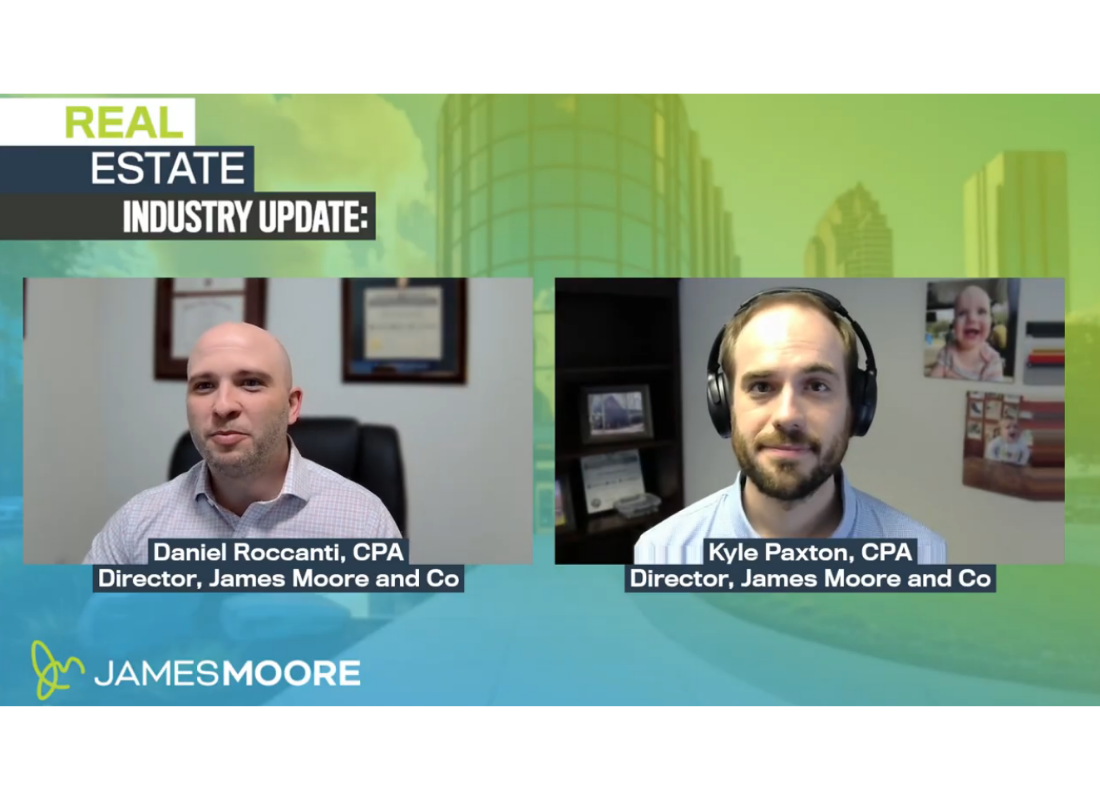
Capital is sitting on the sidelines. Lenders are tightening standards. And a wall of loan maturities is quickly approaching. In this episode of the Real Estate Industry Update, Daniel Roccanti and Kyle Paxton unpack the three major market frictions driving today’s real estate “deal desert” and outline practical strategies investors can use to deploy capital wisely, protect cash flow and maintain investor confidence over the next 24 months.
Whether you’re raising capital, underwriting new opportunities or safeguarding existing investments, this conversation will help you pressure-test your approach before the market does.
What You’ll Learn
In this episode, Daniel and Kyle cover the three types of market friction creating today’s real estate slowdown, how tightening credit conditions are reshaping deal flow, smarter underwriting adjustments for higher-rate environments, capital structuring strategies built for resilience and cash flow management tactics to protect investor trust.
Resources
- James Moore Real Estate Industry Services
- Real Estate Industry Update Playlist
- Florida Housing Market Shifts as Inventory Levels Begin to Decline
Full Transcript
[00:02] Daniel Roccanti: Welcome to the Real Estate Industry Update. I’m your host, Daniel Roccanti, here with Kyle Paxton, back for another video. Today I think is a very timely topic. We’re talking about deploying capital in a slow market, and if anything Kyle and I have heard from our clients over the last year or two, it’s that this is a really slow market. There just doesn’t seem to be any deals, basically a deal desert. And when you’re dealing with real estate investors, that’s a problem. They’re always looking for the next deal, and they’re just sitting on all this cash and dry powder because every deal feels either overpriced or underwritten. And if you feel the same way, you’re not crazy. Everyone feels that way right now.
[00:45] Kyle Paxton: Yeah. We’re always looking in the past on the tax side. And in preparing the 2025 tax returns, we have our groups that have a whole bunch of syndications, whatever, and it’s funny, there’s just not that many new entities coming through this year. It’s interesting how that works. Nice correlation there.
[01:06] Kyle Paxton: So yeah, let’s explore a little bit, Daniel, and talk about this and different sources of funding and ways to work through this slow market here.
[01:13] Daniel Roccanti: Yeah. I just think people need to realize, the market’s not dead. It’s just slow. Clean deals, they’re sacred right now. It just seems to be a lot more messy deals. But that doesn’t mean you’re out of options. So let’s kind of define, what is this deal desert we’re going through?
[01:22] Kyle Paxton: Deal desert. Dun, dun.
[01:24] Daniel Roccanti: Right. Yeah. It doesn’t mean that there’s zero opportunity. It just means that there’s some friction. And there’s three main types of friction right now. Pricing friction. This is basically sellers are anchored to yesterday’s valuation. They want that price that they were gonna get back in 2021. It’s hard for them to sell something lower when they knew it was worth more a few years ago. I mean, that’s just common human emotion, right? Doesn’t matter if you’re in the commercial real estate space or you’re just a homeowner. It’s hard knowing that your house was worth more a few years ago, and you’re not getting those same prices.
[02:12] Daniel Roccanti: So pricing friction is a very big deal right now. Next, financing friction. So lenders, it’s tough to get financing right now.
[02:20] Kyle Paxton: Yeah.
[02:21] Daniel Roccanti: One, you’re used to those interest rates a few years ago that were much lower, several percentage points lower. And so you’re looking at today’s interest rates, and you’re like, “Ugh, I’m looking at maybe even a double-digit interest rate sometimes.” High singles or something. And so when you’re seeing interest rates like that, and then lenders are just tightening. I mean, they want much better yields, and they’re willing to give you a lot less. So when they’re not willing to give you as much, interest rates are high, it just makes deals more difficult.
[02:59] Daniel Roccanti: And then lastly is the timing friction. I think this is the one that sometimes goes a little bit unnoticed.
[03:05] Kyle Paxton: Oh, yeah.
[03:06] Daniel Roccanti: But the reality is that it’s taking longer to do anything. Longer for a deal to go through, longer to refinance, longer to sell the property, longer to just find a lease, longer to do due diligence. And so when deals take a longer time, they just have a more difficult time to pencil. You got carrying costs, you have many other things like that. And a lot of these deals, when you add three levels of friction, it feels like there’s no good deals out there.
[03:32] Kyle Paxton: Yeah. And Daniel, I’m seeing a lot when you’re entering this financing space right now, your reporting’s gotta be tight. I’m seeing tax returns get scrutinized in more detail by bankers. I’m seeing those personal financial statements torn apart. The disconnect between a personal financial statement and what’s reported on the tax return. So having really good reporting around your cash flow and understanding how all of your reporting ties together to paint the picture of cash flow is super important in this deal desert market here.
[04:05] Daniel Roccanti: Yeah. I mean, I think back in 2021, you could buy these deals and they would be thin, small amount, ton of cash flow, and then the market just bails you out. You can’t do that anymore. Now we’re in 2026, the market cannot bail you out anymore. And so it really takes skill and talent.
[04:27] Kyle Paxton: Yeah.
[04:32] Daniel Roccanti: As a real estate investor, when you’re going into these deals, you can’t just buy something and it’s gonna work out. So this really is testing all our real estate investors out there. Are you really that good of an investor? If you can succeed in this market, then you can succeed in any market. It’s just we had it really good from about 2012 after the huge ’08 recession happened. It’s been basically going up since 2012. From about 2012 to, I would say, ’21, ’22, somewhere in that area, I’d say ’22 is probably when it started really going down. You almost couldn’t mess up. And so now it takes an extra level of skill to make sure your deals are working.
[05:10] Daniel Roccanti: So let’s go into some of the biggest drivers here, maturities and margins. And so what’s happening right now with some quick market context. Mortgage Bankers Association shows that in 2025, about 20% of outstanding commercial mortgages were scheduled to mature. So one in every five was basically coming due.
[05:40] Kyle Paxton: And we’ve seen it. Right.
[05:42] Daniel Roccanti: And then scheduled to mature in 2026 is another 17%. So you’re talking about almost 40% of all mortgages out there are basically gonna need to get refinanced in 2025 or 2026. This is a huge wave. It doesn’t mean that deals are dead, it just means that we’re in a place now where you might have gotten those really low interest rates, really cheap financing, and now we’re in an area where, “Hey, I’m not getting that. How is that making my deals pencil?”
[06:10] Kyle Paxton: Yeah. And Daniel’s mentioned this before, but we’re really seeing this is the timeframe that really separates the savvy real estate investors from the not so savvy real estate investors. And if you are entering this space as a limited partner or looking to finance one of these real estate operations, it’s extremely important to vet the operators and understand how savvy they are in this space and finding the right tools to do that, because we are really seeing that divide on investments that were entered somewhat haphazardly in the anyone-can-make-money environment into now just the more creative financing needs and cash flow planning. We’re seeing more separation there.
[06:55] Daniel Roccanti: Yeah. And I wanna report, deals are not dead.
[06:58] Kyle Paxton: Yeah.
[07:00] Daniel Roccanti: In quarter three of 2025, there’s still reported $150 billion in commercial real estate transactions. So there’s still a significant amount of deals out there. They’re just not getting the numbers you used to. So let’s get a little bit more tactical now, Kyle.
[07:16] Kyle Paxton: Yeah. Let’s do it.
[07:21] Daniel Roccanti: So how should underwriting change when deal flow is sacred?
[07:24] Kyle Paxton: Yeah, absolutely. So I wanna reset the base here. Cash flow durability beats pro forma optimism, and you really wanna stop asking, “Can I hit my return rate?” And start asking, “Can this asset self-fund its problems?” And so this is where, again, this is so important for survival. So really what we’re looking at is exit cap discipline, debt stress testing is non-negotiable through this process, making sure we have timeline stress. If you are intending or need to hold longer, you have a slower lease-up or stabilization or a lower sales process, you have to be ready to do that.
[08:04] Kyle Paxton: The model expense realism, this is huge. We operate in Florida, insurance is really, really high, property taxes are a hot topic and high. And so you wanna make sure that you’re modeling those big ticket items correctly. And we see it in the accounting industry, it’s across the board, payroll costs are only going up, and that doesn’t necessarily fluctuate with the markets.
[08:39] Kyle Paxton: And the same deal is repairs, right? Depending on what type of assets you’re entering here, we’re seeing those costs just continue to go up and up. So making sure you’re modeling around your expected expenditures and unexpected expenditures in a realistic way is huge.
[08:58] Kyle Paxton: And then kind of tied in with the repairs, CapEx and reserves, making sure that you have the cash flow or the funding set aside to where you can make those improvements that you promised your investors, whatever it is, to bring rents up to market rates and really maximize your investment.
[09:17] Daniel Roccanti: Yeah. I think people really need to understand here is that your job is not just buying a deal.
[09:22] Kyle Paxton: Yeah.
[09:23] Daniel Roccanti: Your job is to make sure the deal survives the next 24 months. It’s not begging for mercy. Your deal might work now, but is it gonna work in a couple of years? And so in today’s environment, underwriting is all about probability-weighted outcomes. So when you are doing your deals, you really wanna make sure you’re tightening your exit and widening the range. So stop using a single exit cap. You need to start having two different ones, a base exit cap and a defense exit cap. If deals only work in a best case scenario, it doesn’t work. You need to make sure it works if the market got worse in two years.
[10:02] Daniel Roccanti: And no one knows what the future is gonna hold, but the reality is, in today’s market, it could still get worse. And so does your deal still work in this worst case scenario? It can’t be all optimism. I mean, I’m a very optimistic guy, I wanna think for the best, but when you’re really buying a deal here, you almost need to go the other way and say, “Hey, what’s worst case scenario?” Because if you’re thinking, “Oh, everything will be better in two years and the market will again save my deal,” that’s not a plan.
[10:35] Daniel Roccanti: And so what happens when you need to refinance and interest rates went up again? That’s a real problem right now. Is your deal still gonna pencil if that happens? What if I wanna exit in five to seven years and I can’t, and I gotta exit in 10 years because the market’s just not a good timing? So are you planning for this slower time? That’s more carrying cost. Takes longer to get this refinanced. You really need to make sure that you are fully understanding, what’s my worst case scenario here?
[11:05] Daniel Roccanti: And Kyle mentioned it, but be conservative on your expenses. Insurance, taxes, always going up. I have not gotten a property tax bill that was lower than last year’s. I don’t know, maybe Kyle, maybe it’s happening for you.
[11:18] Kyle Paxton: Nope.
[11:19] Daniel Roccanti: But I’ve never gotten one. So be honest on that stuff. There’s gonna be repairs, there’s gonna be CapEx, be conservative on that. And if it can pencil at a worst case scenario, the reality is that’s probably gonna be a deal worth buying even in this market.
[11:34] Kyle Paxton: Yeah, absolutely, Daniel. So let’s get into a little bit of creative structuring and talking about what we see in that space, because I’m seeing more and more different types of financing come through with talking about financing challenges through more traditional means like banks. So one thing I’m seeing quite frequently actually is seller financing. And really what that is, is it’s a price gap solution. A seller wants a certain number, buyer can’t make a number work with their bank financing, so all of a sudden the seller becomes part of that capital stack.
[12:08] Kyle Paxton: And there’s plenty of reasons why a seller would want to do that. It often comes from, I have a lot of conversations around this from the tax side on saying, “Hey, if I do a seller financing deal, I don’t have to pick up all that gain in year one, I can spread it out. There’s some more tax strategies around that.” But oftentimes it works best when the seller has low basis and doesn’t need all that cash at closing. The asset is financeable, but today’s senior proceeds are light and the sponsor has a clear takeout plan or refinance or sale that’s gonna then get the proceeds back to that seller.
[12:51] Kyle Paxton: So I’m seeing that quite frequently in deals. And it allows the seller a lot of flexibility on recognition of gain, timing of capital, all of that stuff. And so it tends to work out a lot of times on both ends.
[13:05] Daniel Roccanti: Yeah. I’ve seen a lot more seller financing too. It’s just a really good way to kind of bridge that gap right now with having a hard time finding traditional financing and things like that. Now, this does take a seller who’s willing to do this. That should be a caveat. But sometimes sellers are willing to do it because they’re not having a lot of options to sell.
[13:25] Kyle Paxton: Right.
[13:26] Daniel Roccanti: If it’s somebody who doesn’t need the cash immediately, not gonna turn around and deploy it, sometimes they actually will prefer it because it’s kind of like a retirement plan for them, like a pension. Like, I’m gonna get X amount of money over a long period of time. And then you can be pretty creative this way and structure it into the deal and stuff like that. And so this is a really good way if you are a buyer and you’re trying to work your deals, see if seller financing is an option. You’d be surprised just by asking that it might be.
[13:58] Kyle Paxton: Yeah. And Daniel, I see this a lot too. This is a smaller scale than what we often talk about, but I have a lot of clients right now who are entering that retirement age. They’ve been a business owner for a long time, and they’re selling their small business. And so they have a key employee who’s trying to buy the business. There’s a building attached to it. The key employee wants the whole operation, the building and the actual operating entity.
[14:20] Kyle Paxton: And so maybe that employee is having a hard time getting financing due to all the constraints that we talked about. And the business owner who’s trying to exit, to your point, just wants that kind of retirement payment over time. And so they’re happy to make that arrangement where the buyer gets whatever financing they can through SBA, bank, whatever it is, and then they can enter that stack and help with that transition.
[14:50] Kyle Paxton: And a lot of times that helps ease the seller’s pain because in that specific example, this is somebody who’s worked with you for 15 years, and you really feel good about them performing in the business, and you’re optimistic about the business’s success going forward. So that’s another way that this can look. It’s a little different than what we typically talk about, but something that I’m seeing quite often here in 2026.
[15:10] Daniel Roccanti: Yeah. And another one we’ve talked about before is preferred equity. Another creative way to make sure a deal works.
[15:17] Kyle Paxton: Actually, this is probably becoming so common nowadays, I almost feel like it’s not even a creative way.
[15:22] Daniel Roccanti: Yeah. It’s just…
[15:23] Kyle Paxton: It’s kind of almost the standard more often than not.
[15:26] Daniel Roccanti: Right. But right now in this market, we have this gap. It’s between the senior debt and your common equity. And a lot of times we gotta figure out, they call it the financing gap. The gap between what the banks will be willing to loan you and what you’re trying to raise with your investors. So we’re having to find creative ways. There’s mezzanine debt, there’s things like that you can get out there, but it’s high interest rates. That’s just gonna make your deal even worse.
[15:54] Daniel Roccanti: So preferred equity is becoming more and more popular to kind of fill that gap. And because it’s becoming a more popular tool though, we need to understand truly what it is, because it can look great, make your deal look great, and then you don’t realize when you’re looking at your waterfall, “Hey, this could be a real problem. It’s gonna squeeze your cash in a few years.” Because you’re basically guaranteeing that they’re gonna get money first. You’re preferring an 8% or something preferred.
[16:25] Daniel Roccanti: So you’re not only getting your money first, but you’re gonna get your return and then usually it accrues. So, hey, I might not be able to give you your 8% return the first year or two, and that 8% just keeps accruing, and then it’s 8% on top of that 8% accrued. And so it keeps coming, and then finally when the deal starts making money, you have to pay these people out first. And that can basically put some strain on cash. So it relieves pressure, but it compounds, and so the obligation can be a problem or just needs to be penciled into your deal later on.
[17:08] Kyle Paxton: This is a good time to shout out. We got a whole video on waterfalls. Make sure to go check that out. But yeah, the big thing to look at with preferred equity is really just making sure that it works out from a cash flow perspective. And then, like Daniel said, oftentimes it can accrue, but making sure that you are balancing the preferred equity structures with your common distributions, even if your NOI is okay for the project as a whole, just making sure the cash flow is actually aligning with the expectations there and you’re communicating clearly around that is key.
[17:46] Kyle Paxton: As we’ve talked about, it feels like more deals than not that are coming through right now, preferred equity is involved in some capacity. So maybe not so creative in this day and age, but definitely something that should be on your radar in the current financing environment.
[18:02] Daniel Roccanti: I just think if you’re not using preferred equity, you need to consider it just because of the creativity it adds. Like you say, it doesn’t feel creative anymore, but reality is, it’s just a creative way that’s really made deals work. And so everyone’s starting to implement it. Preferred equity isn’t bad. It’s just you’re trading flexibility today for obligations tomorrow. So just understand what that is.
[18:30] Daniel Roccanti: All right, let’s jump to joint ventures, unless you have anything else you wanna talk about there.
[18:35] Kyle Paxton: No. Jump in.
[18:37] Daniel Roccanti: Uh, yeah. So JVs are how deals happen when oftentimes we’ll see one party has the operating platform and the other has the balance sheet or the capital or the fresh equity without blowing up the whole capital structure.
[18:51] Kyle Paxton: JVs are often super common in 1031 arrangements, where you have one party who’s interested in entering or exiting a deal with 1031s. That can drive a JV structure from the tax perspective a lot of times. And they’re common in tight credit environments because with higher rates and tighter debt, capital partners demand more governance and economic control, and so that’s a way that can divide up those roles.
[19:22] Daniel Roccanti: I love joint ventures because this isn’t actually a new concept. It just actually goes back to old school real estate, where you got a 20-something-year-old up-and-coming, “I got no money, but I got time and energy.” Right? “So I’m gonna run the operation. So what do I do? I need to find someone with capital.” So I find the seasoned veteran who could maybe train me a little bit, but they don’t wanna put the time in. They got the money, they wanna invest it with you and let you run with it.
[19:55] Daniel Roccanti: And so at the end of the day, it’s the same model concept, you’re just doing it at a bigger level here. And so you’re trying to bring in a partner that has money. But that’s gonna bring complexities. So when you bring in a partner with money, they’re gonna wanna have a say. They’re gonna wanna know how much of a say do they even have? How are we structuring this? Because you’re really not underwriting the property anymore, you’re underwriting the partnership.
[20:24] Kyle Paxton: Absolutely.
[20:25] Daniel Roccanti: It’s completely different here, and so you just gotta make sure if you’re bringing in another player for capital, you really need to talk it through and understand, when are they gonna get out of here? Because again, you’re sacrificing return, future returns so you can get cash today, but it might be the only thing you can do to make the deal work.
[20:53] Daniel Roccanti: So joint ventures are a nice way to kind of come back and fill that gap that I feel like a lot of people who first got into real estate, it’s like, “This is how I started, was joint ventures, and now I’m doing it at just a much bigger level.”
[21:04] Kyle Paxton: Yeah, they ebb and flow over time, but I have seen a resurgence as of late. And it does allow a lot of flexibility in the structuring and kind of keeping the sides of the house separate to some degree. There’s a lot you gotta work out through that.
[21:18] Kyle Paxton: So I think let’s kind of jump over here to cash flow.
[21:22] Daniel Roccanti: I mean, I think this comes back to just the base of a deal. And when you’re talking about cash flows and decisions on whether to buy the property, I have a big component of if the property doesn’t cash flow, find a new deal.
[21:38] Kyle Paxton: Groundbreaking stuff there, Daniel.
[21:40] Daniel Roccanti: I love real estate. And real estate has more benefits than just cash flow, right?
[21:46] Kyle Paxton: Sure. Of course.
[21:47] Daniel Roccanti: You got appreciation, you got tax benefits. But the reality is, if it doesn’t cash flow, you’re gonna have a hard time just operating that deal, keeping it going. So you really need to be looking at that property level cash flow and saying, “All right, defense first.” Defense wins championships. Make sure that you’re really understanding, if I do a conservative approach here, am I gonna have cash flow at the end of the day?
[22:15] Daniel Roccanti: Cash is like oxygen to your property. You gotta have it. So what’s your break-even occupancy? What are your collections looking like? Are you looking out, what’s the next 12 months? Are you doing a 13-week cash flow? It really needs to make sure that if I’m buying this deal, it’s gonna have cash flow right away, and you’re not going to just basically buy a property where you’re gonna have to put more money in the deal right away, or potentially in a year or two, and it’s not gonna operate on its own.
[22:53] Daniel Roccanti: If a property cash flows, the rest of the benefits you receive is just icing on top, baby.
[22:58] Kyle Paxton: Yeah, occupancy is the low-hanging fruit there. Just making sure you have a good understanding of that. We already talked about expense control and making sure you’re modeling around expenses and CapEx. Important.
[23:15] Kyle Paxton: So the property stuff is just making sure that thing actually works like you intend it. Let’s jump to fund level, right? So that changes things a little bit, and this gets back to, we’ve talked about this at length in the Real Estate Industry Update here, investor relations, making sure communications with our investors is clear.
[23:42] Kyle Paxton: But this comes back to how are we obtaining financing, which is what we’ve been talking about. What do capital calls look like? What are timing of capital calls if they’re needed? How is the communication around them? And then a big one is, what distribution expectations have you set with your investors, and making sure that you’re delivering on those.
[24:02] Kyle Paxton: And so making sure you’re tying in these true cash components of the fund level, what the investors are seeing closely, which is cash out of their pocket or cash in their pocket, connecting that with the operations of the properties themselves on an ongoing basis, your big reserve CapEx expenditures, all that, tying that together is key to make a fund successful.
[24:25] Daniel Roccanti: We’ve said this many times, but it’s transparency with your investors. It’s all about clear communication. If you’re needing to build your reserve, and so distributions are gonna be lower, just say that. You need to communicate that as soon as possible and as clear as possible. That’s not bad performance. That’s actually a good fund manager. That’s a good GP being, like, realizing, “Hey, we need to build our reserves. By distributing cash, we’re actually hurting the deal, and it’s gonna be worse down the road.”
[24:55] Daniel Roccanti: So you need to sometimes make a decision that is about the long term, not about right now. A good investor, an experienced, seasoned investor is gonna understand that cash today is not worth hurting the overall deal at the end.
[25:13] Kyle Paxton: The tax trap you wanna be careful with here is the classic real estate fund has a large depreciation deduction in year one that has a large taxable loss that’s allocated to all the partners. That is a positive for the investors from a tax perspective in that they’re potentially reducing their income at the individual level, or however the entity is structured. Great news.
[25:42] Kyle Paxton: The trap you wanna watch for in years two through seven when you’re exiting is, do you have taxable income being allocated to the partners because you no longer have depreciation, you have that huge roof improvement you’ve gotta capitalize, you have refinancing, and all of a sudden, from a taxable income perspective, you may not be cash flowing positive, but you have positive taxable income, and now you don’t have money to distribute to the partners to pay that tax liability that’s being allocated to them. That’s a trap that happens, and it’s not fun.
[26:07] Daniel Roccanti: It’s not. Yeah. And I kinda wanna end this with what I think is really important, and that is sometimes holding capital is the smartest decision than deploying it.
[26:16] Kyle Paxton: Yeah.
[26:17] Daniel Roccanti: Real estate people love to buy, but sometimes not buying is the best decision. And so holding capital is correct when the deal only works in an upside case. So back to building out kind of your base and defense models here, what’s a worst-case scenario? If it has to be a best-case scenario for this deal to work, you’re just potentially causing a future problem where it’s not a best-case scenario, and now this deal doesn’t work.
[26:47] Daniel Roccanti: You need to be planning out, what is the refi gonna be like? A lot of these deals, unfortunately, there is gonna be a refi moment. No one’s getting 30-year fixed on commercial real estate. So what’s your plan? What happens if the market doesn’t improve? What if it gets worse? So you really need to be structuring meaningful downside protection here. And so just understanding that sometimes not making a deal is actually the best deal you can make.
[27:21] Kyle Paxton: Yes, sir. And then it gets back to the investor communications. What’s your posture? What are the underwriting changes that are coming, and what to expect around that? What’s your pipeline looking like? What would change your mind in your investing decision? And then what you’re doing in the meantime to help make sure that you’re positioned for changes and things like that.
[27:46] Kyle Paxton: And I see this show up in a lot of different ways. I see funds that do webinar series for their investors, where they go through and they run through all this. I see more passive where they hand you a stack of papers and move on. You got your emails on what’s new this quarter. So this can look different across the board, but that communication is key in making sure expectations are clear.
[28:10] Daniel Roccanti: Yeah, and like Kyle, I’m just gonna add back onto that. Investor communication is important, so just really be upfront with them. Maybe we’re focused more on our current deals and our cash flow. And optimizing our current deals. Maybe we’re still looking at deals, but none of the deals are penciling, and so we don’t wanna make a bad deal. We wanna be good trustees with your money and things like that.
[28:40] Daniel Roccanti: So it’s just about being upfront, transparent with your investors of why we haven’t invested and why it’s important that maybe we actually hold for now and really work on optimizing the deals we have now so we can maximize the returns.
[28:55] Daniel Roccanti: It goes without saying, but I’ve talked to a lot of investors in the last year, in 2025 and 2026, who have entered bad deals, and they would have much rather the contrary have happened. Investors get upset when they get surprised, and they get those bad deals. That’s the two things you wanna avoid.
[29:09] Daniel Roccanti: All right. Well, thanks for listening today, and watch our next video. Have a great day.
[29:14] Kyle Paxton: Thank you.
[29:15] Narrator: To learn more about James Moore and Company’s real estate accounting and business solutions, go to jmco.com. And don’t forget to subscribe to our Real Estate Industry Update series to receive updates when new videos are released. If you’d like to be a guest, or if there’s a topic you’d like to see covered on a future episode, contact us through our website or email us at info@jmco.com.
For a deeper look at deploying capital, watch the full episode and subscribe to the Real Estate Industry Update for new episodes.
All content provided in this article is for informational purposes only. Matters discussed in this article are subject to change. For up-to-date information on this subject please contact a James Moore professional. James Moore will not be held responsible for any claim, loss, damage or inconvenience caused as a result of any information within these pages or any information accessed through this site.